Sansui QR 4500

I have a very basic, novice question (impressive how much knowledge is here).

I just got a Sansui QR4500 quad receiver (to go with my Sansui SD5050 reel deck) but am worried about blowing it out after reading some of the cautions here. I plan on using newer bookshelf speakers: the Andrew Jones (60 ohms, 80 watts) and the Klipsch (80 ohms, 50 watts). Am I safe here? Any cautions from the experts in the room? Thanks.
 
I have a very basic, novice question (impressive how much knowledge is here).

I just got a Sansui QR4500 quad receiver (to go with my Sansui SD5050 reel deck) but am worried about blowing it out after reading some of the cautions here. I plan on using newer bookshelf speakers: the Andrew Jones (60 ohms, 80 watts) and the Klipsch (80 ohms, 50 watts). Am I safe here? Any cautions from the experts in the room? Thanks.

These are very old receivers, they were made for carrying speakers with a 4 or 8 ohm load. The speakers you're describing are 6 and 8 ohms I guess, seeing that 60 and 80 ohms would be ridiculous. The receiver is fine using them. The receiver will start to clip if the load is getting too high, but it is always a smart approach not to run these old machines too hard. Unless you have had a full restoration they are filled with components that are in dire need of servicing. Think of it as your car, would you dare not service it for 40 years?
 
These are very old receivers, they were made for carrying speakers with a 4 or 8 ohm load. The speakers you're describing are 6 and 8 ohms I guess, seeing that 60 and 80 ohms would be ridiculous. The receiver is fine using them. The receiver will start to clip if the load is getting too high, but it is always a smart approach not to run these old machines too hard. Unless you have had a full restoration they are filled with components that are in dire need of servicing. Think of it as your car, would you dare not service it for 40 years?
Thanks! Yes, my error...I meant 6 and 8 ohms, respectively. I also thought I read something about not switching from 2 channel to 4 channel while the power is on...is my recollection correct?
Important: I'm getting the 4500 to use in a 12x12 room that serves as my office. Obviously I want the best sound possible, so would I be better off going for a Sansui quad receiver that's not first-generation? I'm open to that, but 1) not keen on spending big money, and 2) once you get into the 5, 6, 7, 9000 models, these things are absolute beasts that would be problematic for fitting into this room (which already has two other RtoR decks, by the way).
 
Hey there. If your office is 12 by 12 meter, I would certainly use another amplifier / receiver. While the QR4500 is a capable machine it is 'only' 27 watts. While those are true watts it's not a real powerhouse. Good for a large living room but I would not use it in a large room (12 x 12 meters = 144m2, the common living room would be around 40m2). For larger room amplification, if you want a Sansui, you would be better off getting one of the three or four digit line, for instance an AU-999 or AU-8500. They are not that big, but they are expensive. The larger the room, the more power you need to get an even soundscape; but again this depends on your listening position. Stereo is always better in my opinion than Quad, unless you are adding other quadraphonic equipment and plan on using quadraphonic records.
 
Hey there. If your office is 12 by 12 meter, I would certainly use another amplifier / receiver. While the QR4500 is a capable machine it is 'only' 27 watts. While those are true watts it's not a real powerhouse. Good for a large living room but I would not use it in a large room (12 x 12 meters = 144m2, the common living room would be around 40m2). For larger room amplification, if you want a Sansui, you would be better off getting one of the three or four digit line, for instance an AU-999 or AU-8500. They are not that big, but they are expensive. The larger the room, the more power you need to get an even soundscape; but again this depends on your listening position. Stereo is always better in my opinion than Quad, unless you are adding other quadraphonic equipment and plan on using quadraphonic records.
Hi, I feel bad about putting you through all of that explanation -- because when I say 12 by 12, I meet 12 feet by 12 feet -- not 12 meters by 12 meters, which is like saying 39 feet by 39 feet! So it's a small room. Good acoustics, hardwood floors, but a small room. Thanks.
 
Another question I have: What is the difference, in terms of quality, when it comes to a Sansui QRX 4500 and a QR 4500? I've read that the X models have more-sophisticated decoders, but what does this mean in terms of sound separation quality? Is it significant? Thanks.
 
I love my 4500! I bought mine for under $200 (shipped) when I sent my 9090DB in for a total restoration. A real workhouse she is!
 
Hello, I've got three of these QR 4500's sitting on the shelf waiting for testing and recapping. Do you have a cap list you used to order your parts? It would be much appreciated. I know it has been a long time since you worked on this but it would really be a time saver to have a list. I also have a QRX 9001 and a 9090 that I'm not touching till I finish these three. .

Good luck
 
Hello, I've got three of these QR 4500's sitting on the shelf waiting for testing and recapping. Do you have a cap list you used to order your parts? It would be much appreciated. I know it has been a long time since you worked on this but it would really be a time saver to have a list. I also have a QRX 9001 and a 9090 that I'm not touching till I finish these three. .

Good luck

Not here. I use Vishay caps almost exclusively as they are superb quality. And cool blue ;-). My stock is large so I don't need to BoM every time I am working on something.
When I don't use Vishay I generally take Panasonic caps. I have never encountered a situation where Vishay or Panasonic did not fit the bill.
Don't get hung up on the 'audio capacitor' discussion; any high grade capacitor will outdo 40 year old caps.

For small values in the audio signal path (up to 4.7uF) I use Wima film capacitors.
Some ceramics I change for c0g mlcc caps, this depends on their location, function and state.
Sometimes I change ceramics into mlcc just because they are so dirty and stinky even after thorough cleaning
The eye also wants some candy.

For the QR 4500 I used Elna audio grade filter caps; these work fine but they are expensive.
If I didn't have this batch already I would have used Vishay.
Just make sure that you order the caps with the correct diameter!
Height is personal preference; I like to use minimum half of the height of the original.
But again: more height in these filter caps means more money.
 
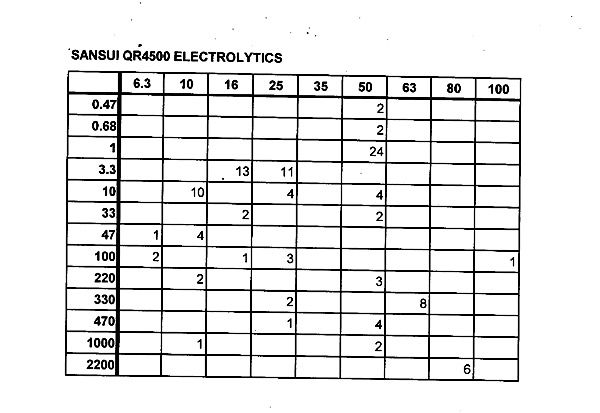
No guarantee the list is complete as this was a while back, and some of my notes get lost as I get into these things, but this should get you going. Went all Elna Silmic here when possible, but had to go with some Nicholson and Panasonic audio grades to fill in what wasn't available. I was also able to find the big caps on fleabay for a later project - maybe counterfeit, but they test good.

qr4500-cap-list.jpg

You'll also want to check the complementary transistors on the quad boards - easy to find as they've got copper straps bridging the cases so they heat evenly. They're also probably green with corrosion - every one I've seen has that problem. Most still do the job, but are butt ugly and I imagine ticking bombs if the cases rot thru. Check back in the thread for specifics on those.

Have fun!

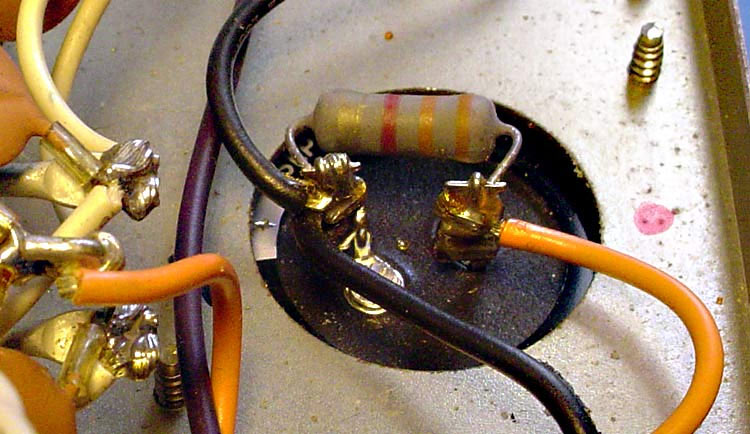
** All the big caps I've seen are twist in. What I've done in the past is clip the spades on the old caps close to the cap, then just solder those to the twist terminals. Works great, but make sure you get the polarity right on each. Lot easier than moving all the doodads to the new terminals, and no problems with the wire length as there's not a lot of slack to work with.

power-cap-terminal2.jpg


Another question I have: What is the difference, in terms of quality, when it comes to a Sansui QRX 4500 and a QR 4500? I've read that the X models have more-sophisticated decoders, but what does this mean in terms of sound separation quality? Is it significant? Thanks.

The QRX series does have an early version of the phase matrix decoders, but the only major change is that it adds support for true SQ decoding (even if they call it "phase matrix" to head off any lawsuits from Sony). The SQ feature is nice (I use it regularly on my 9001 for stereo source material) but I wouldn't call it a deal breaker. One thing I will say, what the QR4500 is lacking in power it more than makes up for in ... mellow. Very rich and full sound, and IMHO, also the purtiest receiver of the bunch. The quarter turn feature on both the QR and QRX versions is very handy for matching the system to your seating position as well. Darn shame they dropped that on the newer models.
 
Last edited:
The list is a good start. I remember the 4500's had some noise and the controls were dirty. I was working then so I just stacked them on the shelf. I've got over 300 caps in stock. Most are Panasonic PC and some Nichicon 1uF. I'm looking at the Wima, Vishay and Kemet film caps cause it is cheaper to buy by the hundreds. I've started a spread sheet for 14 different receiver's with caps and board locations. Mostly Marantz first and Sansui next with Pioneer and Yamaha later. I double check the manual list and finalize after I see what is installed in the unit.. I've got 3 sets of receivers to help me learn one unit really good. I'll do a rebuild 3 times. I'll update the cap list for the QR 4500 and send it back to AK.
That's a good idea on cutting the lug instead of unsoldering everything. I like to take pictures before I start any work.
 
Back
Top Bottom