• The move to the new server is done. There are some software and database maintenance updates in process. This has us passing the hat around to help out. We appreciate any donations. Seriously, even a dollar helps. The payment page may be found here - https://www.audiokarma.org/support.html

A simple mod for the later H-K turntables

Pio1980

AK Member
H-K T60, simple mods for the later H-K turntables

To damp the platter, sub-structure, suspension spring, and bottom cover LF/MF resonances.

Needed, 2 broad washers that will go onto the 2 sub-structure counterweight screws and a few square inches of thin felt. Some soft foam packing scraps. Double-sided sticky foam tape and a large discarded lead wheel balancing weight, or better, something like Dynamat or Roadkill or other auto panel damping media for the belly pan and strips for the sub-frame.

Objective; To provide a lossy coupling between the counterweight's mass and the sub-structure and the platter. This will effectively damp the sub structure resonances and decouple the mass sufficiently to spoil the primary LF resonance's time constant. Lightly stuffing the supsension springs will damp their ringing and the suspension's time constant re sustained bounce, it'll settle quicker. Don't overstuff them, that defeats the isolation and destabilizes settling. Bottom cover belly pan somewhat flimsy, resonant and microphonic. Add some damped mass to quell resonance mode.

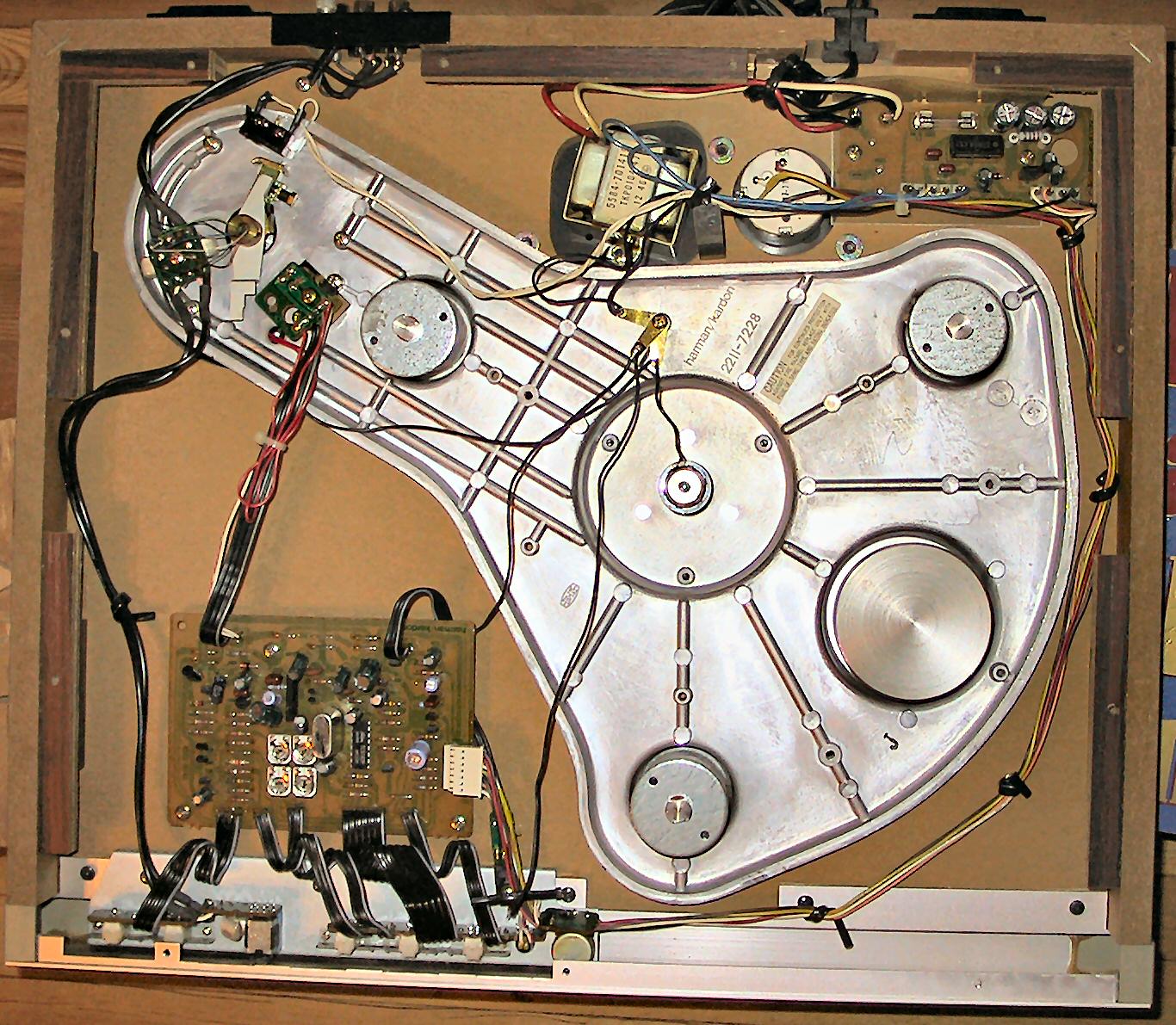
Remove platter, belt and bottom cover. Remove the 2 screws holding the large cylindrical counterweight plug and remove it. Cut a pad from the felt the size of the plug and 2 smaller one's for the added washers and punch the necessary screw holes. Remount the weight with the felt between the weight and sub-structure and between the washers and sub-structure, firm up screws enuff to remove slack but not compress felt tight, see pic. There should be a bit of slack to the weight, it must float in a lossy coupling to the frame to damp it effectively. Somewhat lightly stuff the suspension springs with the foam scraps, use the double-sticky foam tape to attach the clean wheel-weight to the inside center of the bottom cover where it will not interfere with anything inside the assembled TT or apply a square of Dynamat or similar and reassemble. This is a good time to clean the belt and the parts where it rides with alcohol or lighter fluid. If in doubt of the condition of the cleaned belt order a new replacement, looser is better than tighter. Lightly lube the motor bearing under the brass pulley with a droplet of light machine oil.
You will find the LF resonance now completely gone and any others greatly reduced.
Some may desire to recap the board at this time, going up in value with the large power supply reservoir caps ca 50%-100% couldn't hurt. De-oxit and reset the speed control trimpots if necessary to center the panel speed control.

A note about stock platter mats;
Many mfgrs, esp the Japanese are very canny and deliberate with them. The stock mats on most of these T-Ts do a very effective job of damping platter resonances thru careful mass design and lossy coupling to the platter, something many of the aftermarket mats fail to do. They also provide good disk mass "grounding' and damping. Changing mats will certainly change the sound but it's a trade-off and usually to the detriment of the total ensemble. My universal general advice is to stay with the stocker unless you know for sure what you are trading off.

Please see later postings for a simple and effective resonance damper for the ITO arm that together with the substructure damper makes this TT something really special.
 

Attachments

  • Picture 135.jpg
    Picture 135.jpg
    103.4 KB · Views: 516
Last edited:
Register to hide this ad
As I'm looking for a lo-budget / high performance TT recommendation for those on a tight budget, I'm re-evaluating this TT with a $20 A-T 92ECD cart. These 'T" series Harman Kardon 3-point suspension belt drive TTs are probably the best thing going in their class for the asking prices at present and the build quality is excellent.
See this thread for more useful info; http://mail.audiokarma.org/forums/showthread.php?t=350805
 
Hi Bill! Just put it into service and played Pure Prairie League's "Busting Out" thru it last night and side 2 of Leo Kottke 1971-1976, sounded real good from an entry-level A-T. Got to do more auditioning before I can say for sure overall but this is interesting. The TT is very sensitive to floor movement as are most 3-point BDs, bouncy-bouncy.
 
Last edited:
Fascinating stuff. Has anyone tried memory foam for spring-stuffing?
[UPDATE]:as others successfully have done? Ummmm, no, wrong sandbox. I withdraw the question. I'll get my condescending technogibberish BS elsewhere. Thanks!
 
Last edited:
Fascinating stuff. Has anyone tried memory foam for spring-stuffing?


Ummm no. The spring has to go into its resonate frequency when energy is imparted into the spring. The spring should drop energy (acoustic/mecahnical)down to (depending on spring rate/mass load/etc) 2 1/2 hz to about 4 hz. That frequncey then gets turned to heat as the mass the spring is trying to push up at its frequency rate is spent. cramming the spings full of foam turns the spring into the resonate frequencey of the foam materal. There should only be enough damping material in the spring to control the jounce time.
 
Pio, email me about some suspension tweeks.

Marc


BaMorin@AOL.com

Here's a pic from the net of the underside of a T-60;
hk_t55c.jpg

It's weak points IMO are the somewhat resonant sub-structure and the resonant bottom cover that incorporates the adjustable feet.

Topside pix showing readily accessable 3-point suspension adjustments with access thru the platter;
 

Attachments

  • IMG_0234.JPG
    IMG_0234.JPG
    84.4 KB · Views: 328
  • IMG_0235.JPG
    IMG_0235.JPG
    67.6 KB · Views: 238
Last edited:
If the T-60 is like my T-65c then the suspension screws may not be adjustable from the top any longer. It's the bottom end of the screw facing up, with a screw slot cut into that bottom end of the screw. A bit fragile, and seemingly prone to crumbling after this many years. But still easily adjusted by removing the bottom panel to gain direct access to the screw heads.
 
The attached pix are my T-60. I don't know why they would change that useful feature.
BTW, sent you a PM a while back.
 
I just glued a hefty amount of bitumen mat under the platter on my T55C. Made a difference in sound. I'm planning on doing the same on the plinth etc.
 
Here's a pic from the net of the underside of a T-60;
hk_t55c.jpg

It's weak points IMO are the somewhat resonant sub-structure and the resonant bottom cover that incorporates the adjustable feet.

Topside pix showing readily accessable 3-point suspension adjustments with access thru the platter;

Which brings us to the question of why the substructure is resonate. I understand the reflective nature of the bottom covers and how that reflection gets to the subchassis on ARs. But the subchassis should be fairly isolated from the suspension as it attaches to the top plinth. So, my first thought would be to remove the transformer from the table and mount it in a nice shielded box away from the table. ( I had to do this in a KD 500 years ago) My next thought would be a motor damping pod. a place for motor energy to drain other than the top plate. Since the top of the suspension assembly attaches to the top plate, the only way for table noise to enter the suspension and then to the subchassis is through that path. If there is a constant energy source to the top plate the springs will not filter that down probably any more than a 12db drop. As an example the AR motor is 24 pole/300 RPM. That gives a fundamental constant 12.5 hz to the top plate. Even under ideal conditions my measurements show that frequency finding the subchassis. Damping of the subchassis with damping material doesn't solve that issue since sound travels through metal in a longitudinal fashion. It may stop acoustic energy from finding its way in, but mechanical energy will not be damped in that fashion. And remember the closer all three springs are in load support to compression rate the closer to filtering down to their ideal resonate frequency. That is where most of the micro-timing issues occur, or don't occur.
 
The suspended substructure plate is resonant for 2 reasons, one is that being what it is it can ring if not damped, and the other being that the arm/mounting extension mass and the hard-mounted countermass form a mid-bass tuning fork structure centered on the platter's mass. Lossy remounting of the countermass elegantly counters these tendencies. I think a remount of the power xformer on resilient grommets would be an improvement in itself, haven't tried it yet but the same OEM method on Mitsubishi's LT-30 effectively isolates the xformer's micro-vibration as heard thru a stethoscope and the playback, the steth' readily exposes the background noise in the plinth of the T-60.
The bottom cover is basically a resonant and lively drumhead structure that needs damping.

BTW, I can say that with a record on the original mat with the record weight in place, this is one of the deadest metallic platters I recall encountering in my limited experience. Replacing the hard OEM mat with something else would doubtless ruin this intentional engineering decision's results.
 
Last edited:
So the T-60 is different from the T-65c in this area? Perhaps a cost-cutting measure. Cut build cost by a few cents = profit!

Dunno Scott, perhaps it was reassembled inverted? Someone with experience on multiple examples of the various models would have to weigh in.
 
Which brings us to the question of why the substructure is resonate. I understand the reflective nature of the bottom covers and how that reflection gets to the subchassis on ARs. But the subchassis should be fairly isolated from the suspension as it attaches to the top plinth. So, my first thought would be to remove the transformer from the table and mount it in a nice shielded box away from the table. ( I had to do this in a KD 500 years ago) My next thought would be a motor damping pod. a place for motor energy to drain other than the top plate. Since the top of the suspension assembly attaches to the top plate, the only way for table noise to enter the suspension and then to the subchassis is through that path. If there is a constant energy source to the top plate the springs will not filter that down probably any more than a 12db drop. As an example the AR motor is 24 pole/300 RPM. That gives a fundamental constant 12.5 hz to the top plate. Even under ideal conditions my measurements show that frequency finding the subchassis. Damping of the subchassis with damping material doesn't solve that issue since sound travels through metal in a longitudinal fashion. It may stop acoustic energy from finding its way in, but mechanical energy will not be damped in that fashion. And remember the closer all three springs are in load support to compression rate the closer to filtering down to their ideal resonate frequency. That is where most of the micro-timing issues occur, or don't occur.
Marc, I like what you've done to the AR and your approach to making them desirably competetive. Thnx for the E-mail!
If you haven't had an H-K T# 3-point suspended TT to work with I'd be very interested in seeing how you would evaluate and approach these well-thought-out/ well made TTs for improvement.
 
Last edited:
Marc, I like what you've done to the AR and your approach to making them desirably competetive. Thnx for the E-mail!
If you haven't had an H-K T# 3-point suspended TT to work with I'd be very interested in seeing how you would evaluate and approach these well-thought-out/ well made TTs for improvement.

I still think your biggest issue to solve is the top plate energy. That is really the only way the path to the subchassis starts. As I read your post about arm to subchassis counter weight and what it implies to me is the subchassis is going into a fundamental resonate frequency......bowing if you will, as that is the first fundamental reaction. Besides using a stethoscope to hear top plate noise, most of the noise(in amplitude of actually moving the top plate) is below the hearing range. Set a cup of water on the plinth and visably watch the vibrational modes in the water. Move the cup around to get an idea of where these modes reflect and add to the modes. Damp or brace (to create a drain). I also believe adding a harmonic balance assemby to the motor will create a path for energy to be spent instead of moving into the top plate. This thread is about how BigBill went about that with his SP15

http://www.audiokarma.org/forums/showthread.php?t=405770
 
Marc, after dealing with the arm-excited subchassis resonances and that of the bottom cover, your suggestions are very interesting to me as an approach I hadn't considered due to my working in isolation. The water pool instrument is brilliant and simple, thnx for that. Your analysis of the suspension spring system in particular is very instructive. Looking at Big Bill's project it would seen a somewhat different approach here is needed, one that doesn't change the motor's suspended isolation but will allow mass loading of the motor body itself. For the 'drain' I'm thinking a lead collar at it's lower end with a modification to the upper end suspension that will support the added mass without increasing the noise transmission to the plinth, yet to be determined. The lead collar should provide the energy drain for all vibration/noise modes including rotational and axial. Am I off-base here?
BTW My e-mail response to you bounced.
 
Back
Top Bottom