• The move to the new server is done. There are some software and database maintenance updates in process. This has us passing the hat around to help out. We appreciate any donations. Seriously, even a dollar helps. The payment page may be found here - https://www.audiokarma.org/support.html

Turntable vs. Subwoofer. The three-fold isolation question.

pedrohead

Active Member
So I've read a lot on these forums and others about proper turntable isolation/decoupling/damping/etc. I've got a setup that could use three unique solutions/applications, and am not sure how to best apply what I've read.

I have a wooden shelf/component cabinet, on top of which my turntable sits. My records sit on the shelf, halfway up the cabinet. The cabinet sits directly on the floating wooden floor beneath, and my subwoofer sits on the floor underneath the shelves, also on the wooden floor (see attached picture).
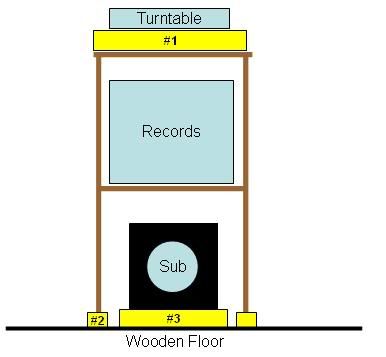
turntable.jpg


My goal here is to install the best DIY isolation that I can (no $300 out of the box iso solutions please) so I'm not getting structureborne vibrations from the sub up to the turntable (through the sub to the floor to the cabinet to the TT), but also do the best I can to isolate the TT from other everyday floor vibrations (not the least of which is a happy, energetic 1 year old). I'm hoping to minimize the airborne transmissions as the turntable/cabinet are somewhat in the 'null' of the SW's energy pumping in front of and behind the structure.

So I have three interfaces I want to treat, and the following ideas based on my readings. Please feel free to tell me where I'm going right or wrong.

1) TT to cabinet. I'm looking to do an air damper with a child's bike inner tube, with the TT likely sitting on a platform of either granite, acrylic, or dense wood cutting board (any preference)?

2) Cabinet to wood floor. I'm thinking of putting spikes on the cabinet to at least reduce the surface area coupled to the floor. With narrow flanks of wood that make up the cabinet ends, I'm not sure what else I could do there.

3) Subwoofer to wood floor. I'm thinking a granite slab/concrete tile, with maybe mouse pads or some simple isloator cushion (keep it from scratching the floor, too).

Does this sound like a good way to attack the system? Can you offer other suggestions? Thanks for your help.
 
Register to hide this ad
Also neglected to mention (so I can save some inevitable answers)...

Definitely if I had somewhere else to put these items, I would move them. I'm very (VERY) constrained by their placement relative to the receiver and the very (VERY) small space that I'm confined to for the setup.

I'd love to have the sub somewhere else, the TT somewhere else, the TT on a shelf (can't do with the plaster walls I'm dealing with right now).

So I'm really just looking for help on how I could make the most out of the admittedly not ideal setup I'm working with.

Thanks.
 
I would start with the innertube isolation of the TT to the cabinet and see how that helps. I would NOT spike the cabinet as spikes are used to better connect with the floor not isolate from it. I would then look for ways to dampen floor vibrations to the cabinet, possibly some kind of U shaped platform that would still allow the SW to fit underneath.

Good luck

Bill
 
1) TT to cabinet. I'm looking to do an air damper with a child's bike inner tube, with the TT likely sitting on a platform of either granite, acrylic, or dense wood cutting board (any preference)?

I too was thinking of this. Is there a concensus as to which wood type to use? Can one get away with MDF or plywood or do you need a "real" wood like walnut or some other dense wood (I assume that pine is too soft?)?
 
Would putting a small and somewhat thick rug under the setup do any good? I would imagine it would cut down on some of the vibrations reaching the cabinet through the floor.
 
I am using one of these on my sub with great results (Suspended Wood Floor) - Auralex SubDude HD Subwoofer/Speaker Isolation Riser. Runs around $50-$60 on the bay.
Regards,
Jim
 
Defintely start with the inner-tube approach under the TT first. ALSO add "roller balls" (hard ball bearings in hemispherical cups) under the board that the inner tube sits on. The combination of roller balls AND inner tube gives great sonic isolation.

Some strips of carpet or similarly "squishy" material under the subwoofer and/or the cabinet base should help. However, if your subwoofer is downward-firing or has a downward-firing port, it may alter the sound. Try it and see if you like it.

You can also buy small rubber vibration-dampening mounts in some household-goods shops. They are usually white rubber with ridges running at 90 degree angles on oposite sides, and are usually sold to be put under things like refrigerators and dehumidifiers, to reduce vibration noise from those devices. Work well under audio appliances, too. I've found that stacking two of them works better than just using one, in demanding situations. You might put some of those under the subwoofer and/or the cabinet base. The effect would be similar to that of carpet, but probably a bit better.
 
Home brewed isolation platform

As an inexpensive experiment, I picked up a bamboo laminate cutting board and felt discs (intended as cushions for furniture feet, about 1 1/2" dia.) to place under my TT. I was so pleased with the improvement in detail and the reduction of harmonic distortion the rig is still in place three months later. Total cost less than $25 at Lowe's. I'm now playing with the idea of laminating two together with a sheet of lead between or countersinking handballs (3-6?) into the top of the lower board. The current setup is not elegant but could easily be made so.
 
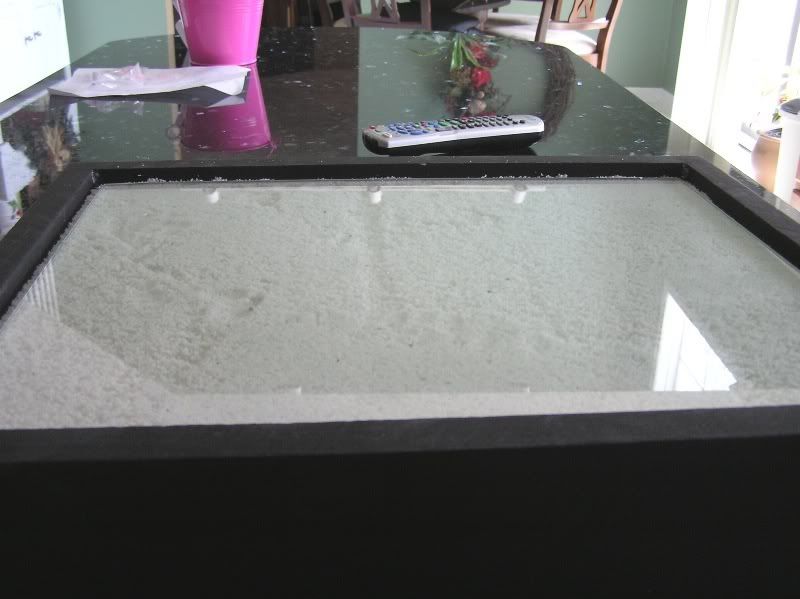
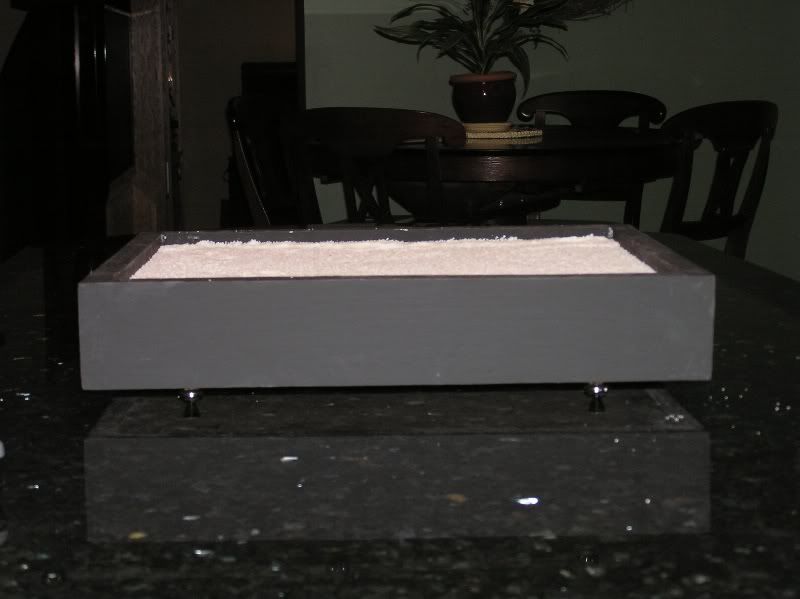
Have you seen or looked into a little "sandbox" for the TT to sit. That is what I use and have no issues.

TT sitting on the sanbox:
ecd1.jpg


Sandbox itself:
sbg.jpg


sb1.jpg


James
 
Last edited:
Have you seen or looked into a little "sandbox" for the TT to sit. That is what I use and have no issues.

James

I have seen the sandbox, I guess I'm just not really sure how that helps against foot falls and low, low freq vibrations. I would think since it's so rigid that it would end up moving right along with everything else. It's not as if the TT platform is skating on the sand so that it wouldn't move when the base does, does it?
 
Well the theory is the "movement" per say has to move all of the sand individually and not as one mass. The glass than sits on top of the sand and does not get shifted.

I have my right channel speaker very close to the entertainment center and run a sonosub (for now) and even cranked talking over 115db at the speaker the TT nevers shows signs of problems. Those Polks in the picture are not the speakers near it now.

James
 
Well the theory is the "movement" per say has to move all of the sand individually and not as one mass. The glass than sits on top of the sand and does not get shifted.

I have my right channel speaker very close to the entertainment center and run a sonosub (for now) and even cranked talking over 115db at the speaker the TT nevers shows signs of problems. Those Polks in the picture are not the speakers near it now.

James

Intriguing.

I guess what I'm thinking in my case is then... if the component rack that I have it on now isn't 100% rock solid stable, then if that whole thing gets bumped and moved to and fro, then the table is just going to go right along with it.
 
Well the theory is the "movement" per say has to move all of the sand individually and not as one mass. The glass than sits on top of the sand and does not get shifted.

I have my right channel speaker very close to the entertainment center and run a sonosub (for now) and even cranked talking over 115db at the speaker the TT nevers shows signs of problems. Those Polks in the picture are not the speakers near it now.

James

James,
Another quick question for you. How is your TT sitting on the glass plate in your sandbox? Is it directly coupled to the glass in some way (with cones or something else)? I'm trying to think about the physics of it all and am thinking if the idea is to have the glass platter as coupled to the TT as possible (so the sand can do it's job on one big mass), or that the TT/glass connection is another isolator.
 
It sites on the glass with the three little feet from the TT itself (it's a Rega Planar 3). The glass does not come into any contact with the frame of the sandbox, it sits only on the sand. The sand is "playground" sand which you can buy at most any hardware store.

I also have 4 little "tip toe" pieces screwed into the bottom of the sandbox so it makes as little contact with the shelf as possible.
 
Back
Top Bottom