• The move to the new server is done. There are some software and database maintenance updates in process. This has us passing the hat around to help out. We appreciate any donations. Seriously, even a dollar helps. The payment page may be found here - https://www.audiokarma.org/support.html

Boiling the Frog -- NAD 3300

Bradbrews

Super Member
I've had my NAD 3300 Integrated Amp since it was new. Other than having drop-outs at low volume due to the troublesome speaker relays (now replaced) it's been a rock solid performer for ~3 decades. A while back I restored some Dynaco MKIII's and given that they are just amps, decided to use the NAD's preamp to drive them. I did this for a few months and was underwhelmed with the MKII's. Nothing worng with them, but not really the difference I thought there would be vs the NAD itself.
Then I built a passive pre-amp (just a POT) and used it instead of the NAD for the MKIII's. WOW - that was the big difference. It sounded like a veil was pulled off of the sound and there was a lot more detail, more crisp highs, harder hitting, less muddy bass. wow. Having gotten into tubes, I then rebuilt a Scott LK-72. Again, sound very similar to the MKIII's, but the Scott has a preamp being an integrated.
So all of this has led me to believe that over the last 30 years, the preamp in the NAD 3300, which is the same as the NAD 1300 preamp I'm led to believe, has gotten a bit dull in the last few decades. This unit always ran quite hot, and I rocked it pretty hard for a long time. Back in the Bachelor days I had to have a fan blowing across it to keep it from gong into thermal shutdown..
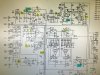
So now I'm thinking about re-caping the preamp - to start with. I've attempted to identify the electrolytic caps in the signal path - there seem to be a Lot of them. In the attached file the ones I think are in the path are highlighted yellow. The others I suspect are not in the path.
How did I do?
 
Register to hide this ad
Greetings;
Members generally appreciate schema uploads but the SM (very good quality btw) is much easier for people to link on without digging it up and easily magnified in pdf. as you've only showed 1/3rd of the schema and not easily readable magnified.
https://www.hifiengine.com/manual_library/nad/3300.shtml
------
Regardless the parts list lists the caps types and generally the signal path follows transistor paths. would help to post up pics of the boards as experienced members have eyes like eagles and can easily pinpoint a lot of detail and reflect on memory. (1 pic=million words) This may include certain other components like subbing in certain resistors types, too.
 
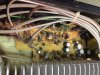
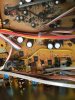
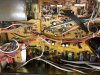
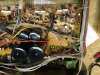
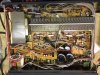
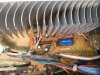
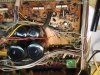
back right.JPG front mid.JPG Front left.JPG Front right.JPG Overall.JPG
Some pictures to help out. Thanks for posting the schematic link.
Just to be clear, the NAD works now with no issues. I do suspect that it's not sounding like it did when new though, particularly after the experience with the passive preamp.
 
Thanks for the pics.. Actually need a little closer shots. especially the heat sink view area.. you may have "shrunk" sleeves on the smaller caps.
----A few facts.. Soldering side of boards are not getting any younger and solder does age. Transistors maybe okay but soldering joints on those heat up and cool and that causes more age.
-Nads are known for bad caps and you may have a good one depending upon hours and use but eventually they will become out of spec.

Right now I suggest if you can look at the solder sides with mag. glass. You might see shiney solder joints while i.e. transistor traces appear more 'gray', typical of heat like transistors cooling. You can reflow those.

I'm sure others will chime in as your post is new. just be patient :D
bink
 
I reflowed most of the solder connections back when I did the relays. There were some real bad ones there.
https://audiokarma.org/forums/index.php?threads/nad-3300-speaker-relays.822914/#post-11638914
I also checked the main filter caps then - they were fine. I do suspect that, since there seem to be a Lot of caps in the signal path of the preamp, some of them are contributing the the current performance. I am building up a parts list, and am trying to improve my ability to recognize those in the signal vs. those others in an effort to order the correct parts for the job they do. Here's a couple more pics. Some solder side ones in the old thread.
 

Attachments

  • IMG_4524.JPG
    IMG_4524.JPG
    115 KB · Views: 54
  • IMG_4510.JPG
    IMG_4510.JPG
    61.4 KB · Views: 46
  • IMG_4509.JPG
    IMG_4509.JPG
    100.5 KB · Views: 46
  • IMG_4525.JPG
    IMG_4525.JPG
    107 KB · Views: 46
  • IMG_4508.JPG
    IMG_4508.JPG
    129.4 KB · Views: 48
I kind of don’t want to admit it but I have all the parts in hand in a box by my bench but have not started on it...:(
I got an Adcom 5802 amp to revive and some B&W Matrix 801s which led to a Schiit Saga + and a Modius DAC and a lot of 6SN7 tube rolling - most of which posted about here- and the NAD has been waiting. I suspect it still has a month or two to sit until I get to it. A major remodel also happened with the work from home stuff and I’ve got a lot of tile and hardwood floor to install yet..
 
I understand. I took a full time job and I have no room to walk in my speaker room from all the discarded projects. Keep us tuned. Good luck!
 
I finally finished the recap of the NAD.
I replaced 68 caps and checked the main filter caps- which were good and not replaced.
There were about 6-8 that were really off value and high ESR- interestingly all 10 uF ones. There were another 20 or so that had ESR’s of 4-6 ohms. The balance were still good but replaced. I didn’t replace the trimmer resistors but they still worked fine to set DC offset and idle current. The idle current is set with test points across a 0.22 ohm resistor for 6.6 mV.
My best meter, a Fluke 87 only reads to a single mV, and I’ve never had it calibrated- so 0.006V is what I can do. Made me think about how accurate readings down there in the dirt really are...
Anyway two CD’s in and it seems that the detail and ambiance are quite a bit better! I haven’t played an LP yet. More listening to come!
 
On the Fluke 87, if you use the mV range, it should go down to 0.1mV resolution to set the bias. Handheld DMM is going to give you limited accuracy at the 0.1mV range, but should be close enough to set the bias. If it matters, good bench meter can give you 0.1 mV resolution without breaking a sweat.

In my 1300, all the non-Rubycon caps were bad.
 
Well sure enough- there’s a whole range for mV right on the selection dial! :confused:
I can’t believe that I didn’t see that! Other than the fact that I’ve not been concerned with 0.1mV before I have no explanation...
Back to the bench for the final setting.
 
Glad you found the mV range, resolution is secondary, the more important aspect is how it affects the accuracy. With the mV scale, it will improve your accuracy 10X because of the +/- 1 digit spec on the 87V. When you used the Auto/6V range, a 0.006V reading means the actual voltage is somewhere between 0.005V to 0.007V. Where as in mV range, a 6.6 mV reading means the true value is between 6.5 and 6.7 mV. But of course, with the trim pot in the NAD, sub mV adjustment is very difficult unless you upgrade to a 10-turn pot.
 
I spent some time with the 3300’s preamp today. It was feeding an Adcom 5802 driving B&W 801 Matrix Series 2’s. I switched it out with a Schiit Saga+ a couple times. The preamps were being fed by an Oppo CD player going into a Schiit Modius.
While the NAD put up a good showing, it is bested by the Saga+. There is more air and room ambiance with it, and the woodblocks in Robert Crays Don’t break this ring are just more like wood. The cymbals also seem more alive with the Saga.
The phono stage tests are still in the que.
Now I do think the NAD benefited from the recap, but it’s still a bit more colored than the passive preamp. I think the amp section also sounded really good, and made less of a difference vs the Adcom- within its limitations- than the preamp.
The NAD seems to be running cooler than it did prior to the recap- but that may be just location and time of year too.
I also only have 4-5 hours on the NAD post rebuild.
 
Nice work on the NAD. As to running cooler. Now the caps are caps and not resistors. All parts of the unit are operating normally. Give it some time it will sound better with more hours on it. Enjoy the music.
 
Back
Top Bottom