• The move to the new server is done. There are some software and database maintenance updates in process. This has us passing the hat around to help out. We appreciate any donations. Seriously, even a dollar helps. The payment page may be found here - https://www.audiokarma.org/support.html

Mid restoration regrets?

Replacing the pots VR 701 and VR 702 cured the problem of the missing right hand power meter but in trying to calibrate the 50W setting I found that turning up the power past 20W or so caused the meter to suddenly drop to zero and stay there until the volume knob was turned to minimum and up again.

I also noticed a nasty sound on pushing the amp hard, over about 20W on the meters though they did not reset during music tests - only sine wave tests.

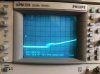
I disconnected the speakers, connected a signal generator and pushed the amp to clipping at 20Hz, 1kHz and 20kHz. The amp produces clean power up to clipping (at around 29-30V rms so up to spec) but clips horribly, not all like my other CR-2020.

I recapped the power amplifier boards, being the only PCBs on this unit I haven't gone through yet, and found the same result. Only the main filter capcitors haven't been changed, otherwise, in this unit.

One channel does it more/ sooner than the other but both do it.

I've tried through the "Main In", bypassing the preamp section, and it still does it which means it's in the power amp boards.

Does anyone have any idea what it might be?
E954AF18-5047-4DCE-B438-5A0AD627236F.jpeg FAB1E75E-59E1-4FC3-AE89-E367E8D2F521.jpeg
 
Last edited:
and it still does it which means it's in the power amp boards.
If this occurs on both channels , probably not.. Power supply.. Main caps or Bridged rectifier ( unregulated supply) or something else in the regulated supply to the amplifier assemblies.. Clipping means you have ran out of available voltage/current from the supply..

Unless you have installed a part in each amplifier assembly incorrectly.
 
Last edited:
Thank you for your help.

I see what you mean but it happens with no load connected as well, it doesn’t get markedly worse when a load is connected and so I’m not not sure if it is a matter of drive.
To test i disconnected the power amp from the pre and drove a signal into it. Taking the signal from the input wires of the power amp board I got a clean signal up to 3v rms or so.

I had suspected the input differential pair, as the DC offset was rather high, and have pulled them to characterise on my DCA 75.

I thought to replace them with matched KSA992a transistors but you’ve made me wonder if it isn’t worth replacing the main filter capacitors first...

I was hoping not to have to, they are big, expensive and hard to find an exact match for, but needs must.

I checked at 20Hz and you can see 50 Hz ripple on the top of a clipped waveform, if that’s relevant?
 
Q608, the bias compensation transistor, seems to be a 2sc458.

If they are as dodgy as they are reputed to be, perhaps worth replacing?
 
I just joined the Yamaha restoration world. This looks like it could turn into a long term project. I have read & will continue to read the CA & CR threads before I ask questions I need to (find the) answer on my own.
Not giving up! Not going to quit on this nice piece. CR-1000.
I have BUNCH of parts in several DIGI carts. Not quite ready to order though. Thinking about the unknown sub-dollar piece(s) I might need and pay $8.00 + to ship, each time.
Wish me luck..pls
 
I bought a CR2020 about a dozen years ago. It was advertised as working, but minimally tested. This was fortunately, an accurate description. I ordered the parts for the service bulletins, and opened her up-and hit a wall, so to speak. Very tight in there, and I quickly realized I was not up to the challenge. So it sat, and sat, and sat.

Earlier this year, I decided to take another look. It now seemed difficult, but doable-I had learned enough to move forward a bit. Boy oh boy is this thing dirty. I spent hours and 100's of qtips later, I had it looking reasonably clean. This cleaning process allowed me to repeatedly inspect and see a bit of how it goes together and comes apart. I had to remove fasteners and move a few things to clean, all the while I was learning. I replaced the resistors and transistors suggested. (but did not bend 2 of the 4 resistor legs so that the device label was pointing outward-oh well). I replaced all of the lamps, and learned that I had to reuse the plastic socket type items and solder the lamps to the original leads-forced me to learn how useful a 'helping hands' device is for soldering\splicing leads is).
Reassembly-it sure was tricky aligning all those lamps in their respective holes and getting the dial glass in place at the same time-but after several attempts-success.

Attach speaker wires, attach music source-use faceplace as my map to see what all the switches should be set to, etc, turn on the receiver-no click-arrgh! Hmm-no obvious shorts, no funny smells, hmmmmm. Ok-turn on and let it stay on for a bit-no outputs getting warm, no resistors that I replaced getting warm, no replaced medium power transistors getting warm-hmmmmm.

I checked the power supply board that I had worked on-removed it and looked underneath-ah HA-I had broken a trace (guess my board cleaning was a tad aggressive) I soldered a bridge wire over it, and put things back together-and BAM-she's a workin"!

Is it up to spec? I highly doubt it. Does it sound good-yes. Could it sound better-probably. No claim of restoration here. I am just happy that I finally completed a task I intended to do a decade before. I needed to learn patience and more methodical thinking than I possessed back then. It might remain used as-is until I learn the necessary skills to complete and confirm the success of a 'restoration'.
 
I've been sitting on this one for months waiting until my skills sharpened a bit... it's extremely clean and in great condition. Like new exterior. But, it does have a PS prob.
 
This was fixed, the issue was that I was matching for gain whereas for the input pair I ought to have matched for Vbe.

This solved the issue and also gave a very good low DC offset.

Go for it, you'll learn by doing and if you can do one of these, everything else will seem a doodle by comparison! :D
 
Back
Top Bottom