• The move to the new server is done. There are some software and database maintenance updates in process. This has us passing the hat around to help out. We appreciate any donations. Seriously, even a dollar helps. The payment page may be found here - https://www.audiokarma.org/support.html

Quality Antenna - A Must

OldRaven

New Member
Wow, what a difference a good antenna makes! I recently picked up a TU-717 and was using with the small Terk antenna that came with it. I would get good signal on most stations 4+/- and the Tune meter would stay dead center, but the sound was still fuzzy and just not the quality I expected.

As luck would have it, I have a Radio Shack FM antenna installed in my attic. (I know outside of the structure is better, but the HOA wont allow it.) I installed the antenna years ago and for my theatre receiver, but never really used FM on that system. So this morning I connected the TU-717 to it and WOW! The signal is now just shy of 5, but the sound is so much cleaner. 90% of the fuzziness is gone on many stations.

I was getting ready to take it in for a good cleaning and alignment, but I think I will hold off for a bit now and see how it does over time.
 
Register to hide this ad
Anyway you can post a pic? An attic antenna is on my To-Do short-list, as outside the structure is also a no-no in my neighborhood... (though i might say F'em).

i have never actually seen an attic mount, so I am curious, and I read/hear good things.

Thanks
 
It's not pretty, but...

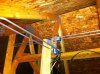
Here are a couple shoots of the antenna. I picked it up a Radio Shack 8-ish years ago. I don't think I paid much, perhaps $30 or so.
 

Attachments

  • IMG_0054_A.jpg
    IMG_0054_A.jpg
    23.5 KB · Views: 197
  • IMG_0056.jpg
    IMG_0056.jpg
    106.7 KB · Views: 218
I had one of them on a 10" mast on my old house. Dang nice antenna for urban/suburban use.
 
From your pix it looks like you have three matching transformers (Balans)
hooked to the antenna at the same time.

You might just get a little improvement in signal if you came off of one of the
baluns and then to a three way 75 ohm splitter. It would be a better match for the antenna to feed line, and provide some isolation for the separate feed lines.

A small amplifier could help over come any feed line loss.

Also it looks like the top left hand element is possibly being shorted out by the metal bracket..Hard to tell from your picture.

Just some suggestions. Glad it improved your FM signal quality.
 
Thanks for the advice. I can certainly reduce the baluns as I am only listening to one tuner at this time. I figured it was better to avoid a splitter, but I will give that a try if I need to go back to more than one connection. And I will check that bracket right now. Again thanks for the advice.
 
I used a couple of the same antenna's in my attic . I removed the adapter and run 300 Ohm flat lead to the rooms . Was able to find splitters for 300 Ohm so able to run to four rooms . (IIRC been 10+ years ago)


Barney
 
Last edited:
Oerets,

I am old enough to remember when almost everything used 300 ohm
connections...Of course we are talking about television and FM radio...

That is about all there was back in the "Good Old Days":yikes:

Back in those good old days you could hardly find a television or
FM tuner/receiver that had 75 ohm connections.

300 ohm systems can work very well...It just was a pain to have to
run the feed line in standoffs and keep it away from metal and other
wiring. Of course it would work if you didn't, just not as well.

And I believe I have a part of a case of 300 ohm splitters and FM traps
and variable line taps stored away somewhere.:)
 
You might just get a little improvement in signal if you came off of one of the
baluns and then to a three way 75 ohm splitter. It would be a better match for the antenna to feed line, and provide some isolation for the separate feed lines.

A small amplifier could help over come any feed line loss.

Agree, the splitter would be better. However, I'd avoid using an amp, as those can be easily overloaded by a couple of strong stations and make a mess of the rest of the FM dial. Intermod distortion products causing interference on weaker stations.
 
wa2ise Agree, the splitter would be better. However, I'd avoid using an amp, as those can be easily overloaded by a couple of strong stations and make a mess of the rest of the FM dial. Intermod distortion products causing interference on weaker stations.

That is true especially with cheap low quality amplifiers...I am used to working with commercial grade amplifiers that are better at handling large signals...In the old days I used to install tv antennae and used mast mounted high gain pre-amps to pull in out of town stations..Both tv and fm and even with some in town stations did not have a lot of trouble with overload in the preamp or the receivers..TV or FM. But the pre-amps had great large signal handling ability...Some times referred to as having a
high third order intercept point or high 1 db compression point although the terms are not actually interchangeable as you know.

..It would be more likely that a high quality amp with a lot of gain would overload the front end of the FM receiver. That is why I said a small amplifier and was thinking of his three pieces of coax needing to be hooked up with either a splitter or with an amplifier with multiple outputs.

But since he mentioned that he only needed to use one feed line the
amplifier is most likely not needed.

On a side note I have fought the intermod, crossmod and overload wars...:thumbsdn::cry:

I owned a two meter repeater for about fifteen years...Nothing like having your antenna be one of about a dozen on the roof a a building, all connected to repeaters, both amateur and commercial and all of them putting out a hundred watts or more:yikes::yikes::yikes:

And the fun came when I had to convince one of my commercial customers that the problem with their repeater was actually with their repeater not my two meter repeater causing the problem:eek::eek:

But again you are correct...If a person runs over to their big box electronics shop and just purchases a cheap RF amp or pre-amp it may cause more problems than it solves. And for those readers not up on the use of RF amplifiers you give very good advice.

RF is fun stuff :banana:

By the way I have enjoyed reading your posts about modifying receivers...
The one about increasing the tuning range and the one about increasing the IF bandwidth of an AM tuner section were interesting.

But we must remember it is all about the :music::music::music: :):)

Edit: Sorry about the thread hijack...I just have no control when it comes to talking technical...:dunno::scratch2:
 
Last edited:
I also use the same Rat Shack antenna for my omni-directional antenna. But I will contend that its lobe pattern is not consistent. There is quite a hole. I know this cause I have it on the very top of my mast with rotor. Rotating that antenna can improve its performance drastically. But of course your just moving the hole around. However, if you have a weak signal from a station that you believe should or could come in better it is worth the effort to try rotating this antenna 10 or 15 degrees one way or the other. Hope this helps your reception.
 
300 ohm systems can work very well...It just was a pain to have to
run the feed line in standoffs and keep it away from metal and other
wiring. Of course it would work if you didn't, just not as well.

Did mine during the construction of the house so was somewhat easy then , plus knew ahead of time so picked up supply of parts needed .

The 300 Ohm will have a lower loss on long runs an plus inside the walls ran around any metal .Then at the box I installed an adapter wired to the plate just encase would be needed later . The adapters came out of used TV antennas guts and wired to a F connector on plate . Used binding posts for the 300 Ohms connections on the wall plate also .

Tuned it in when installed for best reception and has worked well so far .


Barney
 
I am learning a lot from this thread, so

can I ask another question of the experts? The back of my tuner (AU-717) has a 75 Ohm connection that basically has a ground clamp to contact the shielding and a terminal for the center conductor. Rather than use that, I am using another Balun on the tuner end to connect to the 300 Ohm terminations. Seems fine, but I wonder if one method of connection is preferred over the other? Thanks!
 

Attachments

  • tu-717.jpg
    tu-717.jpg
    25.3 KB · Views: 60
Run the 75 in , should be a direct shot to the input of tuning section . Just strip back the wire and wrap the shielding so it can go into the holder then with a long piece of the center wire bend and put onto the other .


Barney
 
IIRC these tuners use a tuned transformer as part of the tuned first RF amplifier stage and the RF input to the tuner is just the input of this transformer...And the full primary winding is used for the 300 ohm input and a tap on the transformer primary is used for the 75 ohm input.

So either way is a direct input to the first tuned RF amplifier stage and
both connections should give the same sensitivity.

So that being said the only difference that you have is that you are loosing a small amount of signal going through your 75 ohm to 300 balun...

Probably not enough to worry about...Although some baluns that I have
tested have shown more than several DB loss at 100Mhz.

You may try it both ways and see which way gives you the best signal.
If your balun is of good quality you will notice very little difference.
 
I will try and use the 75 Ohm input and see how that changes the signal. Not sure about the quality of the Balun as it came with the tuner and is basically unlabeled. Thanks!
 
Another suggestion

can I ask another question of the experts? The back of my tuner (AU-717) has a 75 Ohm connection that basically has a ground clamp to contact the shielding and a terminal for the center conductor. Rather than use that, I am using another Balun on the tuner end to connect to the 300 Ohm terminations. Seems fine, but I wonder if one method of connection is preferred over the other? Thanks!

I had a Terk powered antenna hooked up to my Sansui 9090 with a balun (lot of signal loss). So yesterday when I was inside the receiver replacing some panel lights, I installed a 75-ohm f-type to n-type bulkhead connector and wired it up internally to the existing 75-ohm screw terminal lead (like the one you have). Removed the balun and plugged in the Terk coax connector to the newly installed bulkhead and the signal level jumped. Now I'm going to put up a 4-element Yagi with a rotator in the attic of my garage and see if I can REALLY improve on the signal strength (and maybe try some DXing as well). :D
 
One of the unsung benefits of using an attic-mount antenna (or any remotely located antenna) is that the antenna is located away from sources of unwanted interference.

In some cases, this can have a much more dramatic effect on sound quality than the
increase in signal strength that can be achieved.
 
Back
Top Bottom