• The move to the new server is done. There are some software and database maintenance updates in process. This has us passing the hat around to help out. We appreciate any donations. Seriously, even a dollar helps. The payment page may be found here - https://www.audiokarma.org/support.html

The Bell 3D: Years Ahead . . . Years Ago

A version of that tape deck with custom electronics (modified on the kitchen table in W Lafayette :D) was installed in several language laboratories throughout the midwest in the late 50's. Deck had problems with the bronze capstan bearings which would freeze up after lubrication with 3-in-1 oil. Peace. Regards.

I have a Bell T-347 Tape Deck, Bought new in 1965. Bell Sound Labs as the Company was known then, was in OH. They were bought out by Rathyon, the inventor of the Transistor. I had to have the power transformer replaced in 1967 and Raythyon sent it to me N/C. I think according to the lady that processed my transformer said that Raython were going into Stereo Home Audio File Business, and bought Bell for the partents and designs. At that time the Japanesse were entering the market and I think that killed Raython from investing in the Home Stereo Business.

Note the Bell Deck is direct drive no belts except for the counter. Had three head, three motor, design built in echo, sound on sound, different pre-amps for 3.75 and 7.75 speeds. All Mullard tubes. I still have it. When I moved to CO in 2003 the movers put it in the Garage in November, in a box labeled Garage parts drawer. I found it in February, tested for an hour one tubes must have been damged and gased up and cracked. Replaced it and spark shot from under the sockect. The one playback channel went dead. Bought replaced tubes, and got a tube tester that will not line adjust correctly. No problems with the motors still working today, haven't oiled them since 2003. The project is sitting on the table in the den. Does anyone know how to repair a Precision 640 tube tester or calibrate it.

Bell Sound Labs entire tube unit stock was bought out by Olsen Elctronics of Arkon OH. The Finished Inventory was shipped to their electronic stores and sold at a 20% discount off list price. All Stereo was Fair Traded then. Employess were able to buy the Decks T-347 and the T-360, 10" deck, and duplicator for 40% of list. That was 1965 when Bell ceased operations. As I remember the decks T-347 listed for $300. and the T-360 for $400.00. Employess got them for $100, and $150. There were amps also available, but I got an Olsen Receiver for a price less than the Bell Amp.

Thanks
RJS
 
Last edited:
Hi,
This is the Bell 3D Binaural amplifier made in 1953. I had one for several years but lost it in a house fire two years ago. This is a wonderful amp once it is rebuilt (which can be a nightmare unless you are really good with a soldering iron and layered point to point wiring) . It is only 10 watts RMS per channel and not super loud but it does sound very nice. I would really like to find a replacement for the one I lost. This was pretty much the first stereo amp out there. It is a true stereo integrated amp that has all the inputs, even ones for mag phono. The newer version (around 1955) was the Bell 3DT. The biggest difference was that the 3D Binaural used potted output transformers while the newer 3DT uses standard end bell type output transformers. Anyone who has one collecting dust that wants to unload it, please contact me. This amp model has a certain sentimental value to me.
 
Does anyone know how to repair a Precision 640 tube tester or calibrate it.RJS

Back in the "old days" a tube tester wasn't real useful. Swapping a questionable tube with a good one was the best way to find a bad tube. I "messsed" with an old Bell deck for a few years and then "moved on". Newer decks from Asia were superior. Regards.
 
i have a bell amp similar to that one but i think it may be the 3dt somebody mentioned. same basic layout but with a gold face and ivory knobs.
 
Bell was AN Innovator

Back in the "old days" a tube tester wasn't real useful. Swapping a questionable tube with a good one was the best way to find a bad tube. I "messsed" with an old Bell deck for a few years and then "moved on". Newer decks from Asia were superior. Regards.


The Teac 4010S was introduced at the time Bell was aready out of business. When we were selling the Bells we compared them to the Teac line. The 4010S was $400.00 and the 7010, was close to $1000. Teac transports were much quieter than the Bells, I loved the touch controls of the Teac, but the electronics (design) were better in the Bells, making the sound better. Bell's major disadvantage was that the Teac's were using the latest electonics, semiconductors, vs tube, and the cosmetics were far superior. We pushed Teac's by saying no heat build up and smooth controls, not the quality of recording and playback, there was a substantial price premium in buying a Teac ($100-$400), and the Bells sounded better on the comparision board. Also Bell was in theory, out of business, when Teac was introduced in the States. Bell was an innovator in all there audio gear, as stated in a earlier post. Anything from Japan in the early 60's was junk, including Sony, Concord, Pioneer, etc. That was when the Bell was in business and the last Bell decks were introduced. In 1967-68 Japan was becoming leader in innovation, Bell was out of business for over 3 years. I think Teac was the company started to change the opinion in the States.

In regards to oil the motor, I've had my deck since 1965 never had the problem and I can't remember the last time I oiled it, and it still works perfect, FF & Rev is almost 50% faster than Teac. The problem is the auto stop doesn't work well and the brake, beats the hell out of the leader before it stops.

True the best way to test a tube is to replace it, with a new known Good tube. That only works if that tube is either Good or Bad, not to test a circuit, and poorly functioning tube. You would have to replace all the tubes. It also is not the best way to match tubes in a stereo application, the best way is using a quality tube testor. When I replaced the blown (exploding) tube, with a tube I thought was a good tube, there was a flash under the tube socket, so putting a good tube in the circuit could have caused damage to the tube and other tubes that followed, since left Playback channel is now out. I am just trying to repair a fine deck, that still makes great recordings, and only has one playback channel working now.

I have several Teac Decks that were introduced in the early / mid 70's 7010GSL, 6300, 4300SX, and the sound of the Bell is almost as good as the Teacs when the Teacs are using Maxell UD Tape. Were the Bell is better when using non UD Tape, which Bell was never designed to use a UD Tape, since the Maxell UD tapes were not marketed when the Bell Decks were being sold.
 
Last edited:
i have a bell amp similar to that one but i think it may be the 3dt somebody mentioned. same basic layout but with a gold face and ivory knobs.
Please post a picture or two.

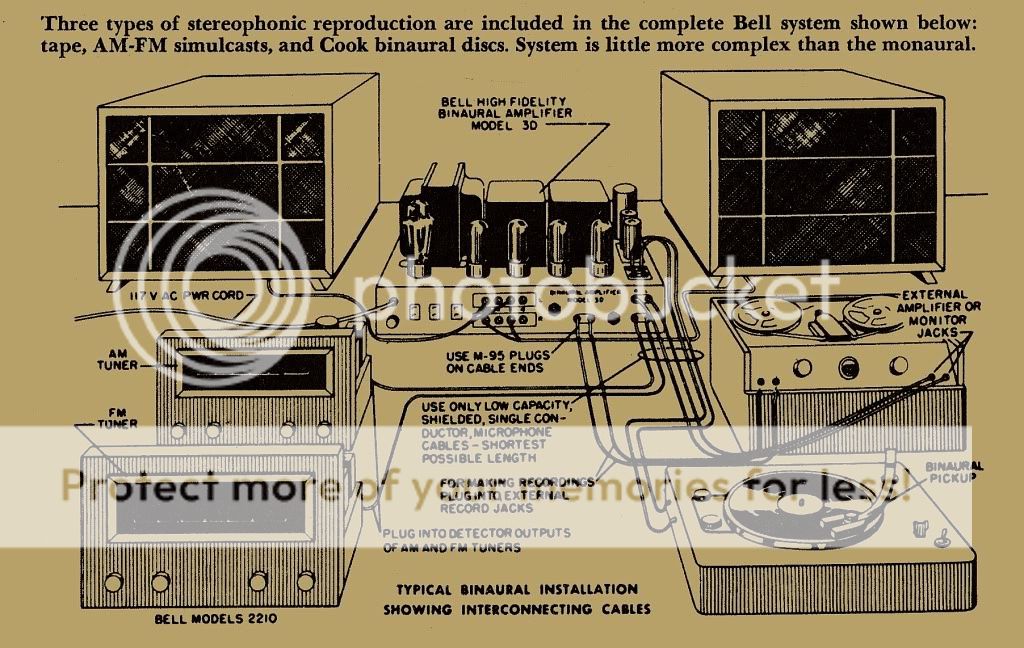
I recently found this in the very first issue of Practical Electronics from 1957:

Bell3DInstallationDiagram-1.jpg
 
Please post a picture or two.

I recently found this in the very first issue of Practical Electronics from 1957:

Bell3DInstallationDiagram-1.jpg

practical? a forked tone arm is practical? pratically insane is more like it.

seriously, though, thanks for all the wonderful scans and bell info, you're one of the reasons i love this site.
 
TheRed1.

I will be getting a Bell stereo amplifier from a friend's father's estate. My friend's father bought the unit new and had used it up until his death a few years ago. My friend has plugged the unit in and turned it on. He says everything works an "all the little lights light up". He'll be bringing it by in the next few days. After reading these posts, I can't wait to get this amp.

I always thought of Bell as being more into PA gear and commercial sound equipment. I had no idea Bell made any home audio gear, let alone some of the earliest stereo equipment.

Thanks again for the great info,
Rick
 
The problem is the auto stop doesn't work well and the brake, beats the hell out of the leader before it stops.

That was one of the problems in the Labs. The "Kiddies" could never thread the tapes properly. ........ and then, .....along came tape cassettes. :yes: ..... and then, ...... I switched to computers, .... and then, recently, I bought an old 4010. It came with the reel turntables "jammed down" on the reel motors. :tears: When the snow flies I will have time to fix it up, I hope. Regards.
 
I finally found a copy of the Bell Sound Systems, Inc. pamphlet from 1958 to which I referred above. Unfortunately it doesn't have any further information on the history of the the company. It does, however, make for interesting reading. It covers the following models: Bell 2315, Bell 2305, Bell 2360, Bell 2520, Bell 2521 and Bell 3030. Bell also had an entry-level "sub-brand" called Pacemaker. These were inexpensive amps which didn't even have the Bell logo on their faceplates. Information here for the following Pacemaker models: Pacemaker 2221 and Pacemaker 2215.

BellHasIt-1.jpg

Bell2.jpg

Bell2315-2325.jpg

Bell2360-Tuner.jpg

Bell2520-2521.jpg

Bell3030.jpg

BellPacemaker2221-2215.jpg
 
My dad's first stereo console with a cabinet made by Churchill had Bell electronics and Jensen speakers. The bell 2325 looks like what his amplifier looked like. He also had the dual AM/FM band tuner. For stereo, one channel was on AM and the other channel was on FM. It sounded amazingly good. In those days (mid to late 50's) Bell was highly regarded.
 
edit : They had a Bell amp in music class in JR high in the early 60's with a large speaker system (mono system) it it was maybe a 2360 or similar tube rig
The set up was total custom one equipment cabinet and the large separate speaker cabinet which was at least 4-5 ft tall all done in mahogany looked like they spent some decent money on it it wasn't your average classroom phono that's for sure thing sounded pretty decent.
 
Last edited:
I have a Bell 2325 currently in the audio hospital getting a complete update before going back online. It was given to me by a friend who found it while cleaning out his deceased Dad's house. I gave it a thorough cleaning prior to sending it out. Really straightforward design with top notch build quality.
 
Read about some research back in the 1930's at the phone company (AT&T Bell Labs) on what we would call stereo sound today. One experimental result was that they could not reproduce a good "soundstage" with just two speakers. Guess that they needed better speakers and a good amp. And some low oxygen patch cords... :D

Just saw this post, after all this time.

One thing that definitely could have limited the soundstaging potential of a two-channel system back then, was the extreme phase shift of most truly "full range" (capable of below 100Hz and above 10KHz) speaker designs, between the low and high sections. In most cases- especially the early Western Electric horn systems- the type that AT&T would likely have been using in the early 1930s- the mid-high horn was many feet long, while the bass was from an open baffle direct-radiator. . This resulted in massive time delay between the bass and the highs- which was shown up, in the famous "double tap" tests that were done (a recording of a tap dancer was played back, with the result that each tap was "smeared" into two taps- first from the open-baffle woofers, then from the long mid-high horn.

This was the main problem that was addressed, by the famous MGM/Shearer horn project- which basically is where many men that we all know the names of- John Hilliard, James B. Lansing, Robert Stephens, and John Blacburn- originally came to prominence in the audio industry. They designed a truly full-range system, without all the time delay- using bass horns and treble horns of similar length, just using the larger mouth area of the bass horn to get low frequency extension This is directly what led to the famous Altec Voice of the Theater systems, in essence...

http://www.audioheritage.org/html/profiles/lmco/shearer.htm

Regards,
Gordon.
 
Back
Top Bottom