• The move to the new server is done. There are some software and database maintenance updates in process. This has us passing the hat around to help out. We appreciate any donations. Seriously, even a dollar helps. The payment page may be found here - https://www.audiokarma.org/support.html

Switch of a Sony TA-E88 and TA-E900 disassembled

y.e.

New Member
Here some pictures of the switches of a Sony TA-E88 or TA-E900, taken while disassembling them for cleaning.

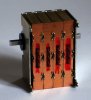
Schalter komplett 1LR.jpg

Schalter komplett 2LR.jpg

One module.

Modul.jpg

The module disassembled.

Modul zerlegtLR.jpg

You do not need to take the modules out of the housing for cleaning. You can just remove the bottom plate for cleaning.

Note there are two types of switches with different switching characteristic. So do not confuse them (well if done so it will probably be no disaster).
ÜberblickLR.jpg

The "switch" before cleaning
Vorher.jpg

... and after cleaning.
Nachher.jpg

It is some work doing this for all these switches, but it is worth doing it. You will hear the difference!

I did not use any desoxit like stuff, as this removes material from the switch. I cleaned them in a electrolytic way. In a first step with silver-electrolyte the corrosion (silver sulfide) is reduced back to silver and some additional silver is put on the contact. Then as protection for further corrosion (for a while) I proceeded with a layer of gold.
 
Register to hide this ad
Very nice work y.e. !

I do not dare threading on that kind of territory!

Gotta clean (thus take apart) the volume and balance pots on my TA-E88B, still haven't gotten around to doing so, but not too eager anyway, it's quite a job!
 
Stoffie said:
Very nice work y.e. !

I do not dare threading on that kind of territory!

Gotta clean (thus take apart) the volume and balance pots on my TA-E88B, still haven't gotten around to doing so, but not too eager anyway, it's quite a job!

I do not think cleaning the volume and balance pots is really necessary. I opened them in both, my TA-E88 and TA-E900. They look clean, some signs of wearing of cause.

BalanveLR.jpg

So only replacing the lubricant stuff on the surface after 20 years could be worth the effort. But even here the stuff Sony used still looks good.
On the other hand getting a live look inside may be worth taking them apart :)

If you disassemble the pots make sure that you fix the shaft of the pot so that it can not move (forward-backward, turning does no harm). If it moves while disassembling, most likely the balls of the ball bearing of the shaft will fall out, and it's a lot of work to get these back in place.
For fixing you can use the joint of the volume knob.

Moreover take care that you do not confuse the parts of the left and right channel, ...


But I strongly advice to clean the switches. This had a major effect. I think the "dirt" transforms the switch in a weak capacitor, which has a lower resistance for high frequencies.
The TA-E88/900 switches might be more endangered than those of other models, as they seem to consist of silver or a silver alloy. They are not sealed and so 20+ years have their effect.
 
Hmm, I do think I need to do the pots because they crackle sometimes.

Knowing the switches need cleaning too, I am totally not looking forward to this :no:

I does still sound very good though, so I'll just find me some courage sometime and do it :D
 
I do not think cleaning the volume and balance pots is really necessary. I opened them in both, my TA-E88 and TA-E900. They look clean, some signs of wearing of cause.

View attachment 47615

So only replacing the lubricant stuff on the surface after 20 years could be worth the effort. But even here the stuff Sony used still looks good.
On the other hand getting a live look inside may be worth taking them apart :)

I would tend to agree with you. If it works leave it alone. The pots are pretty well sealed and don't really seem to cause any problems. And are totally irreplacable!

Moreover take care that you do not confuse the parts of the left and right channel, ...


But I strongly advice to clean the switches. This had a major effect. I think the "dirt" transforms the switch in a weak capacitor, which has a lower resistance for high frequencies.
The TA-E88/900 switches might be more endangered than those of other models, as they seem to consist of silver or a silver alloy. They are not sealed and so 20+ years have their effect.

Out of a spirit of enquiry I decided to do a step cleaning test and listen between to see what actually had the biggest effect.
Firstly I had a good listen to some favourite tracks
Secondly blew all switches through with compresses air to clean the surface dust off. I manupilated the switches while this was being so that all the surfaces were exposed. Btw the inside was pretty clean even though it I havn't opened it for 15 years.
Had a good listed and there was a major improvement.:thmbsp:
Thirdly cleaned each switch with a few spots of alchohol as a degreassant applied with a pipette worked the switch and blew out the excess so that the muck didn't just recoat. Repeat twice.
Listen again: the overall effect is quite incredible. Vocal highs that were a tiny bit disjointed have come back together perfectly. Bass is much improved. Image is much more stable and doesn't cloud into highs. :thmbsp::thmbsp:

I would be very wary of dismantling the switches given that I don't think it is 100% necessary and I would be very cautious about using anything that modifies the surface. Just clean it properly: alchohol is the traditional cleaner of choice and it works very well. The whole thing takes about 30 minutes. I'll post some pics. I do agree that the dirt is probably forming an thin film capacitor.
 
Hi,

could you please describe a little better how you electro chemical remove silver oxide and how you later put gold on the contacts.
I am in the middle of a complete Sony TA-8650 restoration. All switches has been soldered out from PCB and taken apart for cleaning, but firstly I have been uncertain how to clean them properly without destroying the thin silver layer and secondly I have been wondering how to preven having to do this over again sometimes in the future. Gold is a perfect sollution.
 
I need help finding an Original copy of the service manual of the TA-E900 Esprit series preamp.
Anyone here has a copy or PDF scan available? I need to solve a one dead channel situation. I hope no module is down... None available.
Please mail mgrouwenhorst@hotmail.com
 
I need help finding an Original copy of the service manual of the TA-E900 Esprit series preamp.
Anyone here has a copy or PDF scan available? I need to solve a one dead channel situation. I hope no module is down... None available.
Please mail mgrouwenhorst@hotmail.com
After some research NO dead channel in this baby.
Just a switch of output selector in one channel. I will fresh silver-solder all pins to the board here first as a relais might cause the humps too but most likely a switch is to blame.
I still need a copy of the circuit diagram!?!
I also found myself a nice TA N901 amp but here one channel is seriously dead. Has anyone ideas or recommendations for replacement transistors for this one? I will do both channels then.
 
Back
Top Bottom