• The move to the new server is done. There are some software and database maintenance updates in process. This has us passing the hat around to help out. We appreciate any donations. Seriously, even a dollar helps. The payment page may be found here - https://www.audiokarma.org/support.html

Two 3-way University cabinets with pictures

tensleep

Addicted Member
I picked up a couple of University cabinets today and am listening to them as I type this – very sweet!

The first is a three-way corner cabinet and appears to have been a kit, very well put together. According to the speaker array, this is a 16 ohm cabinet. I could not remove the back panel, as it was glued in place, and I don’t want to disassemble the cabinet until I am truly ready, so no nudies.

Through the narrow port that runs from the top to the bottom of the cabinet in the back panel, I was able to observe the following:

A very large crossover network mounted to the bottom of the enclosure. I could not ready anything, but could see a pair of large inductors and a terminal strip. The transducers, from top to bottom, are as follows:


• Electrovoice Model T35, 16 ohm
• University SA-HF, 30 watts, 16 ohm, mounted on a K1000 horn
• University Model C15W Dual Impedance Woofer 50 watts, 16 ohm

The SA-HF driver also has a sticker that reads:

Tested & Approved by
Klipsch & Associates
LSM 18 June 58 (handwritten and printed)

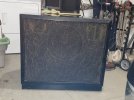
The large three-way cabinet looks to be factory. This is set up as an 8 ohm cabinet. I was able to remove the back of this cabinet, so a link to nudies will follow. The transducers, from top to bottom, are as follows:

• University Model T-30 Driver, 8 ohm, Cobreflex II horn
• University Type T-60 Driver
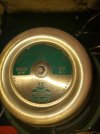
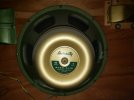
• University Model C15W Dual Impedance Woofer, 50 watts, 8 ohm

A University Model N-3 three-way crossover is also installed in the enclosure.

Here are links to the pictures:

http://www.micksmothers.net/gallery2/v/Billy/Stereo+Gear/University+Cabinets+and+GE+Console/
http://www.micksmothers.net/gallery2/v/Billy/Stereo+Gear/University+Cabinets+and+GE+Console/Large+University/
http://www.micksmothers.net/gallery...ty+Cabinets+and+GE+Console/Corner+University/

Please excuse the mess in the garage; I am halfway done with a privacy fence and the garage is totally out of shape.

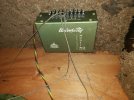
A GE mono tube console is also pictured. I intend to have the bottom portion removed and use the top as a mono source for the larger University. I will probably have a cabinet maker modify the console - I would royally screw it up.

Anyway, more information to come. I already know that I will be learning to reveneer - the bottom of the large University is toast. I will also learn how to repair veneer - chips and scratches. I will also learn how to sort out the tube amplifier, if the consensus is that it is worth it and will drive the large University. I am very tired now, but am very happy!
 
Register to hide this ad
Question regarding running these cabinets in stereo

I have a question regarding these cabinets. One is 16 ohm, the other is 8. I have an Alesis RA 100 as a test amplifier. What can I expect when running these speakers in stereo with the difference in impedance?
 
If all other things were equal, the 16 ohm speaker would be 3dB less volume, or conversely, the 8 ohm speaker would be 3dB more volume.
 
The drivers are very similar, as is the cabinet layout. The larger cabinet has a crossover with L-Pad adjustment, so I can match the mid/high frequency range closely. The woofers are identical, other than impedance. The RA 100 has good channel separation and separate volume controls, rather than a balance. So far, they sound great together. I didn't think there would be a problem short term - after all, they are both loads that the amplifier is designed to drive. Long term, will one channel get overworked, per se?

BTW, I have a graphic EQ for fine tuning, but these babies sound great with the EQ bypassed!
 
An observation

These Universities are my first real experience with HiFi horns. In my youth, I fooled around with some PA gear, running sound for a frat band, but didn't really know what I was doing. I did run some pretty cool quad-amp systems that I managed to set up pretty well more often than not. But that is another story:rockon:.

I have the Universities set up temporarily in the garage, facing a wall about about 14' away, with probably 20' of open air behind them before another wall. The desk where I am typing is maybe 2' behind and off to one side of the large speaker. The reflected sound off of the wall is incredible! Is that a function of the horns aligning the sound waves? I have also heard, but don't understand, the term long-throw horns? I can't recall hearing reflected sound so clearly, especially at low volumes. Once I get my JBL 4410's off the bench, I will have to set them up in the same position to see if it makes a difference, them being cone/dome drivers. Of course, the JBLs are near-field monitors, so it may not be a fair comparison. Comments, please?
 
Long throw generally means the dispersion angle of the horn is less.

Are you familiar with shotguns? Think of it like the different chokes, improved cylinder gives a wide pattern up close but not much distance, a full choke gives a tighter pattern up close but gives you more range.

Many horns are 90 degree, some are 120 degree. Long throw horns generally would be 60 degree or less, IMO.
 
I see you have these set up in the garage now. Are they going in the house?

Yes, they are going in today, once I make sure all the spideys are dealt with :pistols:. I'll post more pics once they are in. The console will stay in the garage - no space, haven't brought it up on a variac yet, still identifying the chassis, don't think the speaker load is connected properly, etc.

Long throw generally means the dispersion angle of the horn is less.

Are you familiar with shotguns? Think of it like the different chokes, improved cylinder gives a wide pattern up close but not much distance, a full choke gives a tighter pattern up close but gives you more range.

Many horns are 90 degree, some are 120 degree. Long throw horns generally would be 60 degree or less, IMO.

The shotgun analogy works well! From University lit, the dispersion is 60 deg. vertical, 120 deg horizontal. However, the Cobreflex horn design is a two-chamber siamese with one driver loading both horns. So, each individual horn may have a 60 deg horizontal (long throw) pattern.
 
Universities in the House

:music:

Listening+space+080908+jpg+002.jpg


Listening+space+080908+jpg+001.jpg


Listening+space+080908+jpg+003.jpg


I am using the EQ and running the large University mono. The location isn't as ideal as the garage, so a little curve massage was in order. This baby is so dramatic - and she is responding very well to the RA-100 and vice versa. I have used the Alesis with several other speaker combinations, but it has never sounded this good! This will work until I get the GE tube amplifier ready. I also have a Hammond tube amp out of an organ, but it will have to be adapted/modified to work in an audio environment. I intend to use the Hammond as a guitar amp, but ya never know!

The corner University is a lamp holder for now. I think that the crossover is very weak, especially when comparing this cabinet's performance with the large University. Not only that, the cable is of poor quality and too short. Besides, I will have to route the cable under the carpet or through the walls to hide them. Maybe a mono Accurian setup, wireless:scratch2:?
 
I gotta say, the large University absolutely shines when reproducing acoustic guitar music. I am listening to Leo Kottke right now, and he is playing in the room with me. I'm gonna have to get the other cabinet hooked up soon. I gotta pull out the crossover first.
 
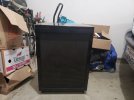
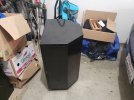
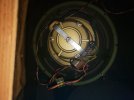
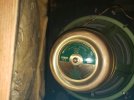
Picked these up from my grandfather a few years ago. Anyone know where I can have them restored and reconed?
20190327_125911.jpg20190328_185122.jpg
 

Attachments

  • 20190327_120343.jpg
    20190327_120343.jpg
    99.2 KB · Views: 13
  • 20190327_125823.jpg
    20190327_125823.jpg
    74.2 KB · Views: 12
  • 20190327_125835.jpg
    20190327_125835.jpg
    131.8 KB · Views: 10
  • 20190327_125841.jpg
    20190327_125841.jpg
    140.1 KB · Views: 11
  • 20190327_125848.jpg
    20190327_125848.jpg
    68.5 KB · Views: 11
  • 20190327_125852.jpg
    20190327_125852.jpg
    88.7 KB · Views: 11
  • 20190327_125905.jpg
    20190327_125905.jpg
    68.7 KB · Views: 11
  • 20190328_185147.jpg
    20190328_185147.jpg
    100.8 KB · Views: 11
Last edited:

Attachments

  • 20190328_185122.jpg
    20190328_185122.jpg
    122.4 KB · Views: 6
  • 20190328_185137.jpg
    20190328_185137.jpg
    75.8 KB · Views: 6
  • 20190328_185147.jpg
    20190328_185147.jpg
    100.8 KB · Views: 6
  • 20190424_204503.jpg
    20190424_204503.jpg
    91.1 KB · Views: 6
  • 20190424_204552.jpg
    20190424_204552.jpg
    101.3 KB · Views: 6
  • 20190424_204652.jpg
    20190424_204652.jpg
    105.2 KB · Views: 6
  • 20190424_205401.jpg
    20190424_205401.jpg
    68 KB · Views: 8
  • 20190424_205422.jpg
    20190424_205422.jpg
    104.6 KB · Views: 7
  • 20190424_205633.jpg
    20190424_205633.jpg
    91.7 KB · Views: 6
This looks like a big project. This looks like two different model University speakers, possibly used in 2 separate mono systems. I don't know if they can be used together in a stereo setup. Hopefully someone with direct experience with these speakers will chime in.

As far as renovation goes - what makes you think that they need to be re-coned? Typically re-coning is needed when the coil has failed (as it can be overheated and the wire insulation has melted). Probably not the case for you.

Usually the circumferential surround needs to be updated. This is an easy do-it-yourself project. Older speakers often had folded paper surrounds, which may be in usable condition (no attention required). This is likely your situation.

The main repair to older speakers is the replacement of capacitors in the speaker crossover. Capacitors, inductors and resistors are used to divide the total sound spectrum into thirds (for a three-way system) to both protect and use the three separate drivers in an optimal fashion. This is another do-it-yourself project. Dayton Audio Capacitors (+/- 5%) would serve you well. They can be found at parts express. You will find many discussions and recommendations for higher cost capacitors here on AK. Resist the temptation to spend more on capacitors until you gain an appreciation for the subtleties of high fidelity.

For one of your speakers the crossover is in a metal box. For the other speaker the crossover seems to be mounted on the woofer.
 
Back
Top Bottom