• The move to the new server is done. There are some software and database maintenance updates in process. This has us passing the hat around to help out. We appreciate any donations. Seriously, even a dollar helps. The payment page may be found here - https://www.audiokarma.org/support.html

Victor Brociner and the Fisher 30C

TheRed1

Console Conservationist
59AmbassadorIICatalogB.jpg


AK member Tubetone recently got me curious about the design of the Fisher 1959 Ambassador II. It's one of Fisher's early makeshift stereo console conglomerations based around the TA500 - a very early mono receiver. The 500 used in the Ambassador was apparently a version of this receiver (TK-5?) adapted for stereo. (Perhaps Tubetone will post some photos of his...) In the '59 Ambassador it was combined with a Fisher 30C mono controller/EQ/pre-amp and a 30-A amp. It's unclear exactly how the 500 and the 30C were interconnected but Tubetone's 500 has dual concentric volume pots which probably served as the master volume/balance.

Fisher30-C.jpg


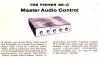
Purely by chance I came across the 1959 Sam's folder for the 30-C which shows its controls: (from L to R) CHANNEL SELECTOR, RUMBLE FILTER/LOUDNESS CONTOUR, VOLUME, BASS & TREBLE. In the same group of Sam's folders was an earlier 30C from 1957, the Brociner Mark 30C. It has almost the exact same control layout and very similar circuit design and component arrangement.

Brociner30-C.jpg


My understanding is that Victor Brociner, as one of Avery Fisher's partners in Philharmonic Radio, is given much of the credit for the design of their pioneering Hi-Fi consoles. But he left after WWII to found his own company. There must have been some kind of post-war connection between Brociner and Fisher for their products to have been so similar. And I wonder if Brociner had anything to do with the design of the TA500 itself. Brociner's designs are noted for their "industrial design". He certainly like to cram a lot of electronics into a small, sleek package - such that they must be a pain to work on.

The Brociner Electronics Corp. also produced a 6L6/5881 amp in 1957 called the 30A; though it looks nothing like Fisher's 30-A. (Brociner's 30A is a neat looking vertical chassis with the transformers, chokes and PS caps residing on the ground floor and the tubes on the floor above, protruding through the roof - looks kind of like a computer tower.)

Postscript: After Brociner Electronics Corp. failed and Victor Brociner scraped up enough money to pay off all his creditors he went to work for University Loudspeakers, then did a stint as Engineering VP for H.H. Scott in the early 60s and finally Engineering VP for Avid. He is credited with many Hi-Fi innovations including one of the first integrated amps and the first practical Williamson (the UL-1?) Does anybody have any further information on this little known Hi-Fi pioneer?
 
Register to hide this ad
Brociner & Fisher were friends (as was Joseph Grado IIRC). Brociner also did the design work for Lafayette on the LA-70 mono amplifier, about the size of a Heath W-6M. The actual relationships between Brociner, Fisher, Marantz, Grado, Pickering, Stanton, Pilot, Fairchild, Lafayette and more would be a fascintating study in the post-war era of hi-fi. Much like New England is credited with loudspeakers, the melting pot for audio electronics & hi-fi playback was LIC and these men were all in the thick of it making it happen.
 
I'll try posting a few pics.
CIMG1802.jpg

CIMG1800.jpg

CIMG1795.jpg

CIMG1794.jpg


The first couple pics show the RCA connections that are part of the TK-5 stereo conversion as I understand it. A normal TA 500 will not be equipped with these. Exactly how this would connect to the 30C and possibly the 30A is a bit of a mystery.
The last two pics just show the faceplate of a TA 500. Sorry that the third pic is a bit fuzzy, I must have moved.

Thanks go to TheRed1 and spartanmanor for their assistance in my pursuit of truth and knowledge.:thmbsp:
 
Brociner also designed and sold a version of the Lowther speaker with the driver facing upward into a curved horn. I think it may have been a domestically acceptable version of the Voigt horn, and it was widely admired in the early days of HiFi. It may have had high frequency drivers -- its been a while since I contemplated upon it.
 
Any idea what the MLTPLX output was used for? This was a standard on the 500-TA and can be seen on the last two photos above.
 
Multiplex output was used to add stereo FM to a mono tuner. Armstrong (the inventor of FM) invented multiplex as well and demonstrated it in the late '30s, so the principle was known - it just had to be standardized. Several different systems were proposed, but the final version wasn't decided by the FCC until 1961. Meanwhile most tuners had a multiplex jack - it was just an extra audio output without the normal de-emphasis low-pass filtering.
 
So in theory If you were to get the Fisher recommended 30-A amp and the 30-C Master Audio Control the 500 TA could be used as one channel for a stereo setup and the multiplex out would give the 2nd channel for FM.
 
Here is the sales info on the 30-C and 30-A
 

Attachments

  • fisher 30-A.jpg
    fisher 30-A.jpg
    82.5 KB · Views: 64
  • fisher 30-C.jpg
    fisher 30-C.jpg
    58.9 KB · Views: 60
So in theory If you were to get the Fisher recommended 30-A amp and the 30-C Master Audio Control the 500 TA could be used as one channel for a stereo setup and the multiplex out would give the 2nd channel for FM.

Actually, you needed to have a little unit called a Multi-Plex Adaptor. The single multi-plex output jack carried both the carrier and the sub-carrier wave, and the adaptor split it into a stereo signal.

So the adaptor had a single multi-plex input jack, and two left & right output jacks.
 
If like other units, the mpx output went to the mpx adaptor. From the adaptor, one channel went back to the 500 and the other to the C-30. From the 500 a interconnect went to the C-30 if there are dual volume controls on the 500. The 2nd power amp plugged into the 500 and the volume controlled from it. The C-30 selectors were set to equal the 500's corresponding controls and the volume control on the C-30 was either by-passed or used to match to the amp in the 500. Sounds more confusing that it is. Fisher was not the only company to have a stereo conversion system. Sherwood had an integrated stereo preamp with mono amp and to conver, you only needed the additional mono power amp. These mono amps from Sherwood are somewhat rare and sought after. Dyna had the stereo adaptor to convert a pair of PAMs to a stereo preamp. An interesting time for engineers and consumers who had no idea what format was going to emerge as a victor, not too dissimilar to today.
 
Another rather odd configuration was the "Tuner B" input on my 610-ST chassis. The guy who fixes my stuff told me that at the time some radio stations would broadcast one channel of stereo on their FM frequency and the other channel of stereo on their AM frequency. Listeners would need two tuners, one for each channel tuned to either AM or FM. The auxiliary tuner (tuner B) signal would be patched into the preamp via the special input then sent to one speaker, while the main tuner signal would be patched to the other speaker. Can you imagine a hybrid AM/FM stereo setup like this? Thankfully it did not catch on, for obvious reasons! :yes:
 
That was a competing system to multiplex and actually had wide support. A number of companies made tuners during that period with separate am and fm tuners for this reason. For the AM crowd these tuners are sough after as they were made to compete with the sound quality of fm and did a really good job of it. This period can be confusing as the tuners had fm mono but b/c of the am-fm simulcast were advertised as fm stereo or am-fm stereo. Today, espeically for younger persons who did not live through the period they buy the tuner only to find out it is not mpx stereo. Some of them, but not all had mpx outputs as the companies either were hedging their bets or were in the anti-mpx camp. A last thing is that many of the fm tuners were wide-band, i.e. could go to 20,000kc and not limited as happened with the adoption of mpx and can sound better in mono than many mpx tuners can sound.
 
Does anyone have a close up of the multiplex adaptor or more info on how this works? It looks very straight forward but I would like to have more info.
 
There are many brands of multiplex adaptors out there. Check out the bay! The only one I own, is a GE Stereo Multiplex Adaptor out of an old console I tore apart years ago. I use it for my old Magnavox preamp/tuner. It actually works pretty good with great seperation.
 
Back
Top Bottom