I found this very interesting so I thought I would share. I've been wanting to compare 6550s to KT120s for some time in my faithful friend the CJ Premier 11. I wanted to compare bias (will the KT120s bias properly), max power, power bandwidth, and total harmonic distortion. I found some expected results and some very surprising results. This is not a perfect test bed environment in that I don't have the power resistors to load both channels simultaneously, so I used only the left channel for all tests described here.
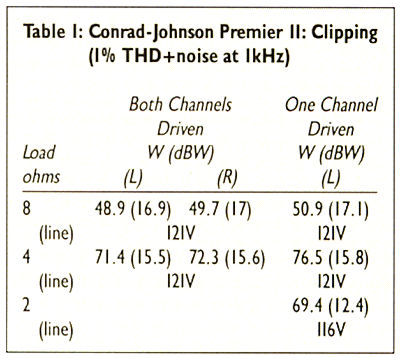
The Premier 11 has received good press over the years, most notably in Stereophile, where in 1994 it received a full review with published performance tests (using GE 6550A's I assume, which was standard issue back then for a new Premier 11 owner). Since this is a well regarded amplifier, I figured this is as good of a test bed as any to compare the KT120 to the 6550.
Here's a picture of my amp. This shot shows KT120s plugged in for the right channel and Winged C 6550Cs plugged in for the left channel. For all tests I used only the left channel and swapped tubes accordingly.

The KT120 tubes biased up perfectly in the amp--the bias trim pots had ample adjustment room on either side. The 10KHz square wave looks very similar to the Stereophile published measurement. Still, I am surprised there is so much initial overshoot and less damped ringing than I would have expected. Nonetheless the amp is very easy to listen to and not fatiguing at all.

Other measurements I took with the KT120 tubes:
Now for the Winged C 6550C's. Here's a picture of its 10KHz square wave at 1 watt output across an 8 ohm resistive load. You will notice it is virtually indistinguishable from the wave generated by the KT120 tubes.

Other measurements I took with the 6550 tubes:
Sound-wise, the 6550's are just perfectly sweet for this amp. The KT120s are "not bad", especially in the mid range where they are a bit fuller which is very pleasing to my ears at least, but there is evidence to me that this amp was built around the 6550 tube, and it measures to prove it--especially producing HALF the distortion, and producing an extremely flat response within the amp's power bandwidth.
Also I should mention that these 6550's were purchased straight from Conrad Johnson. I know that CJ takes great care in selecting only premium manufactured tubes. It is possible that the KT120s would measure as well if they were culled by CJ.
And while this thread isn't about the CJ amp itself, I gotta say I am impressed with these output transformers. They measure fantastic. Observe the nearly vertical side walls on the square waves and the straightness of the edges of the square waves right up to the top of the overshoot. IM-pressive.
The Premier 11 has received good press over the years, most notably in Stereophile, where in 1994 it received a full review with published performance tests (using GE 6550A's I assume, which was standard issue back then for a new Premier 11 owner). Since this is a well regarded amplifier, I figured this is as good of a test bed as any to compare the KT120 to the 6550.
Here's a picture of my amp. This shot shows KT120s plugged in for the right channel and Winged C 6550Cs plugged in for the left channel. For all tests I used only the left channel and swapped tubes accordingly.

The KT120 tubes biased up perfectly in the amp--the bias trim pots had ample adjustment room on either side. The 10KHz square wave looks very similar to the Stereophile published measurement. Still, I am surprised there is so much initial overshoot and less damped ringing than I would have expected. Nonetheless the amp is very easy to listen to and not fatiguing at all.

Other measurements I took with the KT120 tubes:
- Max power (across 8 ohm resistive load): 49 watts @ 1KHz. This is very surprising in that CJ published 70 watts/channel.
- Power bandwidth: 27Hz - 33KHz, +0.6dB, -0dB (the +0.6dB is surprising, and as I found out later, this is an artifact of the KT120 tubes)
- THD at 1KHz and max power: 0.3%
- Unconditionally stable as near as I can tell. I tried no load, 8 ohm resistive load, 2 uF cap only load, 20 uF cap only load, and 8 ohm resistive load in parallel with 20 uF cap.
- I had no way of measuring stability margin.
Now for the Winged C 6550C's. Here's a picture of its 10KHz square wave at 1 watt output across an 8 ohm resistive load. You will notice it is virtually indistinguishable from the wave generated by the KT120 tubes.

Other measurements I took with the 6550 tubes:
- Max power (across 8 ohm resistive load): 45 watts @ 1KHz. Still very surprising.
- Power bandwidth: 24Hz - 33KHz, +0dB, -0dB (excellent)
- THD at 1KHz and max power: 0.15% (Half that of the KT120s!!)
- Unconditionally stable as near as I can tell with same loading parameters as described above for the KT120s
- I had no way of measuring stability margin.
Sound-wise, the 6550's are just perfectly sweet for this amp. The KT120s are "not bad", especially in the mid range where they are a bit fuller which is very pleasing to my ears at least, but there is evidence to me that this amp was built around the 6550 tube, and it measures to prove it--especially producing HALF the distortion, and producing an extremely flat response within the amp's power bandwidth.
Also I should mention that these 6550's were purchased straight from Conrad Johnson. I know that CJ takes great care in selecting only premium manufactured tubes. It is possible that the KT120s would measure as well if they were culled by CJ.
And while this thread isn't about the CJ amp itself, I gotta say I am impressed with these output transformers. They measure fantastic. Observe the nearly vertical side walls on the square waves and the straightness of the edges of the square waves right up to the top of the overshoot. IM-pressive.