• Please note that Audiokarma will be offline briefly for updates early on Monday morning, September 28th.

Pioneer FM-R301 -help needed

Moving Ahead

Well-Known Member
Today a Pioneer FM-R301 arrived in the mail. She is in really good condition. The story goes it came out of a defunct church. So if an amplifier has touched the voice of God this one is it. The enamel case is perfect. The chassis is next to new with no signs of corrosion. The only negative things I can see is a broken rumble filter knob and a missing phono window( fingers crossed its inside).

Being a newbie to this valve stuff I'd like to ask some of you experts on some items.
Attached photos for reference.
001.jpg002.jpg003.jpg004.jpgPioneer_FMR-301_schematic.jpg
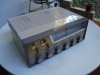
Pic 1/ The unit for your viewing
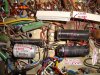
Pic 2/ The underside. I have some circled items. Are these mica caps? Do I replace or leave?
Pic 3/ There is some sign of heat stress. (being a church unit it is not unreasonable to suggest the unit was left on for extended period(s) of time: even for weeks?
The heat stressed area is underneath the output transformer.
The chassis looks browned, The yellow cable is charred in places. The 5K ohm wire wound resistor has coating breakdown and the electrolytic cap is shot.
a)-Would you replace the wire wound resistors 1.5K and 5K? -Perhaps a chassis mount resistor?
b)-Would you replace the 10ohm (x2)wire wound cement resistors?
c)-Would you replace the 500 ohm wire wound output resistor?
d)- Yes the electrolytic is gone. I'll try and give it more air to breathe.(underneath outputs)

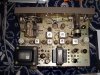
Pic 4/ Top view
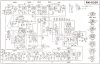
Pic 5/ Schematic- It was still pasted to the inside of the case.

Also if anybody has any history on this model, I will be extremely interested to hear from you.
How early is this model in the Pioneer timeline?

I look forward to your opinions, many thanks.
 
Register to hide this ad
The underside. I have some circled items. Are these mica caps? Do I replace or leave?
Leave them, they're mica caps, and I've never seen one bad.[/B]


a)-Would you replace the wire wound resistors 1.5K and 5K? -Perhaps a chassis mount resistor?

No need for a chassis mount, it probably heated up too much because the tan cap drew current when it went out. Replace 1.5k and 5k and the tan cap. The ceramic cap should be okay.

Inspect yellow wire for bare wire, but I think it's okay. That might wipe off.


b)-Would you replace the 10ohm (x2)wire wound cement resistors?
Not unless they're bad


c)-Would you replace the 500 ohm wire wound output resistor?
If it checks open.


d)- Yes the electrolytic is gone. I'll try and give it more air to breathe.(underneath outputs)
Good idea. Separate the 500ohm and your new 50uf, or more likely a 47uf cap 3/4 inch or so.

Also those grey coupling caps can tend to fail, but not usually causing other damage, they usually open instead of short. Those green resistors are early carbon film and are very stable and good.
 
My experience is that those gray caps are always leaky, which can lead to distortion, noisy controls, output tube red-plating, resistor overheating, you name it...

Wirewound resistors should be changed if value is wrong (or if you WANT to...)

6AR5 is a tube I've only seen in Japanese equipment. Miniature equivalent of 6K6 (as 6AQ5 is miniature version of 6V6). 5R-K16 may be a tough tube to find (but I'm wrong - a quick search finds them for $3 online!). If the eye tube is dim, there are NOS Toyo brand on eBay...
 
Thanks Gentlemen for your replies. You're a great help.

Repair Guy:-Those green resistors are early carbon film and are very stable and good.
That's good to know their compostion. I hadn't planned on doing any changes here. It's a mono unit so theres no requirement for balanced channels. No doubt there will be some resistor drift but i would call that character building.
*Thanks for the repair hints*

Tom:- I haven't looked at the valve replacement options just yet. I'll replace the electro caps and do preliminary testing first. Fingers crossed.

I looked up the serial numbers and it is a june 1960 model.

I dug a little deeper and found this,

Below is a little information I translated on the introduction of the receiver and the move by Fukuin (Gospel) Electric from primarily a speaker manufacture to producing audio components as Pioneer Electronics Corporation.

In 1956, Pioneer Institute for the establishment of formal sound, set up the first private sector silencer chamber to launch non-directivity horn tweeters PT-01 and two-way sub-audio speaker system PIM-8, and PIM-6. In the same year, Japan's short-wave broadcasts began, Pioneer introduced the AM / SW 2-band high-fidelity radio AM-V50, AM-R80, and by PT-3 and PW-8 speaker system consisting of CS-81, CS-82.

In 1958 Nian Pioneer in Tokyo, Omori, Ota-ku, newly-opened a new plant began manufacturing amplifiers. In the same year, in Brussels, World Expo, the pioneer of the non-directional four-way coaxial unit sub-speaker sound system, S-F1 awards, recognition by the Japanese Minister of International Trade and Industry. This year, due to increased market demand for HiFi equipment, Pioneer amp set up in the Omori factory production lines. Important products of the year are: the first combined-type stereo amplifier "Audiomaster" (with stereo music mode), the first FM tuner FT-10 and FM-P300, FM-R301 (FM reception frequency extended to 80MHz ~ 108MHz ), the introduction of a best-selling goods, coaxial speaker system X-8A, and high-woofer speaker system consisting of a traditional Road CS-283, CS-280 and CS-282.


In 1961, Pioneer made three major events: first, in view of the "Pioneer" has been a pioneer in this brand stand out, but people only know "PIONEER", was not aware of "The Gospel Electric Co., Ltd.," and decided to simply put the name of the company is also changed to "PIONEER Co., Ltd." (ie, Pioneer Co., Ltd.); Secondly, the company's stock began the Tokyo Stock Exchange; third, in the Saitama Prefecture new 1038 square-meter factory began producing large speakers, and the United States established RCA's technical cooperation, introduction of the combined sales of amazing amplifier SM-B200. The main products of the same year were: Edge-driven turntable PL-31962, the first set of split stereo system PSC-5A, using new push-pull output transistor 7591 merger of amplifier SM-801, thus beginning a real stereo equipment, research and manufacturing business.
 
Back
Top Bottom