1970s Marantz product line question

liam rtr

Active Member
I was wondering if anyone here could tell me for each year of the Marantz golden era what the Flagship, midrange, and bottom of the line models were. I know that in the early 1970s the 2270 was the top of the line, but I don’t know what model directly replaced it in the following years. I’m not sure what year the lower powered models like the 2010, 2015, 2215, and 2220 came out. I know that by 1980, the 2600 was the top of the line. I’m not sure what years all of the other Marantz models were released and where they fit in the product lineup. Obviously the first two letters of the model indicate the series, and the last two generally indicate the watts per channel, I know that Marantz only had a few models for sale per year, they didn’t offer 25 different models every single year-or did they??

Out of curiosity, can anyone explain this to me? Is there a thread somewhere on here that explains it, or an article on the web.
 
Register to hide this ad
The 2270 was the flagship in the early 70's, the 2325 in the mid-70's, and the 2500/2600 in the late 70's. At least that's my take on it. You could substitute a couple of higher power receivers for the 2325, but there were many more 2325's made than those with a bit more power.
 
From a strictly economic perspective, I think it could be reasonably argued that the "TOTL" Marantz of that era was not a two-channel receiver.
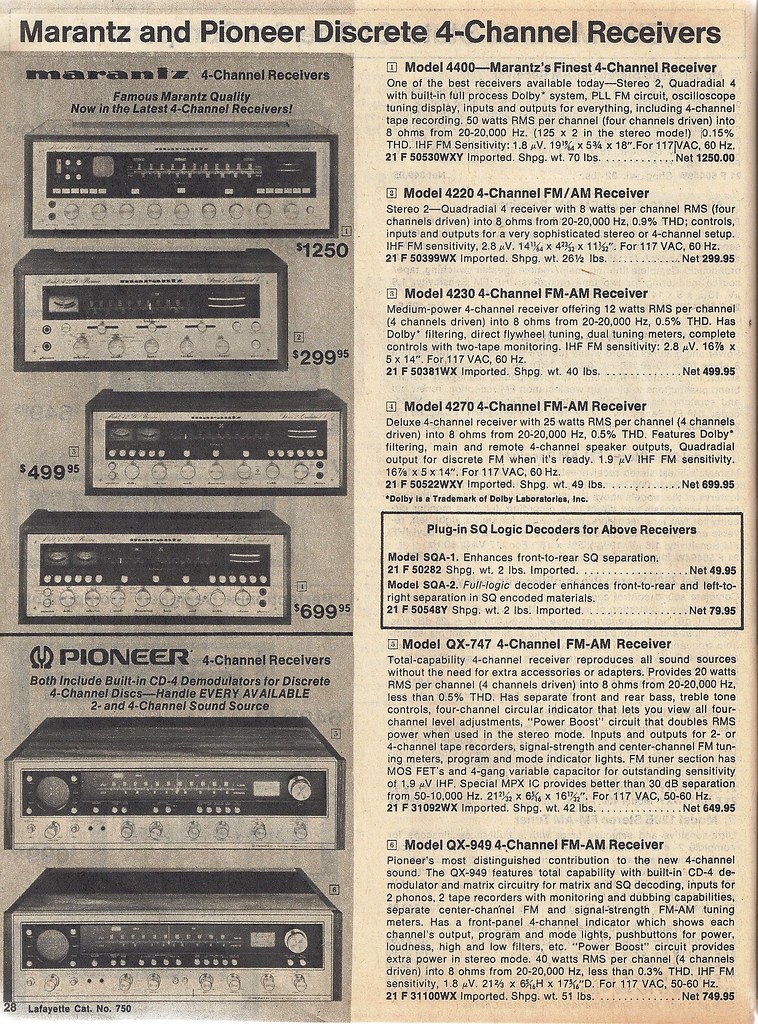
I was in my 20's during the 70's, and was at the bullseye of the Stereo market at the time. I bought a 2230 and a 2245 in 1972. Most of the major audio equipment manufacturers tried their best to entice buyers to "upgrade" to quad sound. It was pushed constantly in the audio magazines as the all-but-inevitable future. A small percent of buyers - mostly the well-heeled type - gave it a try, and even sprung for quad cartridges and 4 channel tape decks. But I and most of the guys I hung around with never saw the value return for the cost of a new system. The demos in the stores were supposed to be whiz-bang impressive, but at least to me, were underwhelming. And to add to the cost, if you wanted to upgrade, you had to add in two more decent speakers. The whole thing was a flash for about five years and then virtually disappeared because the market simply wasn't there. So, yes, from a cost standpoint, the quad units were top of the line. But the market for them never really developed because they just didn't sound that much better than good stereo.
 
Absolutely agree about the quad, was overkill.

Plus being in high school I had to work a big part of my summer just to get an entry level unit and hope mom and dad did not skin me alive for buying it! I could not afford to be a collector until my 50’s. A quad system was not even a thought unless a rich relative gave me one, which never happened lol.
 
Absolutely agree about the quad, was overkill.

Plus being in high school I had to work a big part of my summer just to get an entry level unit and hope mom and dad did not skin me alive for buying it! I could not afford to be a collector until my 50’s. A quad system was not even a thought unless a rich relative gave me one, which never happened lol.
I had a 4220, it wasn’t all that, I much prefer my stereo units like my 2245
 
1972-botl=2220, motl=2230/2245, totl=2270


1973/74-same as 1972 but with the addition of the 2015 as the new botl


1975-botl=2220b, motl=2250b/2275, totl=2325


1977-botl=2216, motl=2226/2232/2238 totl=2252

this is what I pieced together, for stereo receivers, not quads. This is what I got from looking through old catalogs, I didn’t have access to a some years. Those of you who know your models really well could look at this and see how the style evolved throughout the decade. Someone might be able to piece in the missing models. In the early 70s the receivers had mostly clean silver face with the black glass strip at the top of the faceplate. By the mid 1970s the black glass got bigger on all the models with some of the buttons now on the glass like in the 2275 or 2220b. In 1977 they put a strip of aluminum above the glass to surround the buttons, giving the faceplate a more sectioned look like on the 2216 and 2226. By 1978, Marantz mostly sold receivers with white face tuners like the 2238b, and big powered models like the 2500. There was also the introduction of the MR series and SR series in the late 1970s.
 
I was in my 20's during the 70's, and was at the bullseye of the Stereo market at the time. I bought a 2230 and a 2245 in 1972. Most of the major audio equipment manufacturers tried their best to entice buyers to "upgrade" to quad sound. It was pushed constantly in the audio magazines as the all-but-inevitable future. A small percent of buyers - mostly the well-heeled type - gave it a try, and even sprung for quad cartridges and 4 channel tape decks. But I and most of the guys I hung around with never saw the value return for the cost of a new system. The demos in the stores were supposed to be whiz-bang impressive, but at least to me, were underwhelming. And to add to the cost, if you wanted to upgrade, you had to add in two more decent speakers. The whole thing was a flash for about five years and then virtually disappeared because the market simply wasn't there. So, yes, from a cost standpoint, the quad units were top of the line. But the market for them never really developed because they just didn't sound that much better than good stereo.

Steven, another reason it died was none of the companies producing them could agree on a standard. I was 30 at the time and purchased a discrete Pioneer system in Japan. I still have some of the vinyl including Rick Wakeman's masterpieces, but the system is long gone. Personally, I loved it!
 
Would you say if one pays that retail price today for a working piece that would be a good deal?
 
I would say that's generally true... maybe even up to about a 10% bump up. Marantz gear always is highly sought after. I miss my 2245 (my first receiver in '74), but I enjoy my fully reworked 2216 now. Amazing amount of good power for only 16 RMS.
 

unfortunately your going to pay quite a bit more for the 22xx, 23xx etc models than there original retail shown on this website. This probably true regarding anything Marantz.

Most everyone looks at eBay as to “what there Marantz is worth” if they are a seller. Yes u may luck out and find one from a garage sale etc but they are far and few between now. Most sellers know what they have. For every person that found a garage sale, flea market find, the other 10-20 did not. I have bought over 100 Marantz units over the last 8 years and it is next to impossible to find anything underpriced. When you see a reasonable priced unit jump on it and don’t worry about what someone else paid.
 
This site does a good job of listing models and the years they were produced. You'll have to click on each one however to get the details... http://www.classic-audio.com/marantz/mindex.html

They can't be taken as gospel though. 2252 was available 1 year, 1977, then they changed to the 52B for '78/79. They have some overlap of models that probably is wrong, for instance the 2252 and 2252B in '77.
 
Back
Top Bottom