• The move to the new server is done. There are some software and database maintenance updates in process. This has us passing the hat around to help out. We appreciate any donations. Seriously, even a dollar helps. The payment page may be found here - https://www.audiokarma.org/support.html

2230 Serial Number Question

Parallax982

Super Member
Does anyone know how the 2230 was was numbered. As you can see from the photo, my serial number is 51914. But it's got the champagne engraved face plate and the internal design confirms that it's from the early part of the run. I know most models began at 1000 but some began at 1 and some began at 100000. Did the 2230 begin at 50000? That would make sense of what I'm seeing, as I'd have a unit from among the first 5,000.

Marantz 2230 Serial Number.jpg

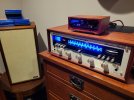
Here's the unit itself:
Marantz 2230 Relamped.jpg
 

Attachments

  • Marantz 2230 Serial Number.jpg
    Marantz 2230 Serial Number.jpg
    74.9 KB · Views: 4
Register to hide this ad
The 2230 began with 1000. The total production run was around 185,000.

This link they begin talking about the 2230 at post #10.
https://audiokarma.org/forums/index.php?threads/marantz-serial-numbers.551678/

Total numbers produced can be found here:
https://www.amkproducts.com/marantz/marantz-production-numbers/
Read towards the end of the introduction to find info on how the 2230 overlaps the numbering systems.


https://audiokarma.org/forums/index.php?threads/marantz-2230-champagne-color-engraved.951303/
 
What doesn't make sense is my 2230 with a serial number that, according to that numbering protocol, would make it the 50,914th unit produced. Yet it has the champagne engraved face plate, which everyone says was produced only for the first 5,000 or so units.

Plus, this blurb that everyone cites doesn't mention anything about the 2230.

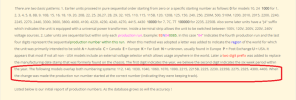
Earlier units proceed in pure sequential order starting from zero or a specific starting number as follows: 0 for models 10, 24 1000 for 1, 2, 3, 4, 5, 8, 8B, 9, 10B, 15, 16, 18, 19, 20, 20B, 22, 25, 26, 27, 28, 29, 32, 105, 110, 115, 115B, 120, 120B, 125, 150, 240, 250, 250M, 500, 510M, 1200, 2010, 2015, 2200, 2240, 2245, 2270, 2440, 3300, 3600, 3800, 4060, 4100, 4220, 4230, 4240, 4270, 4415, 4430 10000 for 7, 7C, 7T 100000 for 2235, 2250B. For purely aesthetic purposes, some audiophiles prefer a low s/n on a unit, but this sometimes an ill-formed idea. Take the would-be successor to the Model 15. The early Model 16's were poorly received and reviewed, and the model underwent a design change involving a newer op amp and bigger p/s caps starting with s/n 1456. The later 16's are markedly better units.​
You need to read that blurb to the end.

Use the search tab in the upper right to find what you're looking for. I remember reading something about it here.

Screenshot (754).png
 
You need to read that blurb to the end.

Use the search tab in the upper right to find what you're looking for. I remember reading something about it here.

View attachment 3207284
Here's the whole thing:

There are two basic patterns. 1. Earlier units proceed in pure sequential order starting from zero or a specific starting number as follows: 0 for models 10, 24 1000 for 1, 2, 3, 4, 5, 8, 8B, 9, 10B, 15, 16, 18, 19, 20, 20B, 22, 25, 26,27, 28, 29, 32, 105, 110, 115, 115B, 120, 120B, 125, 150, 240, 250, 250M, 500, 510M, 1200, 2010, 2015, 2200, 2240, 2245, 2270, 2440, 3300, 3600, 3800, 4060, 4100, 4220, 4230, 4240, 4270, 4415, 4430 10000 for 7, 7C, 7T 100000 for 2235, 2250B. Also some later units have a "J4" suffix which indicates the unit is equipped with a universal power transformer. Inside a terminal strip allows the unit to be switched between 100V, 120V, 200V, 220V, 240V voltage sources. 2. Later units are sequential but within only each production run. Example: 93N040085. In this case "04" indicates the fourth production run and the last four digits represent the sequentialproduction number within this run. When this method was adopted a letter was added to indicate the region of the world for which the unit was primarily intended to be sold: A = Australia C = Canada E = Europe K = Far East N = unknown, usually found in Europe P = Post Exchange U = USA. It appears that most if not all non - USA models include an external voltage selector which allows usage anywhere in the world. Later a two digit prefix was added to replace the manufacturing date stamp that was formerly found on the chassis. The first digit indicates the year, we believe the second digit indicates the six week period within the year.​
​
The following models overlap both numbering systems: 112, 140, 1030, 1040, 1060, 1070, 1090, 2215, 2215B, 2225, 2230, 2235B, 2275, 2325, 4300, 4400. When the change was made the production run number started at the correct number (indicating they were keeping track).​
​
My model, the 2230, is discussed in the last paragraph, but it still doesn't make sense because there is no numeral. 51914 would seem to be the earlier numbering system but far too late to have the engraved champagne face plate.

 
Here's the whole thing:

There are two basic patterns. 1. Earlier units proceed in pure sequential order starting from zero or a specific starting number as follows: 0 for models 10, 24 1000 for 1, 2, 3, 4, 5, 8, 8B, 9, 10B, 15, 16, 18, 19, 20, 20B, 22, 25, 26,27, 28, 29, 32, 105, 110, 115, 115B, 120, 120B, 125, 150, 240, 250, 250M, 500, 510M, 1200, 2010, 2015, 2200, 2240, 2245, 2270, 2440, 3300, 3600, 3800, 4060, 4100, 4220, 4230, 4240, 4270, 4415, 4430 10000 for 7, 7C, 7T 100000 for 2235, 2250B. Also some later units have a "J4" suffix which indicates the unit is equipped with a universal power transformer. Inside a terminal strip allows the unit to be switched between 100V, 120V, 200V, 220V, 240V voltage sources. 2. Later units are sequential but within only each production run. Example: 93N040085. In this case "04" indicates the fourth production run and the last four digits represent the sequentialproduction number within this run. When this method was adopted a letter was added to indicate the region of the world for which the unit was primarily intended to be sold: A = Australia C = Canada E = Europe K = Far East N = unknown, usually found in Europe P = Post Exchange U = USA. It appears that most if not all non - USA models include an external voltage selector which allows usage anywhere in the world. Later a two digit prefix was added to replace the manufacturing date stamp that was formerly found on the chassis. The first digit indicates the year, we believe the second digit indicates the six week period within the year.​
​
The following models overlap both numbering systems: 112, 140, 1030, 1040, 1060, 1070, 1090, 2215, 2215B, 2225, 2230, 2235B, 2275, 2325, 4300, 4400. When the change was made the production run number started at the correct number (indicating they were keeping track).​
​
My model, the 2230, is discussed in the last paragraph, but it still doesn't make sense because there is no numeral. 51914 would seem to be the earlier numbering system but far too late to have the engraved champagne face plate.

I'm just the messenger. Ask AMK about it.
 
Here's another link where they're talking about production numbers.

https://www.audiokarma.org/forums/index.php?threads/marantz-2270-engraved-survey.667552/page-5

In post #99 he says that serial numbers for Europe started with 50001.

Just more info to mull over....
Mull over? I think you figured it out. What else could it possibly be? I must have one of the early European models. Otherwise, my number wouldn't be 1914 units into their starting number and it wouldn't have the champagne engraved face plate.

Thank you! You not only responded, and were the only one to respond, you figured it out.

I'll read the full thread but that single post seems the most plausible explanation.
Yeah, those threads are informative and interesting.
Are those LED's in your pic? Looks too bright, but my camera takes photos like that where in reality they look nice.
 
They are LEDs and they probably would seem to bright to you, as I know they do to many. I like it. I have two shades of blue LED. When I was first trying out different combinations, my wife noted that she liked a certain look that I stumbled upon accidentally, where the lights began bright at one side of the scale and slid off toward dim. I didn't like that but I like my blue two-tone setup.

Here's my 2235 in a wood case with a Geshelli Labs DAC.
Marantz 2235 Replamped with Advents Rescreened.jpg

And here's my 2270, taken in a dark room right after I had put the case back together, before even putting the knobs back in place. The camera doesn't really show the two-tone in either photo.
Marantz 2270 after relamp (w:o knobs).jpg
 

Parallax982​


One clue... yours has many voltages listed under the serial #, indicating that it was for foreign markets and had adjustment taps for 'country of origin'.

The ones in and for the USA just had "120v" on the back.
 

Parallax982​


One clue... yours has many voltages listed under the serial #, indicating that it was for foreign markets and had adjustment taps for 'country of origin'.

The ones in and for the USA just had "120v" on the back.
Great point. Thank you. I think kwayde guided me right to the answer -- that the model number suggests it was in the first 4,000 of the European models, as it has a 50k+ number. So you've provided confirmation. If there was any doubt, you just pretty much eliminated it.
 
A wood cabinet? At this point, no. I had bought it for my wife's office but she's very sensitive to smells and isn't sure she wants it. When these old things heat up, they can emit a bit of a mustiness. She's one of those people who loves music occasionally but really cherishes silence above all else. So I mostly play music alone. Fortunately, our home is large enough that my love of music doesn't interfere with her love of silence.

If she allows me to put the 2230 in her office, I will. But it will be pretty much hidden away, just for occasional use. If she doesn't, it will sit until perhaps one of my children wants it. Or I decide to use it in place of the 2235, which is another possibility.
 
Back
Top Bottom