• Please note that there are a few updates and clarifications made in the Audiokarma Rules, mostly relating to advertising and the addition of the new "Paying it Forward" & "Giving back" forums in the AudioKarma Audio Marketplace section.

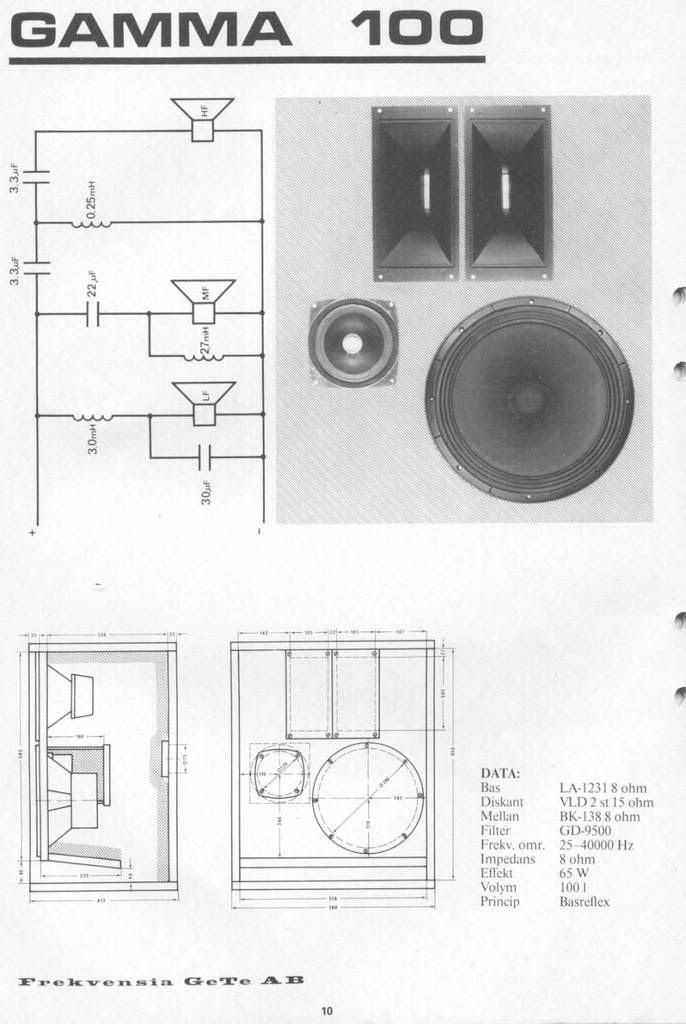
36 year old Gamma 50's x-over questions.

Adda

Super Member
Hello

Now that my Nikko amp is back in business and playing wonderfully, I'm moving on to my speakers.
I'm having a problem in the upper mids and treble range, so mostly in tweeter territory above 3500Hz.
It seems to more of a problem to the left speaker, the right one is pretty consistent.
The problem is elusive, the speakers sound fine, and well balanced, but if I crank the volume, the highs may start wondering around the stereo field, it sounds really weird, as if the pressure in side my ears is going up and down, very disturbing at times.
But then sometimes all of a sudden it's like my speakers wake up, they shine and glow with fluid clarity, but they easily die down again if I lower the volume.
I have checked them for poor solder joints and found none, I have VLD-12 tweeters, they are known to be tricky to work with, but I have found a solution to their connectivity problems, so I don't think they are to blame.

To me it sounds like the x-overs need recapping, I might replace the coils as well now that I'm at it, I may even go for a all new x-over, but have been unable to find one with the right specs (650/3500Hz 12/12/18dB)
Now the questions is, does this sound like x-over trouble to you?

A pic for your enjoyment, if you enjoy looking at discarded homemade furniture, you'll love these.

9558a076_AUT_0701.JPG
 
Last edited:
Register to hide this ad
I'd be looking at the caps for sure, at that age and with a lot of hours on them they may be shot. Sounds like maybe an intermittent short or open circuit is happening. You can blow a tweeter with that. You might check any resistors while you're in there, and if anything is out of spec, replace it.

I wouldn't bother with the inductors. All they are is a hunk of wire, and as long as the solder joints are OK, there's nothing to wear out.
 
Oh thank you for your response, that explains why the ribbon in the left tweeter jumps around like crazy the moment it "wakes up".
There are no resistors in this filter, just capacitors and inductors, I will look at replacing the caps, and see if I can reduce the number of caps needed, there are no less then six caps in each speaker.
I'll also increase their power handling from 50w to 80-100w, and tolerance from +-10% to 5% for the bass and mid woofer and 1% for the tweeter.
The reason I'd like new inductors is that the ones in there are home made and beat up, and "loose", but firmly soldered.
 
You may be getting midrange or even bass into the tweeter. Bad juju.

Now that you mention it, is it possible there are intermittent solder joints on the tweeter? The Infinity EMITs have this problem a lot, and will cut in and out like that. I'm not sure how yours are put together.

I would still do the recap of course. You can only reduce the number of caps if there are two or more in parallel that you can replace with a single value. For example if they used 12 + 1 uf to get 13, and you can replace it with a 13. Otherwise the characteristics of the crossover will be changed.

You mentioned changing the wattage - you probably mean voltage rating of the caps? Probably a good idea to use at least 100V caps. The Dayton metallized polyprops from Parts Express are a good deal, and they are 250V I think. No chance of burning those up with the average amp.

You could use some hot glue to fasten those inductors down better. But if they're homemade, is the entire crossover homemade? Are you sure it's correct for this speaker?
 
I know the tweeters in and out, the ribbon mounting is tricky, but by putting a piece of solder in there and screwing it firmly together, the solder will be flattened sort of sticks everything together, hard to explain.
But this method has been dependable for years.
In the future I'll be using silver based thermal paste to stick it all together, it's conductive and easy to work with.
I have two spare tweeters I assembled that way, it works very well, but they use household aluminum foil so not too good sounding, but dependable.
Before I fix up a pair of tweeters with new ribbons and all I want to fix whats actually broken.
I have had the pair with the right kind of ribbon hooked up to my Aragon 18k pre, to test for bad connections, no problems found, even if I knock them a bit so I think they are fine.

The crossovers are the originals, and nothing has been done to them since they where assembled, these speakers where sold as a DIY kit, from AudioScan, but you had to assemble the crossover and make the speaker chassis your self.
The only major change that has been done is that the bass woofer has been replaced, the original GAMMA's blew last year.

Ok just had a chat with my dad who built these speakers, he says that all the caps except the cap for the bass driver are filter caps, he claims they never wear out.
Only the bass cap is electrolytic, so it will wear out, causing the crossover point for the bass to climb higher.
He says the problems I have cannot be caused by the crossover filter?
 
I swapped out the ribbon tweeter on the speaker that had the most trouble, maybe that will make a difference.
 
A friend of mine loaned me his JBL N2400 crossovers when I was putting my C36 system together and they sounded very good (with all original parts). I found a set on ebay that were cosmetically clean but the guts had been pulled out. I bought all new parts (including the inductors) and rebuilt them. The final result was stunning and my friend was actually pissed that he had clearly never heard his C36's the way they were intended to be heard.

Anyway, I am normally a purist and live originality, but crossovers should be reubuilt, regardless of how they test out as the parts are simply old and tired.

James R.
 
What you referred to as filter caps, you probably mean 'film' caps. There is some merit to what your dad is saying, because electrolytics do have a paste in them that can dry out over time. But there is a lot of direct experience (including yours truly) that replacing older film caps - even from the 70s and 80s - can markedly improve the upper end. Very old caps - I'm talking wax coated paper-foils from the 1930s to 50s - had problems from the paper insulating layers degrading, changing the capacitance or even causing shorts. I couldn't tell you exactly what the mechanism is for modern film caps to deteriorate, since they have polyester and other plastics that you would think would be durable, but there are a lot of independent listeners here who will confirm that the sound improves when they are replaced. Maybe it's the metal film corroding, could be the plastic layers deteriorating from breakdown of the plastic, or a combination of the two.

Anyway the cost is minimal. If you like the speakers, you should really consider it. The tweeter cap is usually <5 uf so it's the cheapest. I'm not one to replace things just 'because', as you saw above from my comments on resistors and inductors.

Now, if you fix your membrane tweets and everything sounds fabulous, maybe the crossover caps are OK. Thanks to the limits of the interweb, only you can hear 'em.
 
A friend of mine loaned me his JBL N2400 crossovers when I was putting my C36 system together and they sounded very good (with all original parts). I found a set on ebay that were cosmetically clean but the guts had been pulled out. I bought all new parts (including the inductors) and rebuilt them. The final result was stunning and my friend was actually pissed that he had clearly never heard his C36's the way they were intended to be heard.

Anyway, I am normally a purist and live originality, but crossovers should be reubuilt, regardless of how they test out as the parts are simply old and tired.

James R.

That's the thing, I read about the success people have had by rebuilding their filters again and again.
But in the audio world there are people with all kinds of opinions, my dads is based on theory.
Since the performance of VLD-12's is legendary, I feel I should do what I can to unlock all that potential.
So I better rebuild that crossover, even if they are not the cause of my troubles.
And get myself some fostex fullrange drivers to replace my GAMMA BK-138a's.

What you referred to as filter caps, you probably mean 'film' caps. There is some merit to what your dad is saying, because electrolytics do have a paste in them that can dry out over time. But there is a lot of direct experience (including yours truly) that replacing older film caps - even from the 70s and 80s - can markedly improve the upper end. Very old caps - I'm talking wax coated paper-foils from the 1930s to 50s - had problems from the paper insulating layers degrading, changing the capacitance or even causing shorts. I couldn't tell you exactly what the mechanism is for modern film caps to deteriorate, since they have polyester and other plastics that you would think would be durable, but there are a lot of independent listeners here who will confirm that the sound improves when they are replaced. Maybe it's the metal film corroding, could be the plastic layers deteriorating from breakdown of the plastic, or a combination of the two.

Anyway the cost is minimal. If you like the speakers, you should really consider it. The tweeter cap is usually <5 uf so it's the cheapest. I'm not one to replace things just 'because', as you saw above from my comments on resistors and inductors.

Now, if you fix your membrane tweets and everything sounds fabulous, maybe the crossover caps are OK. Thanks to the limits of the interweb, only you can hear 'em.

Ah yes, I think you are right, he must have said film caps and thanks for the explanation.

Now you confirm again that rebuilding filters is a good idea, and you even back it up with experience relevant to my speakers age, I think my dad is just being stubborn.

Which brings me to the next point, I'm never letting go of these speakers, not unless they burn or rot.
So what ever is wrong will have to be fixed.
Since it's late I can't test my speakers at loud volumes until tomorrow.

On a side note, there are at least two variations of VLD-12's, I have three of one type but the fourth is different.
I had been using two of different types for a while, since they had good ribbons.
But the speaker that is causing most trouble, has the odd tweeter, I noticed it's magnets are weaker then the magnets on the other tweeters.
So I decided to remove the PCB with the ribbon on it, and move it to one of the other tweeters.
Now the speaker doesn't sound like it needs to wake up anymore, but lets see.
The other speaker however, doesn't seem as extended in the heighs, but warmer in the mids, I need to make new ribbons and try out the silver paste method properly.
 
Oh look at that one of the Gamma kits.

So yes as for your question, yes you certainly need to either replace components or the filters themselves - else you'll ruin the sensitive ribbon tweeter. (something I done myself)
If you get new filters make certain they come with 12 db per octave, preferably 18 db per octave for the tweeters low end. Midrange and up can be either or even less doesnt matter for those.
So yes I got a pair of Gamma myself, those with the 13 inch bass, and dual ribbon tweeters. I still regret I didnt get the model with 4 VLD treble horns, but they still sold as separate tweeter units and in my opinion they still among the best high frequency tweeters in existence. (Runner up to the Elac JET tweeters.)
 
Ok, changing the ribbons didn't make a difference I still have the same problem.
So the corssovers can look forward to being rebuild, unless I can find a replacement.

Great I was hoping someone with a pair of old Gammas would turn up, do you have a pic of yours?
I certainly don't want to ruin my wonderful tweeters, so I better be careful until I get everything fixed up, I usually listen at fairly low volumes so that won't be much of a problem.
They really compete with such an elaborate tweeter huh, it doesn't really surprise me much.
I have never head any tweeter these VLD's don't humiliate, even Fostex planar magnetic tweeters are utterly destroyed, they sound fuzzy and lacks transparency in comparison.
 
Oh by the way, it was good that I replaced the odd tweeter with another one, it sounds much better, much much better.
I guess the AlNiCo magnets in the other one have lost their magnetic charge.
 
Hello Adda. =)
Im surprised to hear that the magnet might have gone for you. But well there's always a first and yes, these speakers do get old so strange things can happen.
In case you consider the one you replaced a complete loss, unscrew the horn on the VLD tweeter and try something with iron/nickel while holding it firmly and see if you still don't get any pull from the magnetic field. But watch the ribbon! The magnet is incredibly strong at short distance if it happen to be intact still.

So as for your former posts, yes its the filters, happened to me also. A friend of mine built his own entirely new filters, and they still play nicely, but he have replaced the bass speakers with Philips ones. He's happy with the result, but I think he downgraded somewhat.

So yes I tried to make my own filters also and made a mistake and blew the ribbon tweeters and had to get replacement which turned out to be more difficult at least for me than what some people say.
So my recommendation is to get ready built ones, unless you're very good at calculating what is needed. And filters with 12/12/18 should be found, but not as standard cheap ones. Try google third order passive filter and something might pop up.
But this said for entirely new filters not based on the original - just replacing components should work fine. =)

So as for a pic, I am quite far from home currently, but I should have one image for you in a month. Bur I might snap one of my friends not-entirely Gamma speakers also,I hope you can stand that wait. =)
 
Ah you just answered the questions I have been googleing for, thank you very much.

The magnet in my VLD is not completely dead, just weak, comparatively testing with a screwdriver :)
AlNiCo magnets can loose charge if pushed too hard, at least they do in dynamic drivers.
But it should be possible to re-magnetize it, just need to find someone with the right equipment, but I'm not in a hurry, I have three horns in good working condition.

I would prefer all new filters, the ones I have are in a bad way, I'd like to get something proper while I'm at it, but "third order passive filter" check.

I'll do my best to be patient, I'll look forward to seeing more Gamma's :)
 
Last edited:
Hmm it seems I better rebuild my current crossovers, if I don't it seems I'll have to build my own, I don't feel confident enough to do that.
 
Brilliant, thank you very much, with this it should be easy for me to make a new filter, this is perfect!
 
Looooook its deer, my preciousssss! =)
Though my bass driver is the LA-1232 ....but yes there's the info.
Now that Mr Zetterberg have delurked, I got just one question.
Where did Gamma originate, were in Romania or Bulgaria or any other country there in the former East bloc?
 
Last edited:
Great to see help coming out of the woodwork! Now get after those 3.3 uf caps and see if they sing even better. Looks like the others - the 22 and 33 - are big enough that you may want to use non polar electrolytics to cut down on the size and cost. Some people will parallel a quality 0.01 cap alongside, it doesn't add significant capacitance but apparently lets some of the more delicious sounds through.
 
Back
Top Bottom