


Jeromeof
New Member
3E Audio A7 - Initial Impressions
So it has been a while since I shared a first impression here. But since I have been using the A7 for more than a month, now I thought it might be value so people can understand what they get from at least one of these 3E audio amplifiers and specifically is it an upgrade from something like the Fosi Audio V3 Monos.Here it is setup with my WiiM Ultra, these 2 together are a nice combination in my opinion:

So, having shared some first impressions of some various other pragmatically priced Class D Amplifiers in the past you might be wondering, why get an upgrade, so I before I get into my sound impressions I think I should explain why I decided to buy this.I bought mine from the 3E Audio Aliexpress store for a little over €300. There are various options available but I went with the A7 with No PSU. I did this to save a little bit of money and only after checking with the 3E Audio Support team that I had an appropriate power supply to use. Though in hindsight I should probably have just bought their power supply as it would have been a bit handier when I was doing some A/B switching test.
Note: I live in the EU, and the VAT was removed from the Aliexpress during the checkout, but then I ended up paying slightly more via the Irish customs VAT import duty, due to extra handling fees.
But I believe "3E audio" has finally launched on Amazon.com, so this slight uncertainty of the final price problem will disappear soon if not already.
Why upgrade?
For me personally, I was curious about the 3E Audio A7 after seeing some impressive reviews on ASR. But since the implementation of PFFB on affordable amplifiers like the Aiyima A70/A80 and especially the Fosi Audio V3 Mono's, I hadn't been too interested in upgrading my amplifiers, I have 3 rooms and a converted garage in my house with various setups. These were already excellent for small and mid-sized rooms with a flat neutral sound and no load impedance issues.But then I spotted the reviews of both the 3E Audio A5 and A7 amplifier on ASR, my interest was piqued again, so I thought why not.
Specifically, while SINAD charts do not tell you anything about sound quality especially at this level, they do indicate the quality of engineering, and both the A5 and A7 were impressively positioned in Amir's ranking:

With the smaller less powerful A5 slightly better than the A7. But I decided the A7 would be better for one of my rooms as is more powerful than the equivalent PFFB amplifiers from Fosi Audio and Aiyima, and both A5 and A7 are very close in numbers to class D amplifiers from the likes of companies like Hypex and Purify which are much more expensive.
So my confession is I guess I wanted to see what a technically better class D amplifier would be like at a reasonable good price. But that is mostly the reason I have bought lots of "audio gear" in the past.
So, let me get into what you get in the box:
What do you get in the box?
Since I bought A7 without the PSU, it came in a small sturdy box with the amplifier securely nestled in foam inserts:
Opening the box:

The package is pretty minimal, just the amplifier and a user manual.

The build quality is good but not necessarily premium-looking.

The front panel is minimalist with just a volume knob (that also serves as power and input selector) and a few indicator lights including clipping indicators.

I used my existing Fosi Audio 48V 10A power supply having checked the specs with the 3E Audio team.
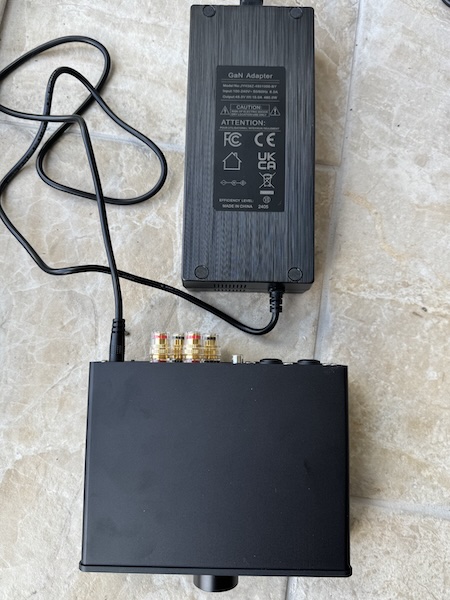
This power supply is very similar to the one you will get from 3E Audio anyway.
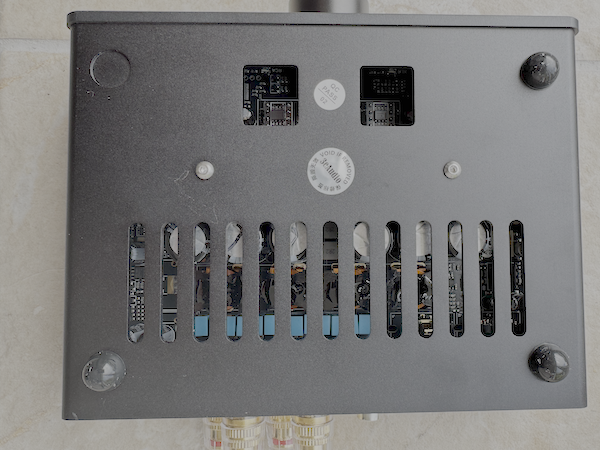
It is solid with an aluminum chassis that helps with heat dissipation and there are plenty of grills on all sides:
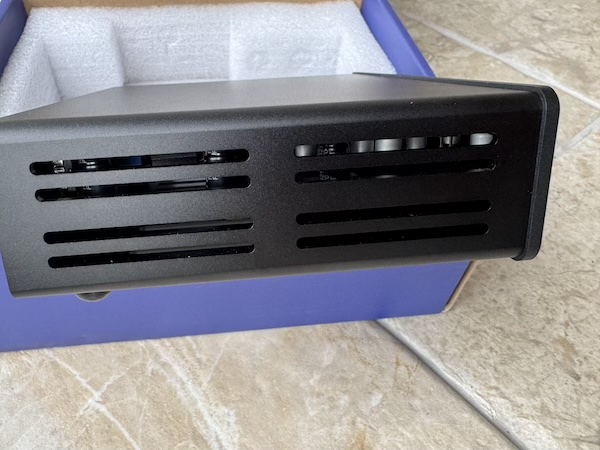
| 
|
Some Technical details
I am a sucker for audio architecture diagrams, and the A7 shows a nice clean layout:
3E Audio provides a few of these for the variations of this design on their website. Specifically, I believe these are some of the key upgrades to the internals:
- ELNA Silmic II HiFi grade capacitors for audio
- Large capacitors (up to 6000uF) with lower ESR
- High current flat wire inductors with low DC resistance
- TDK Film capacitors for the LC filter
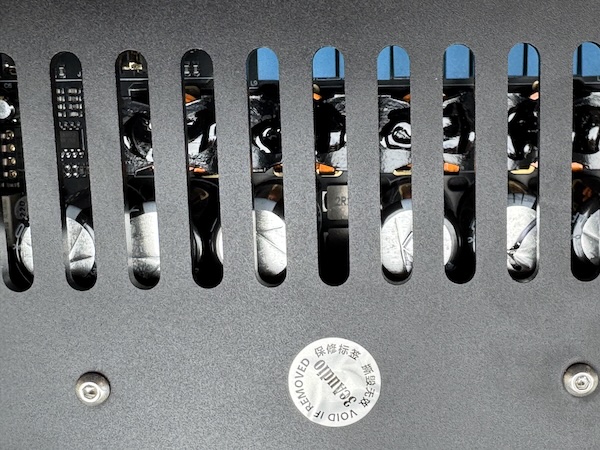
What I was most curious about was if these components help this amplifier handle more demanding speakers with less chance of overheating issues than some competition.
I was also curious about the Dual TPA3255 chips in PBTL configuration, in theory will give significantly more power but also probably increase the termal aspects of the amplifier. So in the ASR review Amir showed this amplifier handling loads down to 2Ω consistently, which I also believe is not possible with the V3 Mono's and other similar budget amplifiers.
Sound?
The A7 promised to deliver a transparent sound across the frequency range, and both in the ASR review and in my own meaurements it does with a variety of my speakers. Its PFFB implementation ensures a flat frequency response regardless of speaker impedance.Note: If people are interested, I can write up my subjective opinion of the sound, but basically it is doing the appropriate job of a transparent amplifier, getting the music to your speakers as cleanly as possible and letting the speaker do their job without the amplifier coloring the music.
Some A/B Testing
For some A/B testing I swapped between the A/B testing against the Fosi V3 Monos and the Aiyima amplifier using the Fosi Audio LC30 to quickly swap (once level matched):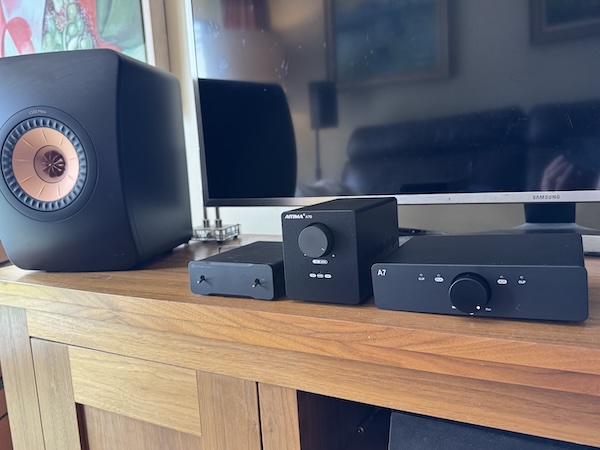
And with the Fosi Audio LC30:
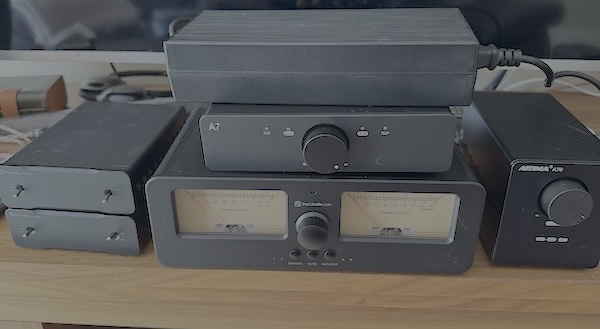
And honestly, in my A/B testing comparisons with the Aiyima A70 and Fosi Audio V3 Mono, I couldn't hear significant differences in sound quality. However, I did notice the A7 stayed much cooler than the V3 Mono's, which would get occasionally get very warm during extended testing, but mostly that was using some specific 'test tones' design to tax an amplifier. The A7 never even approached that same level of heat in a month of testing.
Just to show how transparent the sound is, here is my measurement comparison showing the frequency response of all three amplifiers with the same KEF LS50 Meta speaker:

Note: you will always get some very minor variations in these measurements each time they are run.
But as you can see, they all show remarkably similar frequency response curves, confirming they all deliver the same
linear response, I deliberately offset the volume to show each clearly.
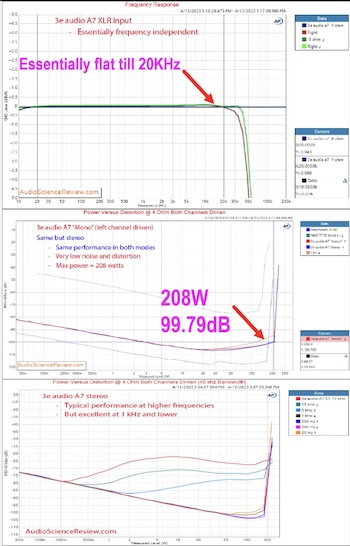
As I mentioned earlier it is well worth checking out Amir's review on AudioScienceReview but here are 2 more measurements that I think show how good this amplifier is:
Specification
The A7 boasts excellent specs, I specifically wanted to try the dual TPA3255, but for those wanting a set of Mono blocks - that is another option the A7 Mono on the 3E Audio.But here are the A7 specifications:
- Class D amplifier with 2x TI TPA3255 chips
- PFFB structure
- RCA and balanced XLR/jack inputs
- THD+N as low as 0.0005% @ 8Ω (XLR input)
- Output power: 2x 250W @ 4Ω, 2x 140W @ 8Ω (1% THD+N)
- Can handle 2Ω-16Ω loads
The SINAD of 102 achieved is exceptional—above the already excellent performance of the Fosi Audio V3 mono's and effectively any other amplifier in this price range and as I mentioned earlier the less powerful A5 actually gets a SINAD of 105.
Summary
I am very happy with the performance of the 3E Audio, while not worth throwing out your other PFFB enabled TPA3255 chipset amplifiers for, if you are looking from an updrade from a non PFFB enabled Class D amplifier, I feel the A7 is, in my opinion, a better amplifier and I believe the measurements confirm this.The superior build quality, better heat management, and slightly better measurements made it a worthwhile and interesting upgrade.
I think for around €300, it represents excellent value and sort of bridges the gap between the Fosi Audio V3 Mono's and the more expensive offerings from brands like Purify and Hypex.
I'd be interested to hear other people's opinions if they've tried this amp!


