• Please note that there are a few updates and clarifications made in the Audiokarma Rules, mostly relating to advertising and the addition of the new "Paying it Forward" & "Giving back" forums in the AudioKarma Audio Marketplace section.

'70s/'80s DJ turntables other than Technics 1200s?

http://www.djhistory.com/interviews/kool-herc

Interview with DJ Cool Herc, the father of Bronx Hip Hop:

Then the place burnt down and I started giving parties back over here, at The Twilight Zone. And every time I would play out somewhere and come back from one of my parties I would come back with a piece of the guy’s equipment that I’d bought.

What equipment?

I’m rolling with the big Mac. That cost like say $1600. A 2300 Mac, the biggest there is, the top of the line. The guy had top of the line stuff. he had GLI, and the new company came out, he had the disco fours, and he had not one Macintosh 2300, he had two of them. And he had two Voice of the Theaters.

So who’s this guy you’re buying it all off?

He used to call himself the Amazing Bert. This system sound like a band. People used to come just to hear the sound, they didn’t give a **** what he was playing. What was coming through. It was crisp, you was hearing it. You could be on the Cross Bronx and be hearing this ****. Yunno. But see he was at Fordham University, he was a student from the Bahamas, so he had grant money. I didn’t have no grant money. So he was getting grant money to buy all this new ****. I bought two of the fours, two of the other Voice of The Theaters, and I had one Mac. The Thorens was still top of the line but I didn’t like the Thorens turntable.

The Technics wasn’t out yet?

My model, the 1100A just came in, to show Thoren that we on the block too. So between Technic and Thoren, they was fighting for the money market. So I went Technic. I went 1100A. But that turntable, people couldn’t afford it. Too expensive. So they pulled it off and put something more durable, and inexpensive with the 1200 ****. I don’t **** with the 1200s. I wouldn’t. I still got mines, and I wish they would bring them back.
 
It's interesting the extent to which Technics really seems to have dominated the market almost completely. You'd think with the increasing interest in hip hop/dance music in the mid-to-late '80s that some other manufacturers would have tried to get at least a sliver of the DJ TT market...

What is ironic is Technics never supported the DJ's... er at least club dj's at all. There were also cheaper versions out there from Gemini and Numark but they really paled in comparison to the sl-1200 and the sl-1200 was fairly cheap by the 90's. I got my mk5's brand new for $825 with tax back in 2004. It was not till hanpin came along around 2007 that Technics had any competition and the Dj's were ready to leave after many years of little caring. Technics looks to me like they are going to lose their audiophile crowd as well with this new table. Just me but I would have much rather seen a sp-25 or sp10mk3 approach for the monies they are charging.

In addition to the original 1100's and 1200 mk1, Im pretty sure I saw some really old pictures of DJs using SL1500, 1700, or 1800s. HAd to be before the 1200mkII came out. Good stuff.

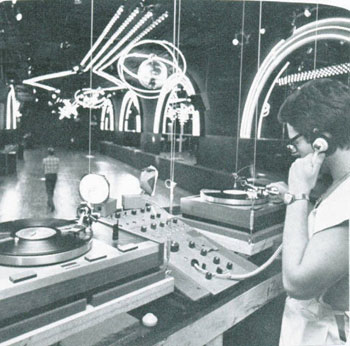
Now what I wonder is who were the first DJs to start actually mixing records together in the 70s, and how did the people react.

The pics all over the net are great.

3187d79ea3983a86d91794c2f3c238c6.jpg

Paradise-Garage-DJ-Larry-Levan-by-bill-berstein.jpg

infinity-bobbydj.jpg

deejay-richie-kaczor-and-club-owner-steve-rubell-in-the-dj-booth-of-picture-id94135906

Cool Herc in Jamaica started it all in the late 60's and then brought it to America in 73. Guys like Grand Master Flash and Afrika Bambaataa really put it on the map. Because of the Zulunation New York avoided allot of gang violence.

On the electronic side it was Larry Levin and Frankie Knuckles that put djing on the map.
 
The SL-1800's manuals (original version) were quite popular with those that could not get their hands on the 1200MK2. My buddy used a set before he go his 1200's in 1985.
 
Yeah, Geminis usually fall into that category. I once bought a Gemini XL-100 demo unit at an electronics surplus sale for $25, primarily because it'd had a Shure M97xE cartridge installed in its headshell. Overall, it was one of the lousiest turntables I've ever used, with cheap plastic parts used for damn near everything. It was apparently marketed to starter DJs, though I have no idea how it'd work too well for the purpose given that it was not only belt-driven, but equipped with an auto-return mechanism. :dunno:
I used to work for Gemini, and they not only werent interested in quality, they werent interested in the dj community. Thats why the tables were rubbish. They kept it that way for the starter djs, and the bodegas that sold them worldwide. Btw, all hanpin turntables. Gemini made nothing of their own. You can see the same equipment with names slapped on them like Gem Sound.
 
Cool Herc in Jamaica started it all in the late 60's and then brought it to America in 73. Guys like Grand Master Flash and Afrika Bambaataa really put it on the map. Because of the Zulunation New York avoided allot of gang violence.

On the electronic side it was Larry Levin and Frankie Knuckles that put djing on the map.
Yeah but was Herc actually mixing records together in the late 60s, or did he just bring the huge street system from Jamaica? I know ror sure hecwas quick mixing in the late 70s, but whT about before that?
 
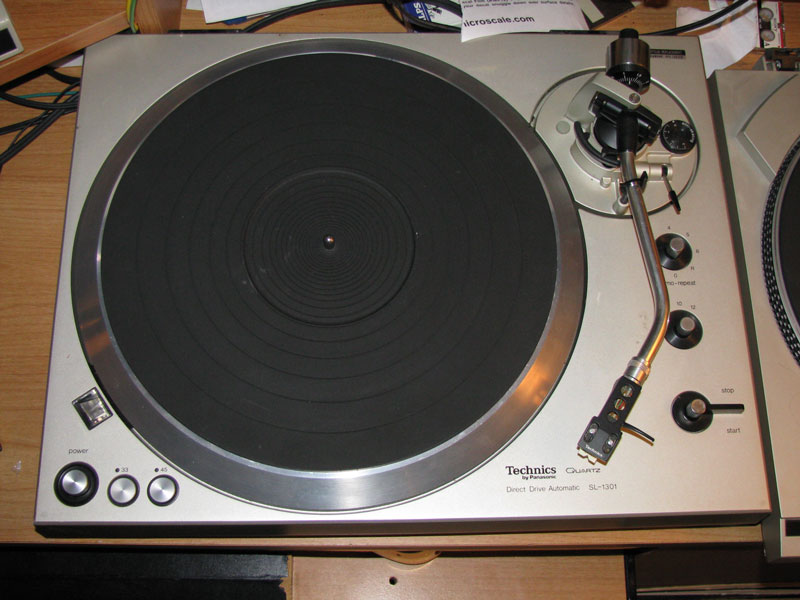
I was given a SL 1401 a few years back and I found it odd that it doesn't have pitch control. I got a new cartridge on it and it sounds great however and the auto return is nice for not having to jump out of the chair.

Most of Technics' quartz-locked turntables which were aimed at the consumer market didn't have an accessible pitch control (there are adjustment pots for 33 and 45 somewhere on the chassis, but they're not meant to be easy to get to). I have a SL-1301, and managed to use it as a rudimentary DJ 'table for a brief period of time (just playing records over a small radio station). I used the main power button as a crude start/stop control.

sl1301.jpg


I used to work for Gemini, and they not only werent interested in quality, they werent interested in the dj community. Thats why the tables were rubbish. They kept it that way for the starter djs, and the bodegas that sold them worldwide. Btw, all hanpin turntables. Gemini made nothing of their own. You can see the same equipment with names slapped on them like Gem Sound.

Thanks for the reply. I figured something like that might be the case. The XL-100 actually makes some of the cheapie BSR record changers look like half-decent turntables (not all of them, though... :rolleyes:). The rebranding thing doesn't surprise me. I found it darkly amusing when I discovered that Esoteric Sound's "Rek-O-Kut Rondine Jr" (second one down) looked remarkably like a modified version of the XL-100, yet they're trying to get $325 for it. I also wouldn't be surprised if the first "Rek-O-Kut" listed on that page was also Hanpin-sourced. :idea:
-Adam
 
First you have to understand that the definition of a DJ table in the 1970's and early 80's is different than the definition of one today. For the most part, the concept of a turntablist (one who uses the turntable more like an instrument than a playback device) didn't exist. A DJ turntable then was intended mostly as a playback unit in a professional environment...like a radio station, or disco/dance hall. They typically were armed with 'broadcast cartridges' that tracked at around 3 grams, with stiff cantilevers that could take the rigors of back-cueing (finding the start of a song, then turning the platter back a quarter or half turn to accomodate wind-up time to playing speed...then hitting 'start' with careful manual timing to produce a great, tight segue or overlap on fade) and slip-cueing (having a felt mat underneath the record and letting the platter spin below that, holding the record stationary at milliseconds before the first beat and letting it go with the same sort of manuall timing aforementioned).

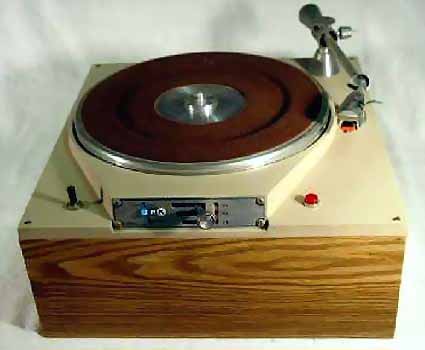
Technics was the primary Japanese player in that market, but it was dominated by industrial decks from manufacturers like Russco, Gates, QRK. Most of those were heavy duty units that were all metal, idler drive with heavy duty transmissions. Most shipped without tonearms, which were selected and installed by the station engineer seperately. They were designed to run 24 hours a day for years and years on end, and had pretty decent specs as well. There's a cult following of those old units now. Sadly, most were sent to the landfill by the truckload when the CD player, then mp3's took over.

I'm pretty sure that several other Japanese companies tried to get a piece of that market but no one other than Technics ever made any real impact on the industry.

To my knowledge, pitch was something introduced to the pro industry by Technics. I don't recall any of the other broadcast tables having such an adjustment, at least from the end user perspective.

A QRK turntable
QRK-12.jpg

Well said.... you spoke as a "learned pro".!
 
Recently... I did see a rather impressive 21st Century, DJ console at a High School Prom. It had the notable screens for uploading and cueing music via stream or the like. To my surprise it also had the "hallmark" center mixing panel. Of course there were all sorts of digital and LCD screen "bells and whistles" to surely enthrall a "disc jockey" and captivate the current day dance audience :naughty:.

Funny thing... someone complained about the music as too loud and knocking down pictures... I didn't believe it to be loud enough :dunno:.. ?

(Speakers just want to be heard... : )
 
Recently... I did see a rather impressive 21st Century, DJ console at a High School Prom. It had the notable screens for uploading and cueing music via stream or the like. To my surprise it also had the "hallmark" center mixing panel. Of course there were all sorts of digital and LCD screen "bells and whistles" to surely enthrall a "disc jockey" and captivate the current day dance audience :naughty:.

Funny thing... someone complained about the music as too loud and knocking down pictures... I didn't believe it to be loud enough :dunno:.. ?

(Speakers just want to be heard... : )
The beauty of djing now is that you can keep it real with turntables, and if you dont have a song that someone is asking about, you can audition it on youtube, download it, and play it right then and there, while the party music plays undisturbed.
 
Yeah but was Herc actually mixing records together in the late 60s, or did he just bring the huge street system from Jamaica? I know ror sure hecwas quick mixing in the late 70s, but whT about before that?

From the interview I quoted above, ground zero for Kool Herc was a party in 1973, mixing between breaks in different songs. He was 12 when his family emigrated from Jamaica in 1967, so he was still a teen in 1973. He preferred SL-1100As to the later 1200 models, and also Mac amps.
 
Exactly. Technics made special gold decks every year for many years for DMC while the turntables were in production.

I won a few DMC competitions, never quite got the gold though. :dunno:

They did not support the dj community for all the dj community did for them. A gold deck here and there for buying 50,000 tables a month for years on end isn't squat. How long did it take for the mk5 to come out after it was crystal clear it was a dj deck? A decade. It was like they did not like the fact it was a dj deck.
 
They did not support the dj community for all the dj community did for them. A gold deck here and there for buying 50,000 tables a month for years on end isn't squat. How long did it take for the mk5 to come out after it was crystal clear it was a dj deck? A decade. It was like they did not like the fact it was a dj deck.
What is it you expected Technics to do for the DJs?
 
Back
Top Bottom