johnda
Addicted Member
Cambridge Audio AXA 35
A Review By
John Dangelo
I finally took a plunge on a new integrated amplifier after years of using Yamaha receivers. I never had any problems with the Yamahas but was very interested the AXA 35 by Cambridge Audio and purchased it from Crutchfield.
The package was delivered to my door only a day and a half after I ordered it, which is a new record for me! The amp was double packed and the packing was as solid as a rock. After some knife work the inner package was revealed and there were three documents, the most important one was a quick start guide. Along with the amplifier, there was a power cord and a remote which uses very small GP batteries.
The quick start manual had instructions on how to get a full owner's manual and I recommend that you download a copy for yourself. Here are the instructions from Cambridge:
“To get the best performance from your
AXA35/AXC35 please read the online
manual. For more information
visit our website”
http://techsupport.cambridgeaudio.com
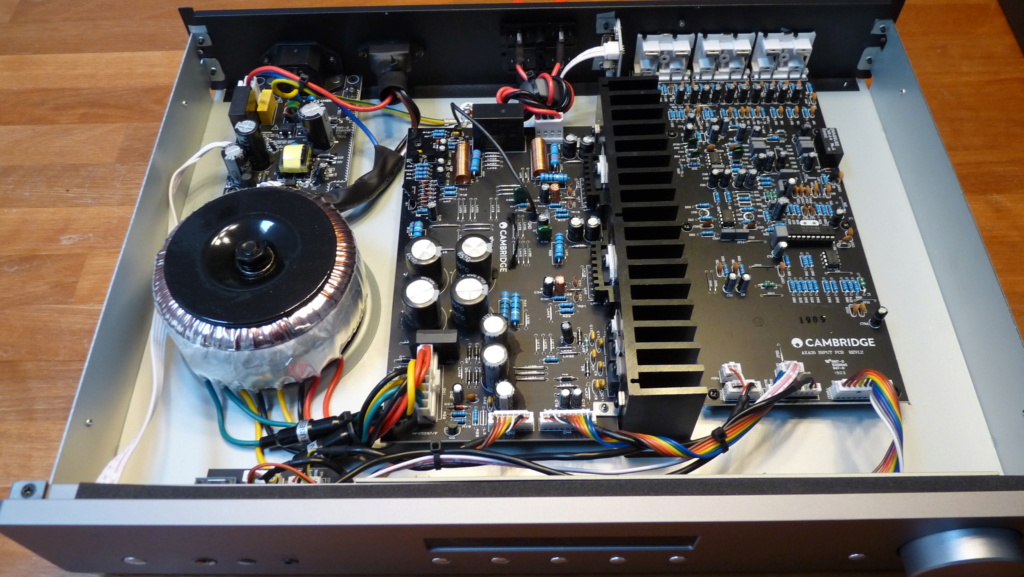
The AXA 35 is a compact integrated amplifier 3.3” High, 16.9” wide, and 13.2” deep. It weighs 12.3 pounds. There are four line inputs, one dedicated phono input and one line output. It only feeds one pair of speakers. It puts out 35 watts per channel into 8 ohm impedance speakers at very low distortion from 20-20K . There is a front display that gives you the source, and as you adjust the power it is also indicated there. Adjustments such as bass and treble can also show, but they are controlled by the remote. The front panel also has four buttons for the sources including the phonograph, and a large volume control. I used the remote for all functions because I have a mobility problem. The amplifier has an unusual base. It gives you the impression that it is floating above the shelf by about an inch, very interesting!
The AXA 35 costs $350.
The AXA 35 is like a slim 5'2” guy you meet at a tennis match and he then beats your brains out !
My current system configuration is now:
Unit Input
Audio Engine B1 Bluetooth adaptor. (A1)
Sony SDHR HD am/fm tuner. (A2)
Denon CD Player. (A3)
Denon DP300F Turntable (Phono)
Pioneer BS 22 LR Speakers, 6 ohms impedance
OK, that's the system and it is dependent on the Cambridge amplifier, so how does it sound?
In a word “Beautiful!”
When I first turned on the system I used bluetooth and tuned to Linn Classical in Edinburgh Scotland. As I listened, I said to myself “Now this sounds like a true British amplifier!” The sound was open, clean, and mesmerizing. It reminded me of great gear from my past.
The amplifier's design offices are located in London UK, and it is constructed in China. My study is only 11x12 so the 35 clean watts per channel were plenty for my listening. I could see this amp working with Klipsch LaScalas or other high efficiency 8 ohm impedance speakers perfectly.
One point; the amp's volume indicator uses -Db as the display so it reads inversely from our percentage displays. The highest power display is zero and the numbers go up as the volume is reduced. I found that in my study -40,-50 Db was fine for me.
The next day I decided to play some vinyl. I have a good number of albums, around 100, that I treated well and quite a few were from the Musical Heritage Society; the two albums I chose were:
MHS 1596
Concerto for Harp and Orchestra by Francois Adrien Boieldieu
Concerto No 6 for Harp and Orchestra by Johann Krumpholz
Performed by Lily Laskine and the Jean-Francois Chamber Orchestra
MHS 3775
Serge Rachmaninoff
Rhapsody on a theme of Paganini Op. 43
Piano Sonata No. 2 in B-Flat Minor Op.36
Performed by Martha Naset and the Royal Philharmonic Orchestra
All I can say is that after two solid hours of listening I was totally captivated. I could envision their fingers plucking at the strings or hitting the keys and the music took me out from my study into another realm. That is all I need from my system.
Happy holidays to everybody in our gang. I wish you love, laughter and good health.
Johnd
A Review By
John Dangelo
I finally took a plunge on a new integrated amplifier after years of using Yamaha receivers. I never had any problems with the Yamahas but was very interested the AXA 35 by Cambridge Audio and purchased it from Crutchfield.
The package was delivered to my door only a day and a half after I ordered it, which is a new record for me! The amp was double packed and the packing was as solid as a rock. After some knife work the inner package was revealed and there were three documents, the most important one was a quick start guide. Along with the amplifier, there was a power cord and a remote which uses very small GP batteries.
The quick start manual had instructions on how to get a full owner's manual and I recommend that you download a copy for yourself. Here are the instructions from Cambridge:
“To get the best performance from your
AXA35/AXC35 please read the online
manual. For more information
visit our website”
http://techsupport.cambridgeaudio.com
The AXA 35 is a compact integrated amplifier 3.3” High, 16.9” wide, and 13.2” deep. It weighs 12.3 pounds. There are four line inputs, one dedicated phono input and one line output. It only feeds one pair of speakers. It puts out 35 watts per channel into 8 ohm impedance speakers at very low distortion from 20-20K . There is a front display that gives you the source, and as you adjust the power it is also indicated there. Adjustments such as bass and treble can also show, but they are controlled by the remote. The front panel also has four buttons for the sources including the phonograph, and a large volume control. I used the remote for all functions because I have a mobility problem. The amplifier has an unusual base. It gives you the impression that it is floating above the shelf by about an inch, very interesting!
The AXA 35 costs $350.
The AXA 35 is like a slim 5'2” guy you meet at a tennis match and he then beats your brains out !
My current system configuration is now:
Unit Input
Audio Engine B1 Bluetooth adaptor. (A1)
Sony SDHR HD am/fm tuner. (A2)
Denon CD Player. (A3)
Denon DP300F Turntable (Phono)
Pioneer BS 22 LR Speakers, 6 ohms impedance
OK, that's the system and it is dependent on the Cambridge amplifier, so how does it sound?
In a word “Beautiful!”
When I first turned on the system I used bluetooth and tuned to Linn Classical in Edinburgh Scotland. As I listened, I said to myself “Now this sounds like a true British amplifier!” The sound was open, clean, and mesmerizing. It reminded me of great gear from my past.
The amplifier's design offices are located in London UK, and it is constructed in China. My study is only 11x12 so the 35 clean watts per channel were plenty for my listening. I could see this amp working with Klipsch LaScalas or other high efficiency 8 ohm impedance speakers perfectly.
One point; the amp's volume indicator uses -Db as the display so it reads inversely from our percentage displays. The highest power display is zero and the numbers go up as the volume is reduced. I found that in my study -40,-50 Db was fine for me.
The next day I decided to play some vinyl. I have a good number of albums, around 100, that I treated well and quite a few were from the Musical Heritage Society; the two albums I chose were:
MHS 1596
Concerto for Harp and Orchestra by Francois Adrien Boieldieu
Concerto No 6 for Harp and Orchestra by Johann Krumpholz
Performed by Lily Laskine and the Jean-Francois Chamber Orchestra
MHS 3775
Serge Rachmaninoff
Rhapsody on a theme of Paganini Op. 43
Piano Sonata No. 2 in B-Flat Minor Op.36
Performed by Martha Naset and the Royal Philharmonic Orchestra
All I can say is that after two solid hours of listening I was totally captivated. I could envision their fingers plucking at the strings or hitting the keys and the music took me out from my study into another realm. That is all I need from my system.
Happy holidays to everybody in our gang. I wish you love, laughter and good health.
Johnd