Hey folks, so-a while ago I got a set of Kef C75 speakers, they have the uni-Q woofer, with center mounted tweeter. I really like these speakers, but one doesn't sound right, maybe a cross-over issue, maybe not, so they have been temporarily retired. Yesterday, I got a great score at a thrift store, a Kef C40 in great mechanical shape, only one, mind you. I also like the C40 very much. The C40 and the C75 are actually very similar, same size drivers, same max wattage rating, similar frequency response-sonically very similar, to my ear. The major difference is that the C40 is 8 ohm and the C75 is 4 ohm. I would like to run these both out of one channel of a 4 ohm receiver. Any issues in doing this that anyone can tell me about? Perhaps the 4 ohm will be louder, but maybe I can use the balance knob to adjust? Any thoughts appreciated.


-
Feeling lucky? Check out the AK 24th Anniversary Giveaway thread and join in the fun!
You are using an out of date browser. It may not display this or other websites correctly.
You should upgrade or use an alternative browser.
You should upgrade or use an alternative browser.
Advice re hooking up one 8 ohm and one 4 ohm speaker to a 4 ohm receiver
- Thread starter severeear
- Start date
Register to hide this ad

uenjoymyself
Surrender to the flow
This page is for those who don't fully understand how to connect their speakers to their amplifiers to present a safe load to the amplifier. Most people want to connect their speakers in the lowest possible safe load to get the most power from their amplifiers. There will be some speaker/amplifier combinations that will not allow full power to be produced safely. In those instances, there will be two choices. The speakers could be connected to present a load that is unsafe (for example, a 1 ohm load for an amp only capable of driving 2 ohms minimum). This would get more power from the amp but it's also likely to cost the owner $200+ to repair the amp. The better option is to connect the speakers to present a lighter_than_minimum load. The amp won't produce full power and the system won't produce as much SPL as it would with the correct load but it's also going to allow the amp to operate safely and reliably.
Series Connection:
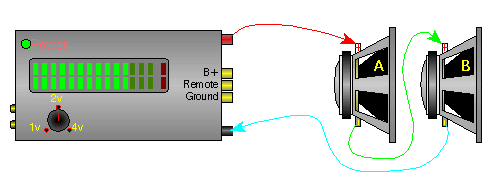
This page will explain how the impedance changes when speakers are connected in series. In a series connection you simply connect the positive terminal of speaker 'A' to positive terminal of the amplifier. Then you connect the negative terminal of speaker 'A' to the positive terminal of speaker 'B'. Lastly connect the negative terminal of speaker 'B' to the negative terminal of the amplifier. If both of the speakers have an impedance of 4 ohms, the total impedance will be 8 ohms. In a series connection, you simply add the individual impedances. If there were two 4 ohm speakers in series, the total impedance will be 8 ohms.
Parallel Connection:
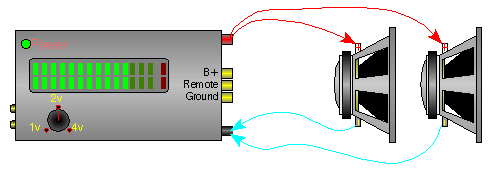
The impedance change with a parallel speaker connection is only slightly more complicated than the series connection. When speakers are connected in parallel, the impedance is reduced. This means that, given the same output voltage, the current demand on the amplifier will be increased. If all speakers have the same impedance, the total impedance is the impedance of a single speaker divided by the total number of speakers. If you have two 4 ohm speakers connected in parallel, the total impedance is 4/2 or 2 ohms. As you can see in the diagram below, all of the positive speaker connections are connected and then connected to the positive terminal of the amplifier. The same is done with all of the negative connections. You must be careful when paralleling speakers onto an amplifier. The impedance can quickly fall below safe levels. This is especially true when connecting speakers in parallel onto a bridged amplifier.
Enter the impedance of the speakers that are connected in parallel.
Data Input:
Speaker one's impedance? = 4 ohms
Speaker two's impedance? =8 ohms
Data Output:
Your two speaker's parallel impedance = 2.667 ohms
Your speaker wired in series = 12 ohms too high
Your speaker wired in parallel = 2.667 too low
Do yourself a favor and get either another 8 ohm speaker or another 4 ohm speaker and be kind to your amp.
2x 4 0hms in series= 8 ohms should suffice.
2x 8 in parallel=4 bingo!
And why do you want to use only one channel?
Uenjoy
Series Connection:
This page will explain how the impedance changes when speakers are connected in series. In a series connection you simply connect the positive terminal of speaker 'A' to positive terminal of the amplifier. Then you connect the negative terminal of speaker 'A' to the positive terminal of speaker 'B'. Lastly connect the negative terminal of speaker 'B' to the negative terminal of the amplifier. If both of the speakers have an impedance of 4 ohms, the total impedance will be 8 ohms. In a series connection, you simply add the individual impedances. If there were two 4 ohm speakers in series, the total impedance will be 8 ohms.
Parallel Connection:
The impedance change with a parallel speaker connection is only slightly more complicated than the series connection. When speakers are connected in parallel, the impedance is reduced. This means that, given the same output voltage, the current demand on the amplifier will be increased. If all speakers have the same impedance, the total impedance is the impedance of a single speaker divided by the total number of speakers. If you have two 4 ohm speakers connected in parallel, the total impedance is 4/2 or 2 ohms. As you can see in the diagram below, all of the positive speaker connections are connected and then connected to the positive terminal of the amplifier. The same is done with all of the negative connections. You must be careful when paralleling speakers onto an amplifier. The impedance can quickly fall below safe levels. This is especially true when connecting speakers in parallel onto a bridged amplifier.
Enter the impedance of the speakers that are connected in parallel.
Data Input:
Speaker one's impedance? = 4 ohms
Speaker two's impedance? =8 ohms
Data Output:
Your two speaker's parallel impedance = 2.667 ohms
Your speaker wired in series = 12 ohms too high
Your speaker wired in parallel = 2.667 too low
Do yourself a favor and get either another 8 ohm speaker or another 4 ohm speaker and be kind to your amp.
2x 4 0hms in series= 8 ohms should suffice.
2x 8 in parallel=4 bingo!
And why do you want to use only one channel?
Uenjoy
Last edited:

2manyspkers
Well-Known Member
Hey folks, so-a while ago I got a set of Kef C75 speakers, they have the uni-Q woofer, with center mounted tweeter. I really like these speakers, but one doesn't sound right, maybe a cross-over issue, maybe not, so they have been temporarily retired. Yesterday, I got a great score at a thrift store, a Kef C40 in great mechanical shape, only one, mind you. I also like the C40 very much. The C40 and the C75 are actually very similar, same size drivers, same max wattage rating, similar frequency response-sonically very similar, to my ear. The major difference is that the C40 is 8 ohm and the C75 is 4 ohm. I would like to run these both out of one channel of a 4 ohm receiver. Any issues in doing this that anyone can tell me about? Perhaps the 4 ohm will be louder, but maybe I can use the balance knob to adjust? Any thoughts appreciated.
If getting another speaker that matches , at least in rating is out of the question another potential option might work.
You will need to check the specs on the receiver, some units can drive 2 sets of speakers one at 4 ohms and the other at 8 ohms, if the receiver can do this in theory you could connect the 4ohm to speaker A right and connect the 8 ohm to speaker B left than run with both A and B speaker sets.
Uenjoy, thanks for the reply.just wanted to clear something up. I am aware of all the info you posted on parallel and series connections and effect on impedance. By 4 ohm receiver, I was referring to a receiver that could accept two 4 ohms speakers in either the A or B channel. So, I guess I should have referred to the receiver as a 2 ohm receiver, capable of accepting two 4 ohm speakers in parallel. Part of the mixup here is also about semantics. The A or B channel is called a channel and so is the left or right channel within the A or B channel. I have no intention of hooking the speakers up to just one left or right channel. 2manyspkrs, thanks also. Regarding your comment, I thought of this as a possibility, but what difference would it make to use both the A and B channel versus just using either the A or B channel. By the way, the receiver can only accept two pairs of 8 ohm speakers anyway when using both A and B channels. But, if you are only using your setup suggestion with one speaker in each channel, wouldn't the total impedance be 2.667 the same as witing them in parallel in either the A or B channel. .
2manyspkers
Well-Known Member
The one variable to consider is the wiring in the receiver itself and how the A / B speaker outputs are wired, they can also be wired in series or in parallel.
If wired in series, your total power decreases by about half when you switch from "A" to "A+B." Four speakers then share this lower output. Your overall volume will decrease, but impedance will increase so the amp runs cooler and is less likely to overheat.
If wired in series, your total power decreases by about half when you switch from "A" to "A+B." Four speakers then share this lower output. Your overall volume will decrease, but impedance will increase so the amp runs cooler and is less likely to overheat.

likebike23
Addicted Member
I'm certainly no expert on this topic so excuse me if my reply is nonsense. Could you run a resistor on the 4 ohm speaker to increase its impedance?
2manyspkers
Well-Known Member
If the receiver can run a pair of 4ohm speakers then you should be fine either way, you will not be going below the impedance the receiver can handle .

What receiver is it?
McIntosh MA-6100
Update: thanks all for the input. Changed the setup some. Instead of using a receiver, have the speakers hooked up to Acurus L10 pre amp, Yamaha MX830 power amp, Oppo DV-981HD (using as CD player). Sounds freakin' fantastic (a sub wouldn't hurt, but soundstage, depth and detail wondrous), with only slight balance adjustment needed. BTW, this Acurus pre kicks butt, even without a phono input and no EQ. If you can get your hands o one, do it-a great example of sacrificing features to produce beauteous sound at a decent price. Matching speakers??!!, We don't need no stinkin' matching speakers!! Cheers
2manyspkers
Well-Known Member
Sounds like you're sold on the Acurus L10, they also make a preamp ACT 3 that looks like a pretty nice unit and of course some amplifiers too. Rock on !
Thanks for the tip, I'll check it out.Sounds like you're sold on the Acurus L10, they also make a preamp ACT 3 that looks like a pretty nice unit and of course some amplifiers too. Rock on !