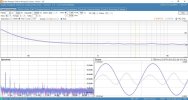
Analog Discovery 2 test results for various tube amps

BmWr75

Top octave? pfffffftttttt
Subscriber
 

Attachments

  • 1 - thd vs frequency.JPG
    1 - thd vs frequency.JPG
    91 KB · Views: 67
  • 3 - thd vs power.JPG
    3 - thd vs power.JPG
    80 KB · Views: 60
  • 5 - frequency response.JPG
    5 - frequency response.JPG
    62.3 KB · Views: 54
  • 6 - sine wave.JPG
    6 - sine wave.JPG
    48.7 KB · Views: 55
  • 7 - square wave.JPG
    7 - square wave.JPG
    45.9 KB · Views: 60
Last edited:
Register to hide this ad
Analog Ethos Exordium EL84 SE amp

THD vs. Frequency sweep starts at 40 Hz because THD >25% at lower frequencies. Most amps start at 20 Hz.
 

Attachments

  • 1 - THD vs Frequency.JPG
    1 - THD vs Frequency.JPG
    89.6 KB · Views: 32
  • 4 - Sine wave.JPG
    4 - Sine wave.JPG
    47.6 KB · Views: 29
  • 3 - Frequency response.JPG
    3 - Frequency response.JPG
    62.1 KB · Views: 27
  • 2 - THD vs Power.JPG
    2 - THD vs Power.JPG
    80.7 KB · Views: 28
  • 5 - Square wave.JPG
    5 - Square wave.JPG
    44.9 KB · Views: 33
Last edited:
South Florida Audio Society EL84 Push/Pull amp

This amp hits 2% THD at about 2.4 watts. disappointing for a P-P EL84 amp. The small OPTs may have something to do this this, looks like the original OPTs were kept.

Edit: these results are erroneous due to a measurement error issue caused by powering off a USB connection instead of an optional 5V PSU.
 

Attachments

  • 1 - THD vs Frequency.JPG
    1 - THD vs Frequency.JPG
    94.9 KB · Views: 19
  • 2 - THD vs Power.JPG
    2 - THD vs Power.JPG
    80.8 KB · Views: 20
  • 3 - Frequency Response after balance adjustment.JPG
    3 - Frequency Response after balance adjustment.JPG
    63 KB · Views: 16
  • 4 - Sine Wave.JPG
    4 - Sine Wave.JPG
    48.7 KB · Views: 17
  • 5 - Square Wave.JPG
    5 - Square Wave.JPG
    46.9 KB · Views: 20
Last edited:
Skunkie Designs 5751/EL34 SE amp
 

Attachments

  • 1 - THD vs Frequency - EL34 power tubes.JPG
    1 - THD vs Frequency - EL34 power tubes.JPG
    92.1 KB · Views: 34
  • 4 -  Sine Wave.JPG
    4 - Sine Wave.JPG
    48.2 KB · Views: 31
  • 3 - Frequency Response.JPG
    3 - Frequency Response.JPG
    59.6 KB · Views: 30
  • 2 - THD vs Power.JPG
    2 - THD vs Power.JPG
    82.7 KB · Views: 32
  • 5 -  Square Wave.JPG
    5 - Square Wave.JPG
    46.6 KB · Views: 35
Last edited:
Skunkie Designs 2A3 SET amp
 

Attachments

  • 1 - THD vs Frequency.JPG
    1 - THD vs Frequency.JPG
    92.5 KB · Views: 27
  • 2 - THD vs Power.JPG
    2 - THD vs Power.JPG
    82.3 KB · Views: 27
  • 5 - Square Wave.JPG
    5 - Square Wave.JPG
    44.3 KB · Views: 27
  • 4 - Sine Wave.JPG
    4 - Sine Wave.JPG
    48.5 KB · Views: 27
  • 3 - Frequency Response.JPG
    3 - Frequency Response.JPG
    62.8 KB · Views: 25
Last edited:
Reisong A12 - 12AX7/EL34 SE amp - BEFORE Skunkie Designs mods performed

Could not get THD vs. Frequency or THD vs. Power to run - THD too high (>25% at least up to 100 Hz) in stock form. Tested with PSVane tubes that came with it. This amp measures terrible in stock form.
 

Attachments

  • 3 - Frequency response.JPG
    3 - Frequency response.JPG
    62.8 KB · Views: 23
  • 4 - Sine wave.JPG
    4 - Sine wave.JPG
    54.9 KB · Views: 22
  • 5 - Square wave.JPG
    5 - Square wave.JPG
    54.1 KB · Views: 23
Last edited:
Reisong A12 - 12AX7/EL34 SE amp - AFTER Skunkie Designs mods performed

Tested with PSVane tubes that came in it.
 

Attachments

  • 1 - THD vs. Frequency.JPG
    1 - THD vs. Frequency.JPG
    93.1 KB · Views: 28
  • 2 - THD vs Power.JPG
    2 - THD vs Power.JPG
    81.1 KB · Views: 30
  • 5 - Square wave.JPG
    5 - Square wave.JPG
    48.1 KB · Views: 28
  • 4 - Sine wave.JPG
    4 - Sine wave.JPG
    49 KB · Views: 27
  • 3 - Frequency response.JPG
    3 - Frequency response.JPG
    62 KB · Views: 30
Last edited:
Magnavox console pull EL84 SE amp - built by an AK member (forget the username right now)

THD vs. Frequency sweep starts at 50 Hz because THD >25% at lower frequencies. Most amps start at 20 Hz.
 

Attachments

  • 1 - THD vs Frequency starting at 50 Hz.JPG
    1 - THD vs Frequency starting at 50 Hz.JPG
    93.7 KB · Views: 20
  • 2 - THD vs Power.JPG
    2 - THD vs Power.JPG
    81.8 KB · Views: 23
  • 3 - Frequency Response.JPG
    3 - Frequency Response.JPG
    61.4 KB · Views: 17
  • 4 - Sine Wave.JPG
    4 - Sine Wave.JPG
    46.8 KB · Views: 16
  • 5 - Square Wave.JPG
    5 - Square Wave.JPG
    45.3 KB · Views: 21
Last edited:
RCA console pull EL84 SE amp - restored by me

THD vs. Frequency sweep starts at 40 Hz because THD >25% at lower frequencies. Most amps start at 20 Hz.
 

Attachments

  • 2 - THD vs. Frequency pull 2 - black plate Baldwin power tubes.JPG
    2 - THD vs. Frequency pull 2 - black plate Baldwin power tubes.JPG
    111.5 KB · Views: 16
  • 3 - THD vs Power.JPG
    3 - THD vs Power.JPG
    100.5 KB · Views: 16
  • 4 - Frequency Response.JPG
    4 - Frequency Response.JPG
    79.2 KB · Views: 16
  • 5 - Sine Wave.JPG
    5 - Sine Wave.JPG
    60.3 KB · Views: 18
  • 6 - Square Wave.JPG
    6 - Square Wave.JPG
    59.8 KB · Views: 17
Last edited:
Decware Zen Triode SEUFO2.1

This is the only EL84/6BQ5 based amp I have tested so far that can start the THD vs. Frequency sweep at 20 Hz. Most have to start at 40-50Hz to get the THD below 25% (an Analog Discovery 2 internal safety cut-off limit).
 

Attachments

  • 1 - THD vs Frequency.JPG
    1 - THD vs Frequency.JPG
    91.9 KB · Views: 26
  • 2 - THD vs Power.JPG
    2 - THD vs Power.JPG
    80.3 KB · Views: 25
  • 3 - Frequency response.JPG
    3 - Frequency response.JPG
    63.2 KB · Views: 23
  • 4 - Sine wave.JPG
    4 - Sine wave.JPG
    48.8 KB · Views: 24
  • 5 - Square wave.JPG
    5 - Square wave.JPG
    48.2 KB · Views: 26
Last edited:
Harmon Kardon Trio A224 integrated (1959 vintage push/pull EL84)

Had to use the balance knob to get the Sine waves to match up. Ended up setting it to about 1:30 o'clock. Can't remember what EL84s are installed in this amp, but that might have something to do with the channel imbalance and other differences shown below. Also have no idea what is causing the weirdness on the THD vs. Power chart starting at about 3.5 watts, but it is coming from the Input Signal (green line). I've seen this strange behavior before testing other amps.
 

Attachments

  • 1 - THD vs Frequency.JPG
    1 - THD vs Frequency.JPG
    93.8 KB · Views: 16
  • 2 - THD vs Power.JPG
    2 - THD vs Power.JPG
    82.2 KB · Views: 14
  • 3 - Frequency response.JPG
    3 - Frequency response.JPG
    62.7 KB · Views: 14
  • 4 - Sine wave.JPG
    4 - Sine wave.JPG
    48.7 KB · Views: 15
  • 5 - Square wave.JPG
    5 - Square wave.JPG
    43.4 KB · Views: 16
Last edited:
Just a minor point, the "T" in SET stand for triode. I don't think any of the above amps apart from the Legendarium use triode or triode-connected outputs, they are either SEUL or SEP.
 
Just a minor point, the "T" in SET stand for triode. I don't think any of the above amps apart from the Legendarium use triode or triode-connected outputs, they are either SEUL or SEP.
You are correct. Will fix that error. Too much copy/paste going on. :)
 
Last edited:
Can you post a loop-back of the analyzer (generator out to analogue in), so we know what we are dealing with here? Or is that in another thread? What is its inherent flatness across the bandwidth, what is the measurement BW, any weighting? Isn't the gen a 14bit DAC AWG?
 
Can you post a loop-back of the analyzer (generator out to analogue in), so we know what we are dealing with here? Or is that in another thread? What is its inherent flatness across the bandwidth, what is the measurement BW, any weighting? Isn't the gen a 14bit DAC AWG?
Don't currently know if the loopback test can be done. Will read up on that and report back.

Here are the specs for the AD2: https://www.digikey.com/en/product-...nGHeSS844vH1cL0ZLfIOTy2t3pTMropRoCUlkQAvD_BwE
 
Wondering what the ringing (squiggle) is on the square wave at the top of the rise is. I have seen this before with tube amps. Does it matter, and can it be minimized? Paul.
 
Wondering what the ringing (squiggle) is on the square wave at the top of the rise is. I have seen this before with tube amps. Does it matter, and can it be minimized? Paul

Are you asking about a specific amp shown above?
 
They all seem to have it more or less except the 2A3 SET. The SFAS EL43 PP seems most prominent. Paul.

Here is what Google AI says about overshoot and ringing (cannot vouch for the accuracy):

Ringing in a tube amp's square wave output is caused by instability from unwanted high-frequency oscillations. This happens when the fast-rising square wave interacts with the circuit's stray inductance and capacitance, creating a resonant circuit that overshoots and oscillates. Key causes include poor power supply filtering, improper grounding, and issues with feedback networks or component placement.

Causes of ringing
  • Oscillations from fast signal changes: The sharp rise and fall of a square wave can excite the natural resonant frequencies of the circuit. This is due to the interaction of stray inductance and capacitance in the wiring, components, and layout of the amplifier.
  • Inadequate power supply filtering: A noisy or poorly regulated power supply can introduce unwanted signals onto the power rails. If the bypass capacitors are ineffective or faulty, this noise can feed back into the amplifier's signal path, leading to instability.
  • Poor grounding: Improper grounding can create ground loops or allow noise from the high-power output stages to feed back into the sensitive input stages, causing high-frequency oscillations.
  • Instability in feedback loops: Tube amps often use negative feedback to control gain and reduce distortion. However, the feedback loop can become unstable at higher frequencies. This is often caused by a missing or incorrectly valued Miller compensation capacitor, which is designed to limit bandwidth and prevent oscillation.
  • Component or layout issues: Poor component placement, long wires, or components too close to each other can create unintended capacitive and inductive coupling, forming parasitic resonant circuits.
 
Back
Top Bottom