Audio cables for older equipment

duckpin76

Active Member
I’m sure this has been brought up elsewhere but I don’t know the best way to ask this.

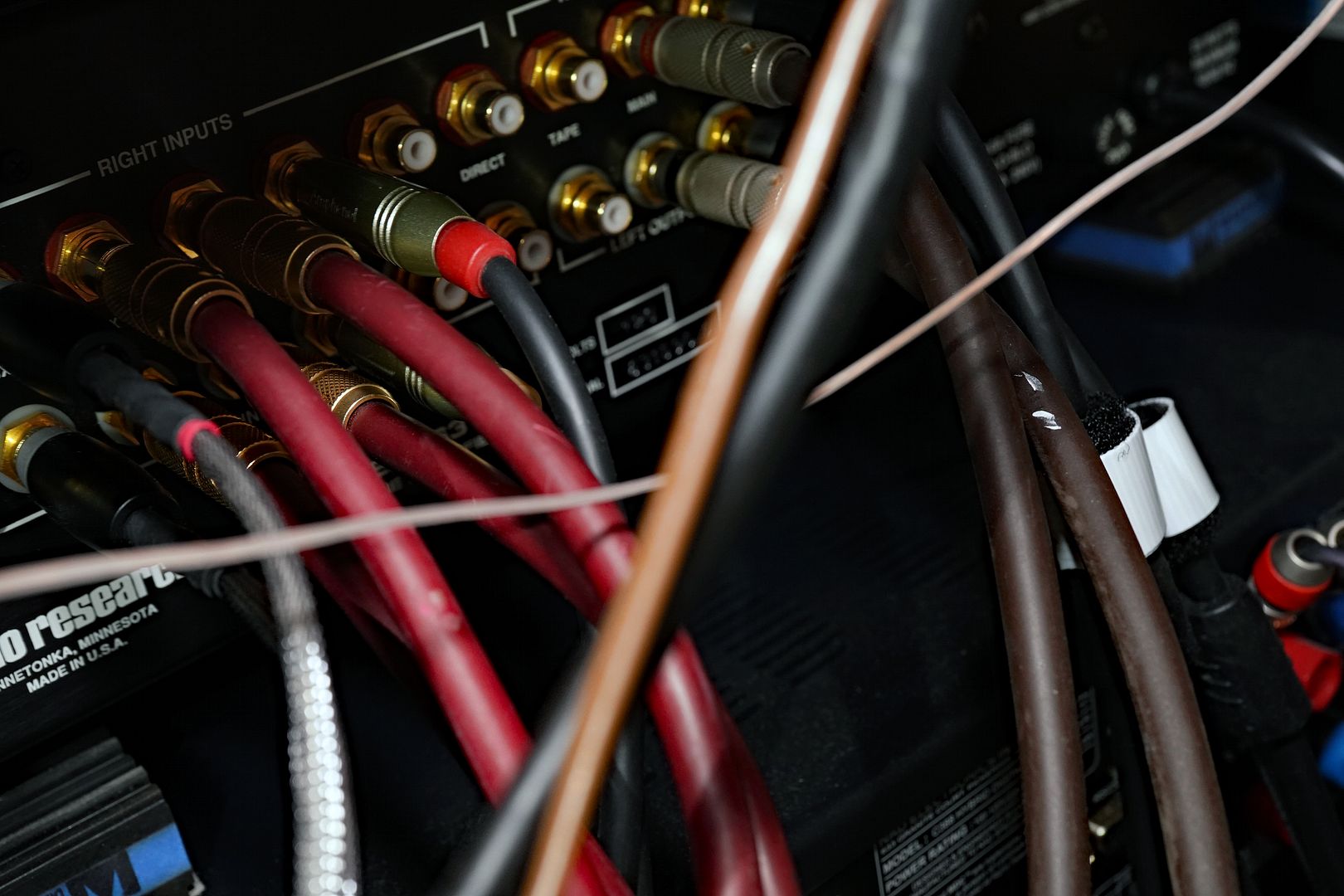
I have older amps/receivers (Pioneer QX9900 and 949; McIntosh MA-5100) and I am finding that the audio inputs on all three, especially the 9900 and 5100, are really close together. My newer cables in some cases do not fit one on top of the other (R/L). Can anyone suggest some component cables that have skinnier “inputs” for lack of a better word so these will have more breathing room?

Thanks,
Brian
 
Register to hide this ad
Used these or similar on my SX-828 .


Or

 
Just to clarify, you want RCA cables with smaller diameter male connectors on the ends.

The Fospower cables that geespot posted look about as small in diameter as possible.

But you can make one of your current RCA cables work. If you have a Dremel, use a grinding tip to grind down the "usually" aluminum outer shell along one side to make a flat spot the length of the male connector. If you did that for two male ends (L+R) and aligned the flat sides face to face on the back of the receiver, you will be able to get them to fit. Just be careful to not grind through the outer shell. Maybe grind away 1/2 the thickness first, and then test to see if they will fit.

I had a headphone cable with a 3.5 mm end that was too large in diameter to fit into the recessed jack on my headphones, so I ground the whole outer aluminum shell of the male end down until it was small enough in diameter to fit, works good! But you only need to create a flat spot along one side of both male ends, that is a lot easier to do.
 
Last edited:
Thank you both. @Sandman1221 what I am finding is that it is the rubber part of the RCA cable (usually in red/white, or blue/green) that is not allowing the cables to fit in properly. I am ordering one of those Fospower cables and will see what transpires. Unfortunately I do not own a Dremel so I am hoping for something that will not require surgery!
 
This is a real problem. I've had the best luck with DIY cables or (hides head in shame) cables from Goodwill at $1.99. Obviously these are checked with a meter before being put into use.
 
If you don't mind a little termination work, the Switchcraft 3502a connector is what I've used on Fisher equipment with tight RCA spacing.
 
Last edited:
Thank you both. @Sandman1221 what I am finding is that it is the rubber part of the RCA cable (usually in red/white, or blue/green) that is not allowing the cables to fit in properly. I am ordering one of those Fospower cables and will see what transpires. Unfortunately I do not own a Dremel so I am hoping for something that will not require surgery!
The rubber part should be easy to cut off with a utility knife.
 
Used these or similar on my SX-828 .


Or

I have a few pairs of these cables. They work well, but I find the insulation to be a bit stiff and can unbalance smaller, more lightweight components, which is probably not an issue with vintage gear.
 
Change the existing male plugs, as suggested. Or make six or eight inch patch cords with smaller male ends.
 
I’m sure this has been brought up elsewhere but I don’t know the best way to ask this.

I have older amps/receivers (Pioneer QX9900 and 949; McIntosh MA-5100) and I am finding that the audio inputs on all three, especially the 9900 and 5100, are really close together. My newer cables in some cases do not fit one on top of the other (R/L). Can anyone suggest some component cables that have skinnier “inputs” for lack of a better word so these will have more breathing room?

Thanks,
Brian
Buy any cheap cables that fit. Then enjoy the music.
 
I’m sure this has been brought up elsewhere but I don’t know the best way to ask this.

I have older amps/receivers (Pioneer QX9900 and 949; McIntosh MA-5100) and I am finding that the audio inputs on all three, especially the 9900 and 5100, are really close together. My newer cables in some cases do not fit one on top of the other (R/L). Can anyone suggest some component cables that have skinnier “inputs” for lack of a better word so these will have more breathing room?

Thanks,
Brian
I like Ohno cables for their sleekness. :)

Ohno Cables.jpg
 
Not to be confrontational, but thats just ridiculous. Buddy is feeding you a line of bull. Whether its intentional or not is another matter.

All that matters for cables is ohms/impedance.

I made my own out of monoprice microphone wire:

IMG_7885.jpeg

Those are about 6 feet each and metered at (IIRC) 0.2 ohms.

Internal construction:

IMG_7884.jpeg

That single 20-ish gauge white carries positive, the black, drain and shield wires were combined for the neg.

The ends:

IMG_7881.jpeg

Those were very affordable ebay purchases.

Installed on the rca switch:

IMG_7895.jpeg

System is dead quiet.

As a matter of fact, running all my diy cables seemed to “fix” a bit of a channel imbalance on the left. Not that the cables are “magic”, its more probable that there was something wrong with the store bought cables I was using, even though they metered fine.

I’ve always been a solid proponent of the old maxim: “If you want something done right, do it yourself.”

And I ran about 170-180 feet of interconnects that way. If any system is going to pick up noise, it’s going to be my 15+ foot runs and they’re dead quiet.

No coax, not “special shielding”, no “vintage for vintage”, no 300-400 dollar (or more!) cables.

In fact, I’ve only got about $320-350 into the whole 170-odd feet of it.

There’s a lot of misinformation around interconnect cables floating around the “audiophile” internet.

As long as they carry the signal they’re good.
 
Last edited:
:crazy: Not to me at all...but whatever.
I'm still using my 1990s-era Audioquest puppies. Connectivity is still good. Not sure if the bandwidth is the same. :idea:

56095d21-8038-4c00-aba3-eafb9d5c77ac.jpg
 
These HOSA cables with the rean silver ends work well on my Pioneer stuff like sx-9000 or old scott amps where the RCA's are close together. They are also slightly oval so you can put the narrow sides together

hosa cables
 
Last edited:
Back
Top Bottom