Average temperature of Class A amp

Vistance

Super Member
I just picked up a Monarchy SM70 Pro amplifier based on advice here and some other factors, and this is a pure Class A amplifier rated at 25 wpc @ 8 ohm stereo. My question is, how hot is normal for a Class A amp?

I've heard "If it's hot enough to fry an egg, it's too hot" but that's not super useful to me since I don't feel like getting a pan and trying that out. I know heat is the natural enemy of electronics, but is it as bad for a Class A amp or are they more built to handle it? According to my amp's manual, it's made to run hot like this and can stand a lot of abuse so I'm probably worrying for nothing. Just would like to know if it's shortening the life by being hot.

Should I put a fan on it to cool it, or is that necessary? I had a Pioneer M-22 which was a 30 wpc class A monster but I swear it didn't ever seem to get that hot. A reviewer stated the amp gets "a little warm, but nothing to worry about" but I'd say this is hot not warm. Warm is just "Oh, this amp is on - yup feel the heat", it's more like "Wow that's hot for an amp" when I touch it. Not so hot that I have to pull away, but definitely not just warm. What temperature do you actually need to fry an egg anyway?

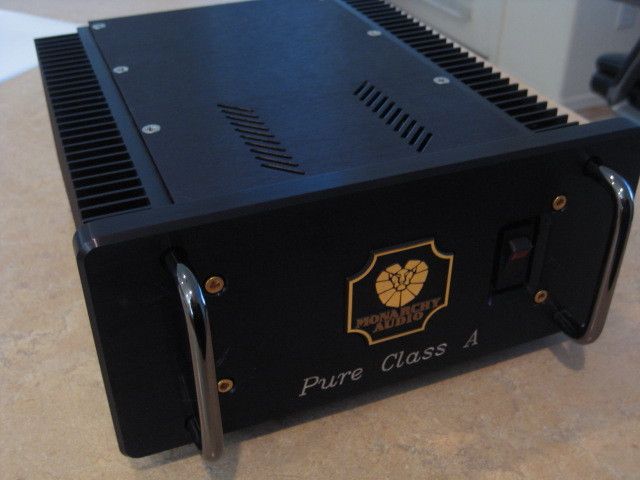
Pic of what the amp looks like if it matters (It's not a full size amp, only 11" x 4.5" x 13" - W x H x D)
108789-monarchy_audio_sm70_pro_superb_monoblocks_pair.jpg
 
Last edited:
Register to hide this ad
It all depends on the people who designed it.

Bigger heatsinks = lower temperatures.

Heat is the killer of electronics, doesn't matter if it is class A, AB, AAB, D or whatever. The most common problem associated with heat, is bad solder joints, but those can be fixed rather easily.

If you feel it's getting too hot for your personal comfort, or if you want to reduce the risk of failure, use fans, especially on hot summer days.

Edit: looks very well built!
 
Last edited:
if its getting too hot for you turn up the volume it might just run cooler .
by the looks of those heat sinks it will run fairly warm .
 
Some class A amps run in excess of 145 degrees F. I can tell you that at 140 degrees, you will not hold your hand on it without getting burned. Consider that amplifiers running at these temperatures move considerable amounts of air from natural convection currents, provided they are placed properly.

Well designed class A amps won't cook components any faster than any other amplifier. By design, most of the board mounted components benefit from the draft induced by the natural convection of the unit. I'd go as far as to say that "some" class A amps may actually keep critical components cooler by placing them lower and in the path of fresh incoming chassis air.
 
If you have ever felt the heatsinks on a FirstWatt amp, that's HOT. Monarchy's run merely warm compared to that. Put a small fan on it, don't worry.
 
Man, I'd hate to know what "hot" actually is if this is just considered warm. I think we need a better scale to describe temperatures! I hooked up an NAD C270 amplifier I had which is Class AB and so far it's barely even warm (Or if we use the scale that says my Monarchy is only warm, it's nearly ice cold to the touch :D). So that makes it sound like my wires or speakers are not to blame.

The only other thing I can figure is that my room is small (8' x 8' x 10') and I keep the door closed so maybe my room has poor air circulation that causes any warm/hot running amps to get even hotter then they would otherwise? I've never had a problem with most amps, they usually do like this NAD and just barely heat up. Even hours of playing barely heats them up, I guess because they're made for you to crank it up pretty loud before they actually start getting hot?
 
I take 120mm silent computer fans powered by a 9v wall wart powere adaptor to a switched outlet on all of amps. I simply place them on top of the chassis air pulling out of the chassis. It dramatically makes a differene in temperature.
 
MOSFET Class A amps will always run the hottest of any S.S. amp, for a given wattage.

As alluded to above, my Stax sets up a noticeable draft that you can actually feel when you stick your hand under it.

The output transistors are probably the most heat-tolerant part in an amp. The main concern from a reliability standpoint is keeping the other components cool. Keeping the heatsink fins on the outside of the amp helps, which you'll notice with many Class A amps.
 
Well, what's odd is the fact the heatsinks aren't even the hottest part. It's actually the center of the amp, that metal plate is the hottest part. The heatsinks don't really feel quite as hot. Is that normal, or should the heatsinks be the hottest part?
 
By putting a fan on it, you're screwing with the idle current and not running the amp as intended, possibly hurting performance.

I think you're overthinking this - just use it as it is. Class A is supposed to be hot. I'm sure the designers knew what they were doing (although the zero feedback claim on it suggests otherwise)...
 
Class A amps consume vast amounts of power a 25w per channel will probably make more heat than a 100w per channel class AB amplifier.

Your comment about the heat sinks got me thinking you may want to try some new thermal paste on the transistors and see if that gets the sinks warmer if not then stop thinking about it.
 
Man, I'd hate to know what "hot" actually is if this is just considered warm. I think we need a better scale to describe temperatures! I hooked up an NAD C270 amplifier I had which is Class AB and so far it's barely even warm (Or if we use the scale that says my Monarchy is only warm, it's nearly ice cold to the touch :D). So that makes it sound like my wires or speakers are not to blame.

The only other thing I can figure is that my room is small (8' x 8' x 10') and I keep the door closed so maybe my room has poor air circulation that causes any warm/hot running amps to get even hotter then they would otherwise? I've never had a problem with most amps, they usually do like this NAD and just barely heat up. Even hours of playing barely heats them up, I guess because they're made for you to crank it up pretty loud before they actually start getting hot?
A healhty full class A amplifier should be up to it's maximum operating temperature in 20-30 minutes in a typical listening environment. Examples with more cooling mass might take a bit longer.

A true class A design operates the output devices at full conduction at all times which means it will get just as hot even if no signal is fed to it, and no speakers connected.

In theory, if you could run it at full output power continuously, it would run slightly cooler because you are now dissipating some of it's energy in the form of electricity to the loudspeakers rather than 99.9% of it being given up as heat.
 
I don't know about all Class A. I do have a Yamaha CA-2010 and in Class A, its pretty warm.

"Fry an egg" is just a cliche', it shouldn't actually be that hot.
More like the inside of your car on a hot sunny summer day.

DO make sure it has plenty of open room around it so it gets natural air flow.

IF the heat sinks themselves are not hot all over, its working fine. They are dissipating the heat and have reserve capacity available (the cooler spots).
 
I don't know... I have Unison Research Primo which is (according to their website) 80W RMS on 8Ω Dynamic A Class. Doesn't have huge heat sinks and it's barely warm.....
 
I don't know... I have Unison Research Primo which is (according to their website) 80W RMS on 8Ω Dynamic A Class. Doesn't have huge heat sinks and it's barely warm.....

Dynamic biasing is a whole different beast. More efficient/less waste heat, but more thermal fluctuation (at least theoretically).
 
Ok, so after I dozed off last night and ended up leaving the amp on for hours I touched it and that sucker was really hot. So I decided to test it in the large room in my basement that I had my Threshold where it barely even got warm. I let it play at similar volume levels on the same speakers for almost 2 hours. The Monarchy was very nearly as hot sitting on a bench in the middle of this room which is cooler and has a lot more airflow as my small room. So it does seem that that temperature is at least the normal temperature for that amp.

So why then did the Threshold not even do much more than get warm doing the same thing? Because it's much larger and actually A/AB so it might have been using Class B? I can't see myself having used more than 10 watts on the Threshold, so arguably that should be pure Class A operation anyway.

Also, to a Class A amp - isn't it like a car engine being at full RPM all the time? So it doesn't matter what volume level you're at, it's essentially always giving it its all? I guess to use the car analogy, like taking a car with a stick and revving the RPMs to something like 7k and then when you're playing at low volumes it's like letting the clutch out and then pushing back in and then out and back in very quickly? I hope that makes sense at least in how I'm trying to explain how I think it's operating. To keep going with that, if you're using a class AB amplifier it's like being in first gear for the first few watts and then when it hits class B then you're shifting into the other gears to get the performance - but you give up the responsiveness that you had in first gear, which is kind of how Class A amps operate all the time (except unlike a car in first gear, Class A amps are supposed to have that responsiveness AND the ability to hit the high speeds - not sure of a car example of this, but hopefully this point makes sense too).

Am I close with that analogy? Way off? Just want to understand the differences here better.
 
Last edited:
The monarchy draws 150 watts continuous, which equates to 517 BTU thermal. There are three things at play here- aluminum has a specific heat constant of 0.22 btu/lbm/ degree F, heat transfer will always be slower than heat production with metal, and larger heat sinks will run cooler than smaller heat sinks, all things equal.

Always have a class a amp at the top of an open rack, unless you like spending money.

How does the monarchy sound? That is the important matter.
 
I definitely know to give it air flow, it hasn't had anything stacked on it (not like anything would fit on top of it though since it's small). My initial impressions are good, it sounds pleasant. Though I must admit, after switching from using my receiver's internal amp section, to the Threshold, to the Monarchy, and to the NAD C270 that I was testing last night...I'm not sure how much perceived difference is based on the physical appearance of the amp and how much is actually there. I feel there's a subtle but better sound to the Threshold and Monarchy than the NAD and my receiver, but it's such that if I don't actively try to say "Does this really sound better/worse?" I can't tell.

If such is true (that being that I can't hear differences in amps, or at least not enough to warrant their given prices) then I think I may just be as well suited to buy something that looks cool, is built reasonably well, and is more affordable. SAE comes to mind, I see nice looking amps from them for relatively low prices all the time but more than anything have just heard them not always described positively for their sound. Hell, how did I not immediately hear a Peavey AMR amplifier compared to my Threshold and go "Yuck! Horrible!"? Is my hearing that off, or am I just stuck in the game of buying expensive amps to satiate the feeling that "Yes, I am definitely an audiophile - for look at my amplifier! Clearly someone who isn't an audiophile wouldn't even own one like this!"

I don't mean to derail my own thread, but since this is related to my impression of stereo gear, I do begin to wonder. I think I need to do some direct ABX testing of the Monarchy vs. the NAD, that should highlight the biggest differences. If I can't easily pick out the difference though, does it make sense to buy more expensive amps solely on the premise that "they're supposed to sound better" and not buy cheaper ones because "they're supposed to sound worse"?
 
It depends on how it was designed. This article is good:

http://sound.westhost.com/project3b.htm

"25W Class-A Hi-Fi Power Amplifier"

"At the recommended supply voltage of ±25V DC (nominal) and a quiescent current of 1.5A, each power transistor will dissipate 37.5W, or 75W for the pair in a single channel"

"Total thermal resistance: 2.2°C / W"

"Based on Table 1, each transistor will operate at ...

Tj = Rth * PowerSo ...
Tj = 2.2 * 37.5 = 82.5°C Above Ambient!"

Which means the transistor junction will be about 102.5°C if outside temp is 20°C. The heatsinks will not be as hot, however if it's 75W per channel, a big 0.5°C/W heatsink would be at about 37°C above ambient... that would mean 55°C to the touch (if ambient was 20°C).

Douglas Self mentioned on his chapter on a Class-A amp that this was "his contribution to global warming" :D
 
Back
Top Bottom