Baldwin orga-sonic

Svoad

New Member
I purchased this organ today from a local thrift store for the price of a pizza. The power cord is pretty frayed so unsure if it works. Any info on this amp Model 51-51p?
I have never seen some many 12au7 and 12ax7. All of them labeled Baldwin but some are yellow and orange made in Japan and green made in USA .
Can this amp be converted to be used as stereo amp?
20190205_161451.jpg IMG_20190205_174523_01.jpg
 
Register to hide this ad
The amp is mono so only one output transformer. Plus, you will have to have some electronics background to know how to separate the amp from the chassis.
 
The amp is mono so only one output transformer. Plus, you will have to have some electronics background to know how to separate the amp from the chassis.

Yeah, I definitely need more than the 4 years of high school electronics I had . I pulled everything out of the organ. I even found a 1964 silver quarter!

Underside of the 51p amp .
20190205_184816.jpg
20190205_163103.jpg

20190205_165624.jpg
 
Well, this is interesting. I had the exact same organ, belonged to my grandfather. It was unusable and a restoration made no sense. So I did much the same as you. Between us, we have the makings of a pair of mono blocks! I have no ability to convert them though. I’m curious to know what it would take to have it done by someone since mine would have some sentimental value to it. Maybe someone here will have more info and/or realistic ideas about practicality?
 
I routinely gut them and use the tubes and power supply components to build other stuff. Lots of great audio grade tubes there...
 
Quite a load of commonly used signal tubes. The green ones are typically Sylvania, the Japan ones are possibly Hitachi or Matsushita.
 
Quite a load of commonly used signal tubes. The green ones are typically Sylvania, the Japan ones are possibly Hitachi or Matsushita.


Cool. Thanks for the info. This organ was a total impulse buy. I just purchased a Magnavox 9302 last week . I'm just waiting for a few parts to roll in and I'll be starting it this weekend . So I have tubes on my mind and I see this beast lol. I couldn't past it up for the price .

I don't think I'll need to purchase a 12ua7 or 12ax7 for awhile.
So who makes the Baldwin 6L6's?


20190205_164714.jpg
20190205_213655.jpg
 
A couple of nice 6L6, a bunch of quality 12A_7s, a (IIRC)5U4 Rect, Heafty PT and PP OPT, and IIRC a PS choke. Very useful stuff if you don't need a spinet organ. There is also a bunch of interesting iron in the tone generators that might be useful if you are equiped to ring it out and see what you have. Interesting cores if nothing else if you can wind your own.
 
yep, RCA. The color of that printing alone is enough of a clue, its the same orange RCA used on their own tubes.
 
If there is sentimental value, and the mechanicals are in pretty good shape, then an organ such as that can be a great learning curve and experience to take on. Not many can take on such a diy project, as it requires some bench space (!) and will consume a lot of time, even if experienced. I've restored a somewhat similar Selmer organ.

As indicated, most will buy a vintage valve organ just to part it out, with no interest at all in the history or design of the organ itself.

If you are in to diy valve amps then morphing the amp section is itself a great journey to take, but will require electronics effort unless you can find a forum thread somewhere that can be used as a running start. The amp chassis circuitry can be sketched in to a schematic (there doesn't look to be one on the net) if you have a bit of circuit experience, as valve circuits are pretty similar. The tone gen chassis etc have some parts and hardware worth retaining/salvaging, such as valve bases, pre-folded and punched chassis, and small inductors. I had one batch of small inductors from a Wurlitzer that were excellent for screen and preamp supply filtering. Some circuit sections could be a great start to guitar pedal effects, such as if it had a vibrato section.

 
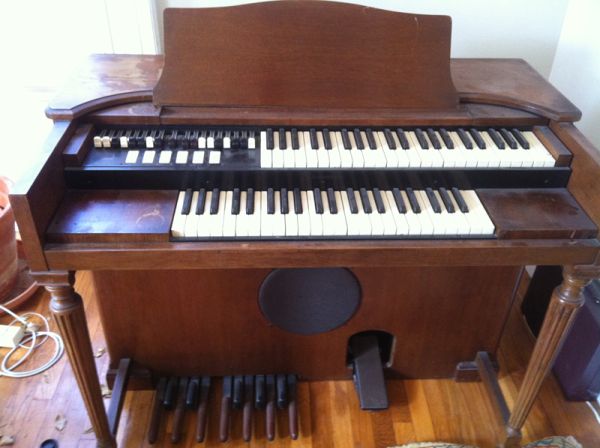
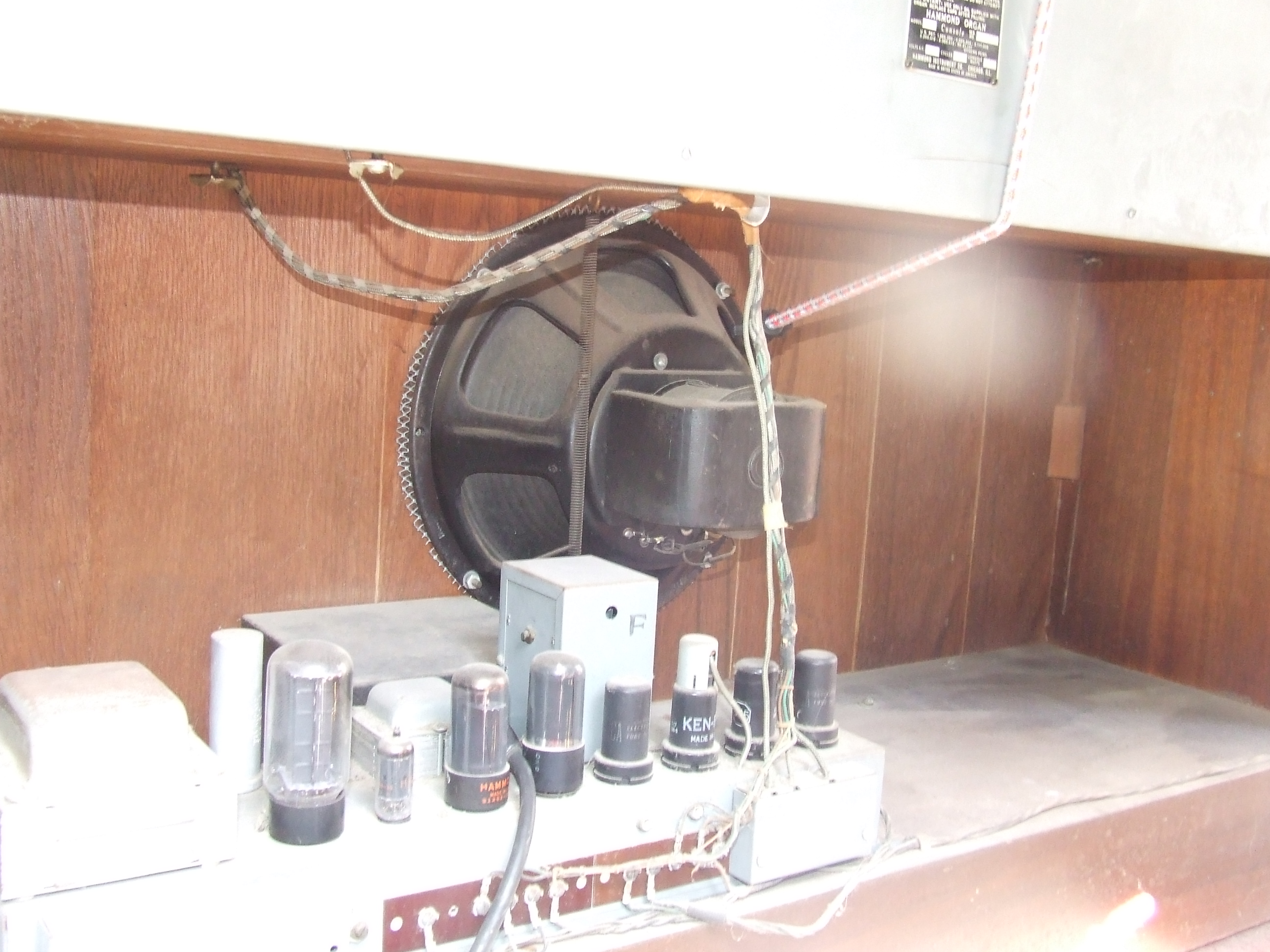
I feel sad when I see older organs like this stripped for their tubes, but understand that not everyone has the room for them, nor the skills to repair any issues which may have come up in 50+ years. I have a few tube-based keyboard instruments in among my collection, particularly the Hammond M:
hammondfront.jpg

hammondspeaker.jpg

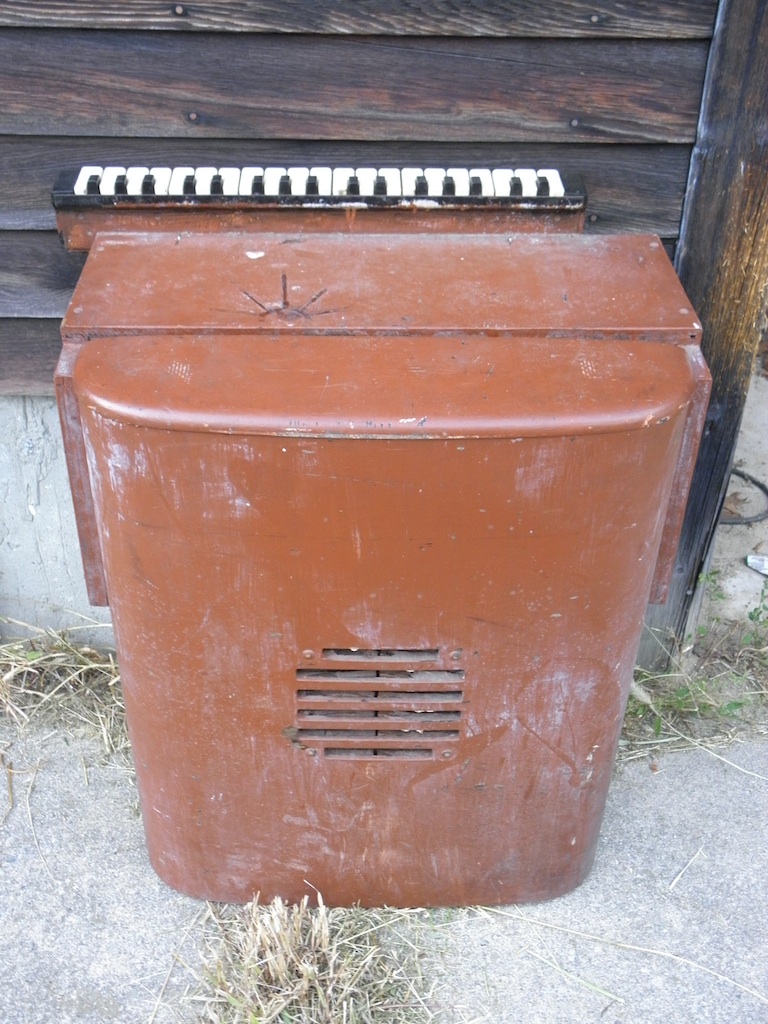
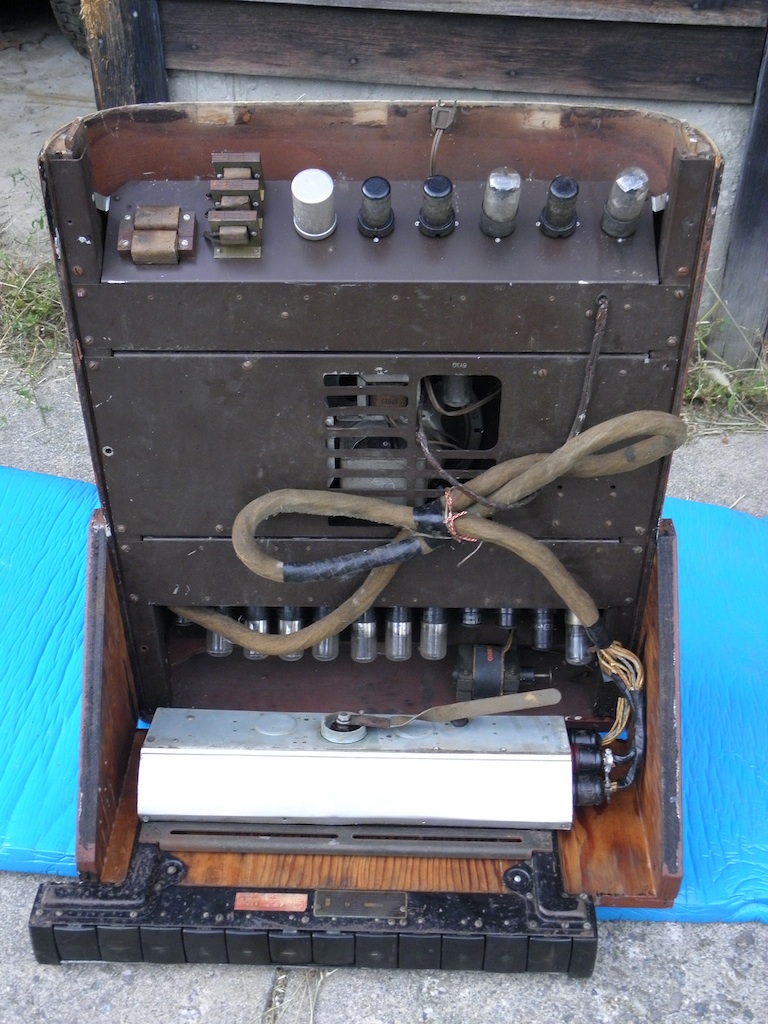
Not as many tubes as the Baldwin, since it uses a tonewheel generator to produce its sounds. I do have a pair of Hammond (monophonic) organs which use tubes to produce their tones, a Solovox:
solovox_front.jpg

solovox_back.jpg

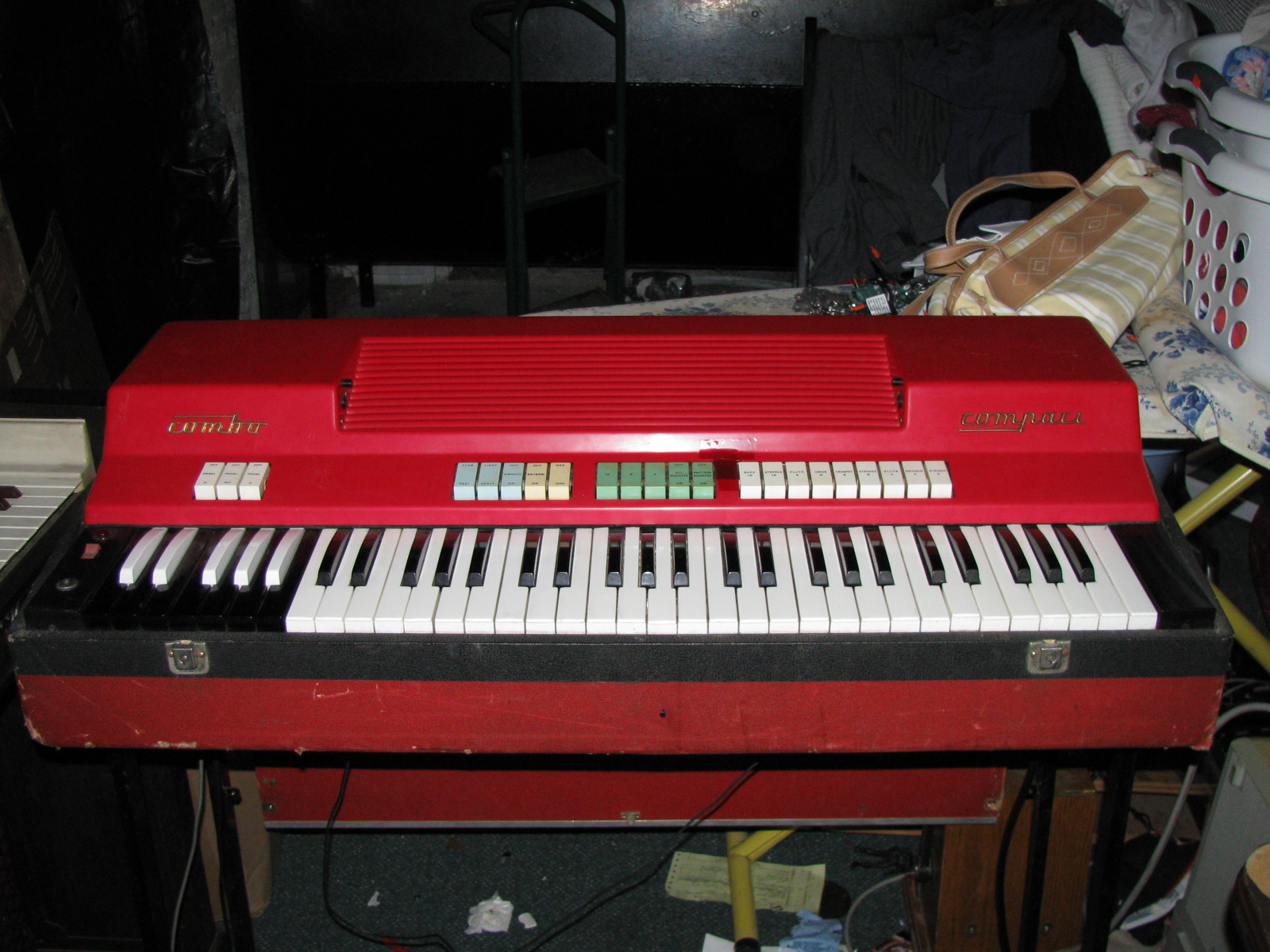
In addition, I have one organ which is mostly transistorized, but still uses a pair of (Mullard!) 12AX7s as part of its preamp section, a Farfisa Compact:
farfisa.jpg
 
As inferred above, it is relatively easy to separate the tone generation sections from the amp itself. Think of tone generation as one or more source inputs, which can replaced by an input jack. Also as noted, there are components in the tone generators that are definitely worth saving. In addition to what was noted, you may have some caps desired by the vintage guitar amp community. If so they can possibly pay the cost for the entire amp purchase (of course the 12AU7 and 12AX7 tubes have already done that).

As far as a matching amp, you should check some of the other Baldwin spinets from the same time (numerous 2-digit models between 30 and 61). Make sure the amp is also a 6L6 amp, as some of those models were 6BQ5 amps. The key is the iron, so make sure to note the transformer numbers and make sure they match. These amps can often be found on Ebay as singles for as little as $100 shipped.

I forgot to ad that you should be able to find a schematic for the amp. If not on A/K, try searching organ forums as they have a lot of documentation.
 
Last edited:
Back
Top Bottom