Best Classical Recordings for Newbies

moviemusic

Member
So I'm trying to expand my knowledge of other genres of music--problem is, there's so much of it! Especially classical, and while I have a passing familiarity the big composers and their famous symphonies (at least the parts that end up in movies and the like), there are so many versions of both their major and minor works that I don't even know where to begin. Plus, I have no idea how to tell a 'good' performance from a 'bad' one in terms of recordings, other than the obvious (no Cincinnati Pops Orchestra!)

So I'm looking for recommendations--what albums are must haves, or that you would recommend as a good introduction to a genre or a composer? Are there any compilation albums out there that are worth having?
 
Register to hide this ad
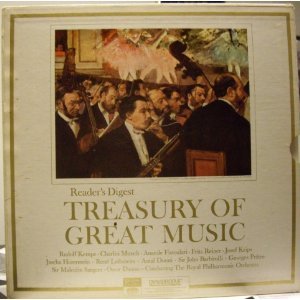
You could do a lot worse than this for starters. Yes, it's old, but the sound is decent and so are the performances. Vinyl of course, and may also be available on CD.

R-2436042-1283945993.jpeg.jpg

Cheers,
Larry B.
 
Oops, probably should have mentioned that I don't have a turntable, so recommendations available on CD or high-res download would be preferred. Sorry about that!
 
$_58.JPG Well, it appears it's NOT on CD - but similar compilations are. There's one available from LaserLight (Delta Music) - they did a lot of that sort of thing.

Search for "Top 100 Masterpieces of classical music" on Laserlight. 10 CD set for under $30.


Cheers,
Larry B.
 
Gotta get Zubin Mehta and LA Phil's The Planets by Holst. Heavy and well recorded.

Vivaldi rocks. I recommend the Issac Stern Vivaldi Gala...an audiophile recording of Stern, Perlman, Zuckerman and others kicking out the jams.
 
I warmly endorse this collection:

41vVB-JRwoL.jpg
 
The RCA VICTOR series of "Greatest Hits" cds are an excellent introduction to any classical composer for a newbie, (Like myself). Various recordings by RCA's venerable roster of stars showcasing classical music's greatest composers.
upload_2017-9-28_14-10-42.jpeg Easy enough to see which artist you like and then explore from there.
I would also recommend this cd as an intro to classical, Mad About Cartoons. Basically all of the classical music used in the Bugs Bunny cartoons, you know far more classical than you suspect: upload_2017-9-28_14-14-7.jpeg
MI0000977452.jpg
 
Do you have a library card?
Going by your location, it looks like you could get access to Hoopla via that. I do as well, and it's a great way to sample stuff without committing any cash. Save that for material you like and want to own.

This is a personal thing, but I think classical comps are great way to get a start, but you may find that after you start digging deeper they won't get much play. I know the ones I have don't. YMMV.

If you want to spend a bit and go for it, there are bunch of boxes similar to the one below. A nice way to get a bunch classic performances and recordings.
You may not like it all, but at a buck or two a disc, it's not a big deal.

https://www.amazon.com/Living-Stere...975&sr=1-3&keywords=rca+living+stereo+box+set
 
So I'm trying to expand my knowledge of other genres of music--problem is, there's so much of it! Especially classical, and while I have a passing familiarity the big composers and their famous symphonies (at least the parts that end up in movies and the like), there are so many versions of both their major and minor works that I don't even know where to begin. Plus, I have no idea how to tell a 'good' performance from a 'bad' one in terms of recordings, other than the obvious (no Cincinnati Pops Orchestra!)

So I'm looking for recommendations--what albums are must haves, or that you would recommend as a good introduction to a genre or a composer? Are there any compilation albums out there that are worth having?

As you say, there's so much ground to cover it's hard to know where to begin. Even among knowledgeable classical music aficionados, which recordings are preferable is often hotly disputed; in a sense, when you're just getting introduced to it, which versions you listen to is probably less important than which works you're listening to. The best works by the best composers are probably going to be quite good even when played by relatively ordinary ensembles, and the fact is, even the "unexceptional" ensembles are still made up of quite talented, professional musicians. As a very rough rule of thumb, however, it's often the case that the interpretations by ensembles in the composer's native land are going to be pretty reliable: German orchestras have long traditions in playing and taking pride in their Bach, Beethoven, Brahms, Wagner, etc.; American orchestras are often better bets for Copland or Gershwin, Czechs for Dvorak -- you get the picture. However, there are many, many exceptions; again, I'd try to look more into what are generally regarded as the composer's major works, and worry less about interpretations.

Just as an aside, many people who listen to classical music focus almost exclusively on big orchestral works like symphonies and piano, violin, and other solo concertos, but there's much great music written for small ensembles like string quartets, for example, or for piano and violin, that is overlooked that way. For example, Beethoven's string quartets are regarded by some as his best works, but many people listen only to the symphonies, piano concertos, overtures, etc., and just ignore the chamber music altogether. It's not a bad idea to take a broad view of what's worth looking at. Or at least that would be my suggestion . . .
 
As you say, there's so much ground to cover it's hard to know where to begin. Even among knowledgeable classical music aficionados, which recordings are preferable is often hotly disputed; in a sense, when you're just getting introduced to it, which versions you listen to is probably less important than which works you're listening to. The best works by the best composers are probably going to be quite good even when played by relatively ordinary ensembles, and the fact is, even the "unexceptional" ensembles are still made up of quite talented, professional musicians. As a very rough rule of thumb, however, it's often the case that the interpretations by ensembles in the composer's native land are going to be pretty reliable: German orchestras have long traditions in playing and taking pride in their Bach, Beethoven, Brahms, Wagner, etc.; American orchestras are often better bets for Copland or Gershwin, Czechs for Dvorak -- you get the picture. However, there are many, many exceptions; again, I'd try to look more into what are generally regarded as the composer's major works, and worry less about interpretations.

Just as an aside, many people who listen to classical music focus almost exclusively on big orchestral works like symphonies and piano, violin, and other solo concertos, but there's much great music written for small ensembles like string quartets, for example, or for piano and violin, that is overlooked that way. For example, Beethoven's string quartets are regarded by some as his best works, but many people listen only to the symphonies, piano concertos, overtures, etc., and just ignore the chamber music altogether. It's not a bad idea to take a broad view of what's worth looking at. Or at least that would be my suggestion . . .
I thinks it's a great aside.
One of favourite classical recordings is this one. I stumbled on it while I was binge buying classical vinyl at thrifts a few years back. I usually forget what it's called, I just call it Beethoven's 'silver bowl album'. Love it.

https://www.discogs.com/Academy-Of-...semble-Beethoven-Septet-Op-20/release/4192920
 
As you say, there's so much ground to cover it's hard to know where to begin. Even among knowledgeable classical music aficionados, which recordings are preferable is often hotly disputed; in a sense, when you're just getting introduced to it, which versions you listen to is probably less important than which works you're listening to. The best works by the best composers are probably going to be quite good even when played by relatively ordinary ensembles, and the fact is, even the "unexceptional" ensembles are still made up of quite talented, professional musicians. As a very rough rule of thumb, however, it's often the case that the interpretations by ensembles in the composer's native land are going to be pretty reliable: German orchestras have long traditions in playing and taking pride in their Bach, Beethoven, Brahms, Wagner, etc.; American orchestras are often better bets for Copland or Gershwin, Czechs for Dvorak -- you get the picture. However, there are many, many exceptions; again, I'd try to look more into what are generally regarded as the composer's major works, and worry less about interpretations.

Just as an aside, many people who listen to classical music focus almost exclusively on big orchestral works like symphonies and piano, violin, and other solo concertos, but there's much great music written for small ensembles like string quartets, for example, or for piano and violin, that is overlooked that way. For example, Beethoven's string quartets are regarded by some as his best works, but many people listen only to the symphonies, piano concertos, overtures, etc., and just ignore the chamber music altogether. It's not a bad idea to take a broad view of what's worth looking at. Or at least that would be my suggestion . . .

Great advice--thank you. I must admit to a certain favoritism towards symphonies myself--I like dynamic music that tells a story, and don't have much patience for endless musical 'noodling', no matter how talented the musician might be. (Always had problems listening to jazz for just that reason.) But I don't want to limit myself to just the big stuff I can hear anywhere, so I appreciate the pointers!
 
Do you have a library card?
Going by your location, it looks like you could get access to Hoopla via that. I do as well, and it's a great way to sample stuff without committing any cash. Save that for material you like and want to own.

This is a personal thing, but I think classical comps are great way to get a start, but you may find that after you start digging deeper they won't get much play. I know the ones I have don't. YMMV.

If you want to spend a bit and go for it, there are bunch of boxes similar to the one below. A nice way to get a bunch classic performances and recordings.
You may not like it all, but at a buck or two a disc, it's not a big deal.

https://www.amazon.com/Living-Stere...975&sr=1-3&keywords=rca+living+stereo+box+set

Interesting--I've been avoiding the streaming options for the most part, since they seemed like a lot of hassle to try and integrate with my Macs. But maybe I'll have to give them a second look.

And yeah, I'm not sure if I want to buy up a bunch of compilations--I already have Amazon's 99 Essential Classical Pieces in Movies, which covers a surprising amount of ground. I enjoy most of it, but obviously they're cherrypicking the most popular works, and I have no idea how to evaluate how good or bad the performances are. But nothing says I can't try to find them via the library.
 
Gotta get Zubin Mehta and LA Phil's The Planets by Holst. Heavy and well recorded.

Vivaldi rocks. I recommend the Issac Stern Vivaldi Gala...an audiophile recording of Stern, Perlman, Zuckerman and others kicking out the jams.

I do have The Planets with Zubin Mehta--it's one of the few classical albums I own. So at least I'm looking in the right direction--I'll definitely have to check out Vivaldi, thanks!
 
This might seem like a silly suggestion, but if you are truly new to classical Walt Disney's Fantasia is a pretty good intro. I'm well versed in classical and its still one of my favorites. As for compilations there are tons and tons of them and you probably can't throw a stick in the thrift store without hitting a pile. I'd just grab a few cheap and give them a listen. Telarc, Naxxos and Laserlight all have some pretty good series. If you find any compilations of overtures then definitely grab that and give it a listen. Overtures (the opening/intro instrumental piece to an opera, oratorio, etc.) are often very popular and used in movies commercials and TV shows. You'll probably find several you like and recognize (William Tell, Barber of Seville, Carmen, Light Cavalry among others). They are often upbeat and very easy to listen to. I'll also throw out a suggestion for my all time favorite symphony: Antonin Dvorak's 9th Symphony (New World). Also don't get too caught up in finding the "best" performance or knowing a good from bad one. You have to attain a certain level of perfection to be in any Symphony Orchestra so even the worst of them are still highly skilled artists.
 
I don't know if it's in print anymore but there exists a book, the idea of which is 'if you want to be serious about classical music, you need to know this material'. I think it's by Fred Child, the 'Performance Today' guy. I think it came in the form of a binder, so as to allow the addition of pages as they were published. The format was that for each piece, three good performances were listed with listening notes for each, in order to set up the compare/contrast for the listener.

Am I hallucinating? This was a real thing, right?
 
You could do a lot worse than this for starters. Yes, it's old, but the sound is decent and so are the performances. Vinyl of course, and may also be available on CD.

View attachment 1013428

Cheers,
Larry B.

Not trying to steal your thunder but this is a very good recommendation for someone to hear and learn about some great classical composers.

Readers Digest and RCA did a great job with this and I'm happy to have a nice set which includes a booklet with brief sketches of the composers lives.

You won't be disappointed with this if you can find a complete set in good condition.

IMG_5066.JPG IMG_5067.JPG IMG_5065.JPG IMG_5068.JPG
 
Great advice--thank you. I must admit to a certain favoritism towards symphonies myself--I like dynamic music that tells a story, and don't have much patience for endless musical 'noodling', no matter how talented the musician might be. (Always had problems listening to jazz for just that reason.) But I don't want to limit myself to just the big stuff I can hear anywhere, so I appreciate the pointers!

I see that some of these have been mentioned already, but for "dynamic music that tells a story", Stravinsky's "The Rite of Spring" fills that bill. Then of course, there's the "Nutcracker Suite" by Tchaikovsy, Smetana's "The Moldau", Bizet's "Carmen Suite", "Parsifal" by Wagner, and Dukas' "The Sorcerer's Apprentice". Mitkraft's suggestion of watching Disney's "Fantasia" is a great idea. That reminds me: Stravinsky's "The Firebird Suite" would also be a good piece to listen to, which is in "Fantasia 2000".

Your description of your perception of what you are hearing as "noodling", IMO, shows you need to do a little more listening. Jazz and classical music often require sensitive listening, which I believe can be acquired by more exposure to the music as well as an effort on the part of the listener to engage with what he is hearing. It's great when music has a great impact on one immediately. And jazz and classical can also absolutely do that, of course. But our media at large, doesn't always give us a musical diet that asks much of us as listeners. I think it's great that you are seeking out different kinds of music to listen to. You may find after listening for awhile, that what at first appeared to you as "noodling" was actually, beautiful, sophisticated and subtle music. Enjoy the journey! :music:
 
Last edited:
As you say, there's so much ground to cover it's hard to know where to begin. Even among knowledgeable classical music aficionados, which recordings are preferable is often hotly disputed; in a sense, when you're just getting introduced to it, which versions you listen to is probably less important than which works you're listening to. The best works by the best composers are probably going to be quite good even when played by relatively ordinary ensembles, and the fact is, even the "unexceptional" ensembles are still made up of quite talented, professional musicians. As a very rough rule of thumb, however, it's often the case that the interpretations by ensembles in the composer's native land are going to be pretty reliable: German orchestras have long traditions in playing and taking pride in their Bach, Beethoven, Brahms, Wagner, etc.; American orchestras are often better bets for Copland or Gershwin, Czechs for Dvorak -- you get the picture. However, there are many, many exceptions; again, I'd try to look more into what are generally regarded as the composer's major works, and worry less about interpretations.

Just as an aside, many people who listen to classical music focus almost exclusively on big orchestral works like symphonies and piano, violin, and other solo concertos, but there's much great music written for small ensembles like string quartets, for example, or for piano and violin, that is overlooked that way. For example, Beethoven's string quartets are regarded by some as his best works, but many people listen only to the symphonies, piano concertos, overtures, etc., and just ignore the chamber music altogether. It's not a bad idea to take a broad view of what's worth looking at. Or at least that would be my suggestion . . .

I agree with much of what you're saying, John, but think it's worth re-emphasizing that there are definitely exceptions to the "home turf" rule. I would also add that interpretation is very important with some recordings. I don't think you'd really disagree. It's just that I've heard some night and day differences in approach to certain pieces, my feeling being that if I had initially heard the one that I don't like, it might have put me off to the piece. The right interpretation can sometimes mean all the difference.
 
Back
Top Bottom