Cartridge overhang adjustment question

dprice45

New Member
I just put a new Shure M97xe on my Pioneer PL-10 turntable. I got it aligned with the Shure protractor, but as for overhang I just eyeballed it and put it roughly where my old cart was placed (toward the front of the headshell slots). It sounds great compared to my old cartridge and my records sound brand new! But I do wonder if my overhang is correct and if this new cart could sound even better. I checked the PL-10 manual available on vinyl engine to see how to correctly adjust overhang, and I'm supposed to use a guage on the EP adapter that was originally supplied with the TT, but of course I bought the thing used and any adapter that came with it is long gone. Is there any other way to adjust overhang with a homemade or other tool? Correct overhang is 15.5mm. Should I contact Pioneer to see if they have something that will work for me?

Thanks for any help,
David in Nashville.
 
Register to hide this ad
Well, David, you've come to the right place. :D

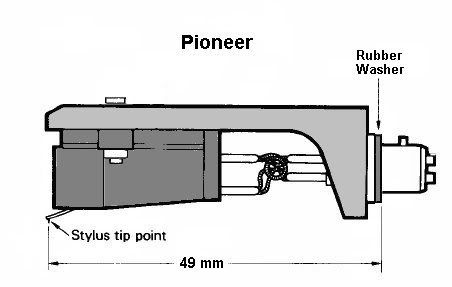
The protractor included with the Shure uses Baerwald geometry, which was not used by Pioneer when they designed their turntables. When followed, the following diagram simultaneously aligns the cartridge and provides the proper overhang. You need to keep the cartridge square with the headshell. It should end up about midway in the slots. Now, I don't know what kind of headshell you are using, but if it's a Technics or Stanton or a DJ type, you may not have enough slot room to mount the cartridge properly. You would need either a headshell that is original to the table, or one that says Pioneer, or a grid-type vintage headshell.

PioneerOverhangcolor.jpg
 
So, just for clarity on my part, you are saying that I should NOT use the protractor included with the Shure, but keep it square with the headshell? And that my stylus tip should measure 49mm from the rubber washer?

I'm using the original Pioneer headshell so that's not an issue.
 
The protractor that came with your SHURE Cartridge is the best way to go! Use the inner most setting to set your overhang and you're good. If you are having distrotion it is not alignmnet but either bearings or headshell leads.

Note that only certin tonearms will be perfectly aligned at both null points. For most S-Shaped arms, just set the alignment using the inner most setting/null point. The outter one is not as improtiant as the inner one IN YOUR CASE.
 
So, just for clarity on my part, you are saying that I should NOT use the protractor included with the Shure, but keep it square with the headshell? And that my stylus tip should measure 49mm from the rubber washer?

I'm using the original Pioneer headshell so that's not an issue.

Yes, that is exactly correct. You can try Joey's suggestion if you like, but my thinking has always been that if the manufacturer recommends a certain alignment, that's the best way to go. Compare the two methods if you like and see which sounds best.
 
No, Todd, it doesn't work that way. Overhang is just one third of the equation. That doesn't take into account the tonearm length and offset angle. Pioneer used different tonearm lengths than Technics. The Technics gauge is set at 52mm while the measurement for a Pioneer is 49mm. Of course, he can certainly buy the Technics gauge, but then he'd have to make a mark on it at 49mm. That would make setup easy and eliminate the need to use a ruler each time.
 
Howard, thanks for the advice, I'm going to try readjusting tonight. Just out of curiosity, where did your diagram and general Pioneer expertise come from? Are all Pioneer tonearms set for 49mm overhang, or just the early 70s models like my PL-10?

Also, what difference does it make in terms of sound if the cartridge overhang is too far forward or backward?
 
Howard, thanks for the advice, I'm going to try readjusting tonight. Just out of curiosity, where did your diagram and general Pioneer expertise come from? Are all Pioneer tonearms set for 49mm overhang, or just the early 70s models like my PL-10?

Also, what difference does it make in terms of sound if the cartridge overhang is too far forward or backward?

He owns more turntables than... well, anybody.

Pioneer did vary arm length. Yours is standard for it's era.
 
Actually, looking at it, do as Hakaplan said, stylus to the end of the headshell. As memory serves, the PL 10 and Pl 12DII were so very close. The PL 12DII had a plinth mount overhand guage and it put it at the end of the Pioneer headshell.
 
Just out of curiosity, where did your diagram and general Pioneer expertise come from?
Reading manuals and specs at various places online and personal experience with several Pioneer turntables. Much of the information is in the library section at vinylengine.com, a tremendous resource. Also, the AK Pioneer Component Database in the Pioneer section, as well as Dr. Strangelove's endless source of Pioneer catalog photos.
Are all Pioneer tonearms set for 49mm overhang, or just the early 70s models like my PL-10?
Pretty much all S-arm models. There might be a few exceptions that I can't think of off hand.
Also, what difference does it make in terms of sound if the cartridge overhang is too far forward or backward?
Usually it's described as distortion, or just not sounding right. Sometimes it sounds okay, but then when it is properly aligned, it sounds much better. That's been my experience for the most part.
 
...doesn't take into account the tonearm length and offset angle. Pioneer used different tonearm lengths than Technics.
Thank you, Howard - so obvious, and I still missed it. :D

To build an overhang protractor for my Yamaha, I used the overall tonearm length (pivot-to-stylus as radius) to draw a circle, then marked the spindle center at the overhang measurement. Drew a line through the center of the spindle and the center of the circle, to give me an aiming point for the pivot. Left me a really big graphic, and I was able to cut out a chunk of it big enough to almost cover my entire platter. Now I have a big sweep of an arc defining the overhang distance across the entire platter - makes it easy to see the alignment, and easy to get the "aiming point" lined up.
 
Something about beating a DEAD HORSE...

The inner most Null Point found on that alignment protractor that came with your cartridge is the best way to go. I have the original Pioneer Overhang gauge and a couple of those Technics ones and they are, well, CLUNKY. It's neat to have I guess, I have ALL the accessories from my PL-12, 12D, and 112D...but over all tracking is far better using the inner most setting of your alignment protractor. When you are aligned on that inner grid, you have ZERO tracking error at the most important part of the record where the high frequency modulations are most concentrated and the most distortion occurs.

When I used the Pioneer gauge, it was WAY off at the inner bands and that is not good! Also, you are not aligning the cart as much as you are the cantaleaver which needs to be dead on. Now, if you’re using a Conical Stylus, well... As you are using an Elliptical stylus, you need that inner most setting as dead on as can be. If you lived in my area, I would gladly set that up for you.

Good luck...

Joey1127
 
Thanks guys for all the advice, I'm experimenting with the two methods put forth here and will let you know which sounds best.

A related question: could these adjustments have anything to do with the low hum I'm getting through the speakers when the stylus hits the record? My ground wire is secure and there is no hum until the stylus comes down, it's only really audible while the stylus is in the intro grooves and during quiet musical passages, just enough to annoy me. So could this be related to overhang/alignment or is it just a factor of using an entry-level 30+ year old deck? Something else?

Thanks!

D
 
Thanks guys for all the advice, I'm experimenting with the two methods put forth here and will let you know which sounds best.

A related question: could these adjustments have anything to do with the low hum I'm getting through the speakers when the stylus hits the record? My ground wire is secure and there is no hum until the stylus comes down, it's only really audible while the stylus is in the intro grooves and during quiet musical passages, just enough to annoy me. So could this be related to overhang/alignment or is it just a factor of using an entry-level 30+ year old deck? Something else?

Thanks!

D

NO, the HUM may be the result of bad leadwires in the headshell or bad interconects on the Turntable itself. Check those carfully for damage.

Joey1127
 
The hum has nothing to do with alignment, nor the table being entry-level. The key is probably "30 years old" and it's probably the RCA cables--possibly the plugs, possibly the cables themselves. Best bet is to replace the cables. They are soldered to a place inside which should be easy to access, especially in a manual turntable. If you decide to go that route, post again and you'll get a bunch of suggestions for what to use.
 
The protractor that came with your SHURE Cartridge is the best way to go! Use the inner most setting to set your overhang and you're good. If you are having distrotion it is not alignmnet but either bearings or headshell leads.

Note that only certin tonearms will be perfectly aligned at both null points. For most S-Shaped arms, just set the alignment using the inner most setting/null point. The outter one is not as improtiant as the inner one IN YOUR CASE.
You keep talking about using the inner most null point. That would have to require keeping the cartridge square with the headshell, otherwise there are an infinite number of positions. If the former, I can see your point; Sony's protractor is simply the inner Stevenson null point, but you must keep the cartridge parallel with the headshell to provide the other reference point.

But I'll add this. I don't know why you think overhang gauges are clunky--to me making a cartridge square with a headshell and matching up the tip of the stylus is about as easy as it gets. And when I use the Pioneer overhang gauge it is, in fact, lined up with the Stevenson inner point, that protractor having been designed SPECIFICALLY to minimize distortion at the inner grooves.
 
Back
Top Bottom