Converting a euro motor to 120v/60hz

Uncle Bambi

Funky Tut
So, I've got a device with a small hard-wired euro electric motor - 220v/50hz.

Short of replacing it, is there any way to make it run on 120v/60hz? Any little breadboard circuit/device that I can build and stick in-line with the power, or should I just go buy a step-up gismo from Amazon?
 
Last edited:
Register to hide this ad
If it has a DC motor (or no motor at all), then you just need a step transformer of the appropriate rating (the unit's rated wattage at 220V + 30%.

If it has an AC motor (which depends on AC supply frequency) then your options are much more limited. You need to provide it with 50Hz.

I acquired a Teac R2R deck only rated at 110V/60Hz and it doesn't have a conversion pulley on the capstan motor. Only way to make function correctly (speedwise) is to power it from a UPS able to provide 110/60Hz. Pretty expensive conversion though.
 
I got a Sony TC-270 a few years ago, I didn't realize at first that it was converted from European 50Hz power to American 60Hz. From what I could figure out, that was done properly, but it still had the 50Hz size motor pulley on it. This meant it could make great, higher-than-7 1/2-ips tapes and play them back, but it couldn't play a commercial tape at proper speed. I was able to get a 60Hz type motor pulley for it, but not exactly the right one (there were four originally available to correct speed). So instrumentals on commercial tapes sound great, but vocalists all sound like their younger siblings or like somebody tied their shorts in a knot.
 
Hold on, let's explain something.

A motor is a motor is a motor...50 Hz, 60 Hz, the motor itself doesn't care. It's an AC motor. It's speed depends on the number of poles it has (P) and the frequency (f).

Here's the formula: RPM = f times 120, divided by P. (The 120 is a constant which takes into account the 60 seconds per minute and the positive/negative...)

The number of poles can be 2, 4, 6, 8, or more, always an even number. This is an important distinction.

So a 2 pole motor, at 60 Hz, is going to run at 3600 rpm. Same motor at 50 Hz runs 3000 RPM. A 4 pole motor at 60 Hz runs 1800, at 50 Hz runs 1500. 6 pole motor at 60 HZ is 1200, at 50 Hz runs 1000 rpm. The motor speed for an AC motor depends strictly on frequency and the given number of poles. If you have a 1500 rpm motor (at 50 Hz), you aren't going to find a motor that turns 1500 rpm (shaft speed) at 60 hz. The number of poles can't be changed to get that particular difference.

So let's use an example: an idler wheel turntable with an AC motor. When a European version of this TT runs its motor at 50 HZ, its shaft pulley is sized to provide the proper speed reduction to reach the desired speed (33-1/3 rpm). A US device is running at 60 Hz, so its shaft pulley must be smaller by a ratio of 50/60. You're not rewinding the motor or anything different because you can't increase the number of poles to make up the ratio of 50/60....poles are going to be 2, 4, 6, 8, etc. Instead it's the speed reduction obtained by the combination of the motor pulley and driven pulley (the TT rim) that yields the correct final desired speed.

Hope that makes sense.

 
Last edited:
What he said. Its the pulley ratio that matters at the end of the day. The 220 vs 120 thing is easy enough to fix with a step-up transformer. At less than an amp, it wouldn't even be a large or expensive transformer that you need.

Since the thing is going to be spinning faster on 60 hz, you can have the pulley cut down smaller if needed, provided the pulley is of some design that lends itself to that. if its a solid hunk of brass, no problem. If its integral to the motor shaft or its plastic or something, that could be more difficult. Gear drives would also be more difficult.

The other question is does the speed actually matter all that much? What exactly is this mystery machine?
 
Does it have an option to switch it to 110/60 hz??

I just recently had a Dual TT wired for Euro use, but was able to switch it to 110v by simply moving a wire. It already had circuitry installed for domestic use.
Perhaps you device may have the same sort of arrangement??
 
Many motors have capabilities to run at 110 Volts or 220 volts (nominal) by changing connections on the taps on the windings. (If the motor manufacturer wanted to make the motor cheaper though, they omitted the taps, leaving the motor fixed at just one voltage.)

Again, though, you can't compensate for a slightly different frequency by moving a wire or two. The Dual TT can be easily changed for voltage by changing a couple of wire connections, but you've got to swap the motor pulley to effectively change from 50Hz to 60 Hz.
 
The other question is does the speed actually matter all that much? What exactly is this mystery machine?

Speed variance does not affect function to a degree that I would notice. The "mystery machine" is a vibratory tumbler that is euro spec. It has one electrical part, a motor. RPM's aren't an issue, as it will still do its job at a slightly higher or lower RPM.

What is an issue is the voltage. I was hoping to open the cover and find a motor that could be re-wired on the taps, but it appears that it is a one voltage motor - I do not see any other taps to switch to. :( Are they easily spotted, or should I look more carefully for something in particular?

So failing that, it looks like my choices are:

1) junk it
2) buy an inexpensive step-up transformer
3) buy a new fan-type motor (it looks like a bathroom exhaust fan motor)

I'll probably trip over a usable motor at the flea market if I look long and hard enough, but I think a 100w step-up can be had for around $10.

I was hoping for an internal-type mod as I wanted to just convert it for use anywhere, without having to find the external transformer every time I moved the thing around.

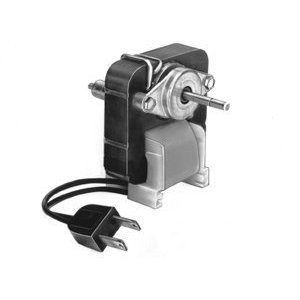
Looks like similar to this:
fasco_c_frame_vent_motor.jpg
 
Hold on, let's explain something.

A motor is a motor is a motor...50 Hz, 60 Hz, the motor itself doesn't care. It's an AC motor. It's speed depends on the number of poles it has (P) and the frequency (f).

Here's the formula: RPM = f times 120, divided by P. (The 120 is a constant which takes into account the 60 seconds per minute and the positive/negative...)

The number of poles can be 2, 4, 6, 8, or more, always an even number. This is an important distinction.

So a 2 pole motor, at 60 Hz, is going to run at 3600 rpm. Same motor at 50 Hz runs 3000 RPM. A 4 pole motor at 60 Hz runs 1800, at 50 Hz runs 1500. 6 pole motor at 60 HZ is 1200, at 50 Hz runs 1000 rpm. The motor speed for an AC motor depends strictly on frequency and the given number of poles. If you have a 1500 rpm motor (at 50 Hz), you aren't going to find a motor that turns 1500 rpm (shaft speed) at 60 hz. The number of poles can't be changed to get that particular difference.

So let's use an example: an idler wheel turntable with an AC motor. When a European version of this TT runs its motor at 50 HZ, its shaft pulley is sized to provide the proper speed reduction to reach the desired speed (33-1/3 rpm). A US device is running at 60 Hz, so its shaft pulley must be smaller by a ratio of 50/60. You're not rewinding the motor or anything different because you can't increase the number of poles to make up the ratio of 50/60....poles are going to be 2, 4, 6, 8, etc. Instead it's the speed reduction obtained by the combination of the motor pulley and driven pulley (the TT rim) that yields the correct final desired speed.

Hope that makes sense.

Very instructive, thanks for the excellent tutorial. And now for a stupid question - how do I determine how many poles this motor has? The motor label does not list RPM - only voltage, hz, and amperage.
 
that type of motor is a shaded pole motor. Its basically a 2 pole. The coil at the bottom is one, the other "pole" is a couple turns of wire up at the top corner.
 
that type of motor is a shaded pole motor. Its basically a 2 pole. The coil at the bottom is one, the other "pole" is a couple turns of wire up at the top corner.

Got it...... so using the formula that nashvillebill provided (as well as actually stating the RPM in his example :)), it is a 3000rpm motor at 50hz, and a 3600rpm motor at 60hz.

Ok - those motors are common, available, and pretty cheap.

I'm going to assume that these types of motors also lack the various taps required to convert the voltage, yes?
 
You might find a multi-tap one but I've never personally seen one. You find them in bathroom fans and other similar applications. SHould be easy enough to get one that runs natively on 120v. Heck, even some cheap record players have them. I know that lower end Garrards used a motor that looks damn similar.
 
I found a wierd sheet metal light box thingy at the swap meet today that had 2 of these 120v motors in it, so I should be good to go......... assuming they work. :)

Cost me $5, so I'm happy.
 
Back
Top Bottom