Describe "Tube Sound"....

I usually find tube amp's to have a softer, less tight bass than SS, but do overdrive into a far softer clipping than SS. Live musicians prefer tube head amp's just for that reason. If using a high wattage SS unit, it's not a problem. I'll only use SS amp's, as I like my bass performance solid and tight. Another problem with tube equipment, is the tubes start to degrade rather rapidly. Sometimes the user doesn't notice this over time, until they replace them and sound's like a whole nother amp. I really think of tube equipment as a hobbyest sort of thing, and really have no opinion for the guy's that are into it.

I don't really have much opinion about if, how, or why tubes and SS sound different in a hi-fi, but I have used a lot of tube gear over the years both for performing and for listening. I have to make some comments here. Musicians prefer tube amps for reasons unrelated to hi-fi. The goal with hi-fi is accuracy and linearity. This is true for SS and for tubes. The goal for guitar amps is to work in synergy with the instrument, effects (if any), and the player to CREATE a tone that is not simply an accurate, linear reproduction of the strings' vibrations. The amplifier is part of the instrument. It is intended to provide tone shaping, coloration, and fairly often a far higher degree of distortion than would be tolerated in a hi-fi. The frequency bandwidth is also dramatically narrower than required for hi-fi. The fact that tubes meet the musician's needs far better (in general) than solid-state is really irrelevant when it comes to hi-fi.

The other comment is on tube life. They really do not degrade nearly so fast as you are implying. Some of it comes down to initial tube quality. Some to the amplifier design, and some to the way it is used. Preamp tubes can last many decades. I'd venture to guess that they may someday prove to last a century or more in normal use. Power tubes can last for a decade or more without meaningful degradation in my experience.
 
Ask 10 different people and get 10 different opinions. I think the best thing you can do is try it yourself. I have heard both tube and SS set ups that sound fantastic. Can you get a local audio store to demo both for you?
 
I found this the other day and thought it was interesting, although I have zippo experience with which to judge its validity...

"Gordon Brockhouse talks to Sunfire’s Bob Carver"
http://www.audio-ideas.com/interview/carver.html

Excerpt reproduced for educational purposes:

GB: Your power amplifiers have two sets of output terminals: one for current source and one for voltage source. What’s the point?

BC: The voltage source has very low output impedance like a solid-state amplifier, so it has the sound of a solid-state amp. The current source has output impedance like a vacuum-tube amp, so it sounds more like a vacuum-tube amplifier. With the current-source output, the output impedance is exactly one ohm. We did a survey of tube amps and they average about an ohm.

We recommend driving an electrostatic or ribbon loudspeaker with a current source, and driving the low-frequency driver with a voltage source. Most people who have panel loudspeakers bi-wire them using that suggestion, and they like it better. There’s a sweet glow to the midrange and a soft high end that you associate with tube amps; along with the tightly controlled bass you expect from a good transistor amplifier. When you hook the panel up to the voltage source, it sounds like a transistor amp. The midrange is a little laid back and doesn’t have that glow; and the highs are sometimes a little sibilant. GB: Does the difference between tube and solid-state sound come down just to output impedance?

BC: Not entirely, but almost entirely. Ninety per cent of the sound quality that we typically attribute to vacuum tubes comes from the output impedance.

GB: Many people think the output transformer, and associated factors like soft clipping and core saturation, create the tube sound. Does the transformer raise output impedance, and thus create tube sound?

BC: The forward impedance of the output tubes and the transformer together usually comes out at about 10 ohms. When you use 20 dB of feedback, it reduces it to around one ohm. That’s basically what a vacuum-tube amplifier is all about.
 
Yep John, sound's like like you're the guy since you play as well, so no arguement here. I haven't run any tube gear in years, but have friend's that use tube power amp's on a daily basis. Just going by some of thier comment's about changing the tube's every few year's and making a big difference. I definitely agree about the initial tube quality, as some of those Western Electric job's will probably out live us all.
 
I can't describe tube sound..... but when I hear vocals played through decent tubed equipment, those vocals sound alive to me.
 
I'm slowly becoming partial to a tubed pre, with a solid state power amp. I think this might just be the best combo.
 
I'm thinking that the "ideal" is a biamped system with tubes for the midrange and above and SS for the bass. It's been rattling around in my brain for a few weeks now since I realized that I have suitable amps to do this. Probably a tube preamp just because.

Thanks, Knee, for the compliment.
 
In the late 70s early 80s some power amps with MOSFET output stages could mimic the warm relaxing sound of tubes. For some reason today MOSFET devices have being abandoned in favor of Bipolar transistors. :dunno:
 
Summing up the tube sound:

Tubes: Warm and relaxing = more distortion, less speaker control
SS: Cold and analytical = less distortion, more speaker control.
Solution: Biamp your speakers, tubes on top SS on the bottom.
Results: :music::king::hdphones::guitar::beerchug::tresbon::thmbsp:
 
I'm thinking that the "ideal" is a biamped system with tubes for the midrange and above and SS for the bass. It's been rattling around in my brain for a few weeks now since I realized that I have suitable amps to do this.

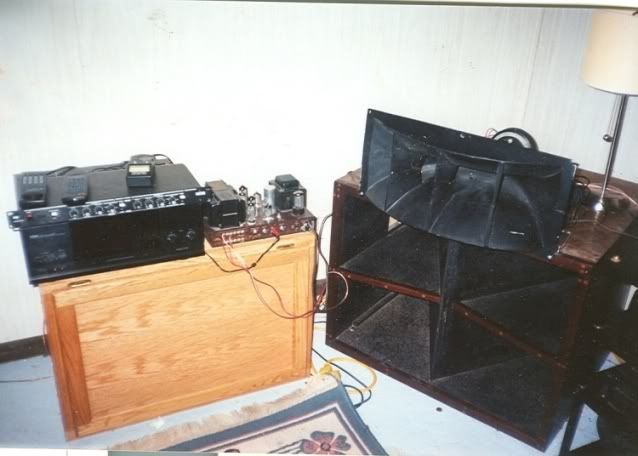
Yeah, many hornys have been doing that for a long time. I had several setups with SS on the basshorns or woofers and tubes on the compression drivers.


Copyoffh-1902-1.jpg
 
People talk about "colouration" and "intermodulation" and lots more stuff I dont understand.

Some people like chev's, some like fords, and others like toyotas.
Some peoples favorite colour is blue, some green, some like red.
Some people like the monalisa, some dont.

Music is art guys, dont try to measure it or justify it (and you know what they say about art - if you have to ask, you dont understand)

I paid some good coin for a 1962 tube amp (working condition) and I must admit, was a bit dissapointed. I then connected a SS amp to it and bingo!

Depending on the style of music playing, I vary the proportions of volume from each amp to obtain what I feel like. Tube amp up, SS down, and I have a mix with more top end, and vice-versa.

I will say that Tube stuff seems to reproduce treble better, and SS gets the bass work done.
Who wants either alone? I'm pretty sure most people want it all. Just plug 'em both in. You are the boss, use the power button and volume control accordingly.

My 47 year old tube amp needs new output tubes and some other things, but if you are still original at 47 years of age, you are doing well (what, never been to the doctor or dentist?) and lots say a much younger SS amp will benifit from a fresh re-cap. Who is winning here?

To the op; A working tube amp always seems to get it's purchase price back. That said, give it a try, as only you can decide. If you dont like it, sell it. You may not notice much when you turn it on, but you will notice it when you go back to SS alone.

good luck
Danny.
 
I found this the other day and thought it was interesting, although I have zippo experience with which to judge its validity...

"Gordon Brockhouse talks to Sunfire’s Bob Carver"
http://www.audio-ideas.com/interview/carver.html

Excerpt reproduced for educational purposes:

GB: Your power amplifiers have two sets of output terminals: one for current source and one for voltage source. What’s the point?

BC: The voltage source has very low output impedance like a solid-state amplifier, so it has the sound of a solid-state amp. The current source has output impedance like a vacuum-tube amp, so it sounds more like a vacuum-tube amplifier. With the current-source output, the output impedance is exactly one ohm. We did a survey of tube amps and they average about an ohm.

We recommend driving an electrostatic or ribbon loudspeaker with a current source, and driving the low-frequency driver with a voltage source. Most people who have panel loudspeakers bi-wire them using that suggestion, and they like it better. There’s a sweet glow to the midrange and a soft high end that you associate with tube amps; along with the tightly controlled bass you expect from a good transistor amplifier. When you hook the panel up to the voltage source, it sounds like a transistor amp. The midrange is a little laid back and doesn’t have that glow; and the highs are sometimes a little sibilant. GB: Does the difference between tube and solid-state sound come down just to output impedance?

BC: Not entirely, but almost entirely. Ninety per cent of the sound quality that we typically attribute to vacuum tubes comes from the output impedance.

GB: Many people think the output transformer, and associated factors like soft clipping and core saturation, create the tube sound. Does the transformer raise output impedance, and thus create tube sound?

BC: The forward impedance of the output tubes and the transformer together usually comes out at about 10 ohms. When you use 20 dB of feedback, it reduces it to around one ohm. That’s basically what a vacuum-tube amplifier is all about.

Mr. Carver suggested that you can achieve much of the “tube sound” by adding a large wattage rating (forgot how high), one ohm resistor in series with your speakers. :dunno:

This I think is explained in detail somewhere here on AK.
 
The difference to me is I can listen to a decent tube amp all day. I can listen to an excellent SS amp for a few hours, and then my head hurts. Tube amps project volume without straining to do so. SS amps always sound like they are yelling. Just my humble opinion.
 
I don't think a good tube amp sounds "colored" at all. I don't know what tube sound is, unless you're talking guitar amps. I know my tube amps sound a little clearer and more open than my solid state amps, almost like a layer has been lifted. But I'm sure there are high end SS amps out there that probably sound even clearer and more open than my tube amps. I actually feel my tube amps are less colored than my SS stuff. Things just sound a little more natural to me with tubes. I haven't heard the whole coloration thing people talk about, except when I was experimenting and had my tubes biased too hot which resulted in a compressed, slightly distorted sound.
 
Not too sure about audio tube amps, but I know for a fact that SS guitar amps cannot even come close to competing with tube guitar amps. It's got that crunchy extremely bassy and mid-range sound to it that sounds cheap and muddy on SS guitar amps. The tube amps clip and create "natural overdrive" thats characteristic of a lot of rock and roll music. When SS amps clip like this, they sound horrible becuase digital clipping is not friendly to the ear. So they make up for it by having a channel that sends the signal to a circuit that poorly simulates the natural overdrive of tube amps. Some computer programmer roughly analyzed the harmonics of a clipping tube and wrote an algorithm that made up the transfer function. It's called digital distoriton and its f*cking painful to the ears.

I also think that tube guitar amps sound way cleaner than solid state amps when you're not trying to overdrive them.
 
The difference to me is I can listen to a decent tube amp all day. I can listen to an excellent SS amp for a few hours, and then my head hurts. Tube amps project volume without straining to do so. SS amps always sound like they are yelling. Just my humble opinion.

maybe youhavent heard any GOOD SS amps. My humble opinion.
 
Back
Top Bottom