

-
Feeling lucky? Check out the AK 24th Anniversary Giveaway thread and join in the fun!
You are using an out of date browser. It may not display this or other websites correctly.
You should upgrade or use an alternative browser.
You should upgrade or use an alternative browser.
Dial bulbs dimming to the bass during high volume
- Thread starter allsmith
- Start date
Register to hide this ad

Unrestored 1981 fisher rs-2015 150wpc, Dial bulbs are dimming to the heavy bass hits after it starts getting up past about 80-100 watts.
Is this normal? Or signs of capacitors or transformer getting weak ? This thing has a huge torroidial transformer in it!
Likely normal. Transformers either output same as new or fail. The transformer as a whole is pulled down on those deep high power bass notes. New caps are a good thing and does help to charge the caps during non-peak demand to keep voltage up. Also many vintage receivers used undersized caps by todays standards. At times physical limitations ruled the day. New caps are much smaller thus larger capacitance replacements are not an issue.

Rob41
Don't stop believin'
Unrestored 1981 fisher rs-2015 150wpc, Dial bulbs are dimming to the heavy bass hits after it starts getting up past about 80-100 watts.
Is this normal? Or signs of capacitors or transformer getting weak ? This thing has a huge torroidial transformer in it!
Right, the transformer is either working or it's not. It sounds like you've got weak capacitors. They are more than 30 years old and I suspect you would find many of them out of spec.


This reminds me of when i lived in a mobile home and use to play the system really loud, the lights in the house would dim at every low note
This was a dual Apt Holman amps, Apt preamp, Rega Planar 3 with Grace F9E cart and a pair of Ls35/A's and dual Satterburg subs..sure wish i still had THAT system:yes:
This was a dual Apt Holman amps, Apt preamp, Rega Planar 3 with Grace F9E cart and a pair of Ls35/A's and dual Satterburg subs..sure wish i still had THAT system:yes:


sKiZo
Hates received: 92644 43.20°N 85.50°W
I get a lot of lights flashing when I'm cranking my Big Mac, but that's mostly to do with the Chauvet led bars and 1200 watts of floods in the lightshow. <G>
I'd say having the dial lights flash would be more "normal" on a tube rig, but in your case I'd suspect the power transistors. Check the heatsinks and power transistors - if the transistors are excessively hot and the heatsinks are cooler, you may get away with popping the power transistors and replacing the heatsink compound - stuff turns to dust and gets relatively useless over time - if the transistors are overheating, they get less efficient and you'll see reduced output. I just peeked at the specs and you might be able to do it without doing major surgery.
I also noticed it's got two AC accessory jacks in the back. That could help brown out the box if you're using those. You could also try upgrading the power cord and see if that helps. That era had some pretty flimsy cords, so it couldn't hurt. Also worth checking the load on the circuit you're running the stereo on. Keep an eye out for increased flashing if the fridge or a/c kicks on. Possible real simple fix would be to replace the fuse - those can get weak over the years and won't pass power to their rating.
If everything else is working good and you're not into doing a full rebuild, you might want to consider getting a good powered sub to reduce the load on the Fisher ... probably last forever that way.
Luck with it, eh.
I'd say having the dial lights flash would be more "normal" on a tube rig, but in your case I'd suspect the power transistors. Check the heatsinks and power transistors - if the transistors are excessively hot and the heatsinks are cooler, you may get away with popping the power transistors and replacing the heatsink compound - stuff turns to dust and gets relatively useless over time - if the transistors are overheating, they get less efficient and you'll see reduced output. I just peeked at the specs and you might be able to do it without doing major surgery.
I also noticed it's got two AC accessory jacks in the back. That could help brown out the box if you're using those. You could also try upgrading the power cord and see if that helps. That era had some pretty flimsy cords, so it couldn't hurt. Also worth checking the load on the circuit you're running the stereo on. Keep an eye out for increased flashing if the fridge or a/c kicks on. Possible real simple fix would be to replace the fuse - those can get weak over the years and won't pass power to their rating.
If everything else is working good and you're not into doing a full rebuild, you might want to consider getting a good powered sub to reduce the load on the Fisher ... probably last forever that way.
Luck with it, eh.
Last edited:
Rob41
Don't stop believin'
Possible real simple fix would be to replace the fuse - those can get weak over the years and won't pass power to their rating.
Luck with it, eh.
Did you have a typo? :scratch2: A fuse will either pass the current or burn out.

allsmith
Super Member
Thanks all! I really appreciate the info!
Yeah by the time the lights start to dim the volume is up to a pretty uncomfortable level and i dont usually play it that loud,but you know... got see what she can do sometimes!! lol
If the problem is in caps,would it be the two big filter caps for the power transformer?I would like to do a full recap on this thing someday.
Now that it is mentioned it does have a very wimpy power cord on it!
I will keep the thermal grease in mind and look into what i have it plugged into,I do have it plugged into a power strip,but i dont think anything else is on that circuit when im using the stereo.
I only run one set of speakers at a time but it does it on my ads l1290's and also cerwin vega d-9's
Yeah by the time the lights start to dim the volume is up to a pretty uncomfortable level and i dont usually play it that loud,but you know... got see what she can do sometimes!! lol
If the problem is in caps,would it be the two big filter caps for the power transformer?I would like to do a full recap on this thing someday.
Now that it is mentioned it does have a very wimpy power cord on it!
I will keep the thermal grease in mind and look into what i have it plugged into,I do have it plugged into a power strip,but i dont think anything else is on that circuit when im using the stereo.
I only run one set of speakers at a time but it does it on my ads l1290's and also cerwin vega d-9's


sKiZo
Hates received: 92644 43.20°N 85.50°W
Did you have a typo? :scratch2: A fuse will either pass the current or burn out.
Try telling that to the people selling the $100 fuses ... <G>
Fuses are just like light bulbs. Over time, they collect impurities and become less efficient. Or so I'm told. Seems a simple enough thing to try anyway.
And not a typo, but more of an oversight. We're not just talking the main fuse ... there may be several other glass fuses inside that could be the weak link. Lets not forget fusable resistors which are even more prone to gradual failure.
sKiZo
Hates received: 92644 43.20°N 85.50°W
I do have it plugged into a power strip,but i dont think anything else is on that circuit when im using the stereo.
I only run one set of speakers at a time but it does it on my ads l1290's and also cerwin vega d-9's
Have you tried bypassing the power strip and plugging the receiver directly into the wall? Most of the cheepie strips can't handle larger loads - if you check the small print, that bad boy of yours might be exceeding the limit on idle. <G> I'd also work the plug back and forth in the wall socket a bit to clean the contacts - copper will glaze over time ...
Speaker efficiency may be an issue also, but I'd not think it to be a problem as long as you're matching impedance ... I'd also check the wire polarity to the speakers - some amp designs can have "issues" if you've got them crossed. While you're at it, check the wires themselves for glazing if they're old, and make sure you're using a decent gauge. With 150wpc, I'd use 14 gauge on short runs and 12 guage for anything more than maybe six feet. The amps may be having to work overtime to squeeeeze the power out. We're talking quality wire too ... any zip cord in the system, toss it. Check your local car audio installers - they've usually got some really good wire for them big woof woof systems ...
Look on the bright side ... even if none of the above solves the original problem, you'll be making some decent improvements in the system.
PS ... here's another simple check, and one that may save your life. Circuit breakers are a lot more convenient in the home than the old school fuses, but people keep forgetting they have to "exercise" them regularly. Those also will glaze and lose efficiency over time, even to the point where the internal contacts freeze and won't trip when you need them. Get in the habit of cycling those a few times when you replace the batteries in your smoke detectors.
Which would be right around now anyway, what with DST and all.
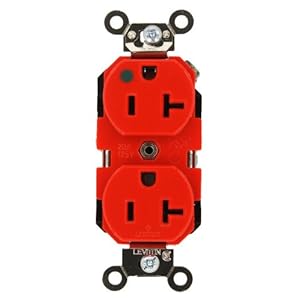
Yet another edit >> Wanna go whole hog on the thing ... I replaced the wall receptacle with a heavy duty "hospital grade" version a while back. Didn't expect much, but was pleasantly surprised to find out it did make a sonic difference. I guess much tighter tolerances and better materials do pay off. Just make sure you go with one that will fit a standard plug. A true hospital grade will just have the horizontal style slots, but you can get one that can accept a typical power cord.
Last edited:
allsmith
Super Member
Thanks sKIZo for all the tips! I will try without the power strip,And yeah i think im skimping out on the speaker wire,i never thought of that! Im using 16 guage dayton speaker wire at about 10 foot length to each speaker.
Also i live in an old farm house and im running off of a original circuit,but the outlet is a new 20 amp and my service panel has been upgraded to 200 amp,i dont think there is much running off of that circuit. I really need to get me a new dedicated circuit ran with new 12/2 wire with ground for all my electronics!
I live in the country and its pretty open out here, i have had lightning strike my power poles down my road,I have lost a tv, a computer, and my realistic audio power meter, and it partially got a cd player(its humming out of one channel) from power surges! That why i keep all my stuff on power strips now,I only turn them on when i use them and if a storm threatens i wont use any of my electronics!!
Also i live in an old farm house and im running off of a original circuit,but the outlet is a new 20 amp and my service panel has been upgraded to 200 amp,i dont think there is much running off of that circuit. I really need to get me a new dedicated circuit ran with new 12/2 wire with ground for all my electronics!
I live in the country and its pretty open out here, i have had lightning strike my power poles down my road,I have lost a tv, a computer, and my realistic audio power meter, and it partially got a cd player(its humming out of one channel) from power surges! That why i keep all my stuff on power strips now,I only turn them on when i use them and if a storm threatens i wont use any of my electronics!!
sKiZo
Hates received: 92644 43.20°N 85.50°W
Wotcher need is an audiophile grade transformer on the pole outside. <G>
I also ran a dedicated circuit all the way behind the primary fuse panel. Yes ... I said fuse panel. Not necessarily because I was all that gung ho about isolating an audio hookup - mostly because I didn't trust what I had to feed the beast. My old country house is still running the original 60 amp service box. Works perfectly well for what it does, and I found a trick long time ago where you add a motor control box directly to the main buss bar for the house. That motor box uses two screw in fuses and you can break that down into two separate new circuits. If I add up all the extra boxes, I'm around 200 amps. You won't get a real electrician to do that, and it probably helps that I don't plan on ever trying to sell the house. I have a feeling certain code issues may have been violated in the process ...
Also ran a separate ground field for that box - not sure if I accomplished anything other than getting some nice exercise pounding a bunch of copper rods into the earth.
Speaking of lightning ... was sitting out on the front porch a couple years back watching Ma Nature getting ready to have a good go at us and <CRACK!!> the transformer that feeds my house took a direct hit that blew it right off the pole. Don't know which was scarier - the strike or the thud as it hit the ground 10 feet away. Fortunately, the power company had talked me into installing a "whole house protector" that slips in behind the meter head. Couple hundred bux, but it saved all the electronics, so money well spent.
Power strips - do try running the receiver directly to an outlet, and if that works, you can upgrade your power strip. I use a couple Eaton industrial grade outlet boxes that do the surge protection and all - certainly not the best, but a big step above the average junk strips they sell at the local big box store.

Special ordered them at the local hardware.
PS ... here's what they're feeding ... which may help explain why power is a real issue for me ...

I got a Kill-A-Watt meter a bit back. Someday when I'm feeling brave I'm gonna have to check just how much juice that sucker's dragging out of the wall when it's hittin' it ... which I'm happy to say, it does on a regular basis.
I also ran a dedicated circuit all the way behind the primary fuse panel. Yes ... I said fuse panel. Not necessarily because I was all that gung ho about isolating an audio hookup - mostly because I didn't trust what I had to feed the beast. My old country house is still running the original 60 amp service box. Works perfectly well for what it does, and I found a trick long time ago where you add a motor control box directly to the main buss bar for the house. That motor box uses two screw in fuses and you can break that down into two separate new circuits. If I add up all the extra boxes, I'm around 200 amps. You won't get a real electrician to do that, and it probably helps that I don't plan on ever trying to sell the house. I have a feeling certain code issues may have been violated in the process ...
Also ran a separate ground field for that box - not sure if I accomplished anything other than getting some nice exercise pounding a bunch of copper rods into the earth.
Speaking of lightning ... was sitting out on the front porch a couple years back watching Ma Nature getting ready to have a good go at us and <CRACK!!> the transformer that feeds my house took a direct hit that blew it right off the pole. Don't know which was scarier - the strike or the thud as it hit the ground 10 feet away. Fortunately, the power company had talked me into installing a "whole house protector" that slips in behind the meter head. Couple hundred bux, but it saved all the electronics, so money well spent.
Power strips - do try running the receiver directly to an outlet, and if that works, you can upgrade your power strip. I use a couple Eaton industrial grade outlet boxes that do the surge protection and all - certainly not the best, but a big step above the average junk strips they sell at the local big box store.
Special ordered them at the local hardware.
PS ... here's what they're feeding ... which may help explain why power is a real issue for me ...
I got a Kill-A-Watt meter a bit back. Someday when I'm feeling brave I'm gonna have to check just how much juice that sucker's dragging out of the wall when it's hittin' it ... which I'm happy to say, it does on a regular basis.

spl225
Super Member
Unrestored 1981 fisher rs-2015 150wpc, Dial bulbs are dimming to the heavy bass hits after it starts getting up past about 80-100 watts.
Is this normal? Or signs of capacitors or transformer getting weak ? This thing has a huge torroidial transformer in it!
How did you figure out how much wattage is being outputted?
allsmith
Super Member
How did you figure out how much wattage is being outputted?
Just based off of what the vu meters are saying, but when the meters start going past 75 watts, 150 comes up pretty fast on the low bass passages, so the the dimming might not be happening till over 100 watts or more

TomTom4049
Member
Incandescent dial lamps tend to mask the effect a bit due to the filaments glowing and they don't cut off real fast like LEDs do. So if you upgraded them to LEDs the effect will be a good bit more noticeable. I'm experiencing this with two Hitachi receivers as well as a Rotel. I find it bothersome. I have 3 or 4 Pioneer receiver that don't do this at all. Better designed power supply perhaps? In a effort to combat this I've added a small board with a bridge rectifier and a capacitor in parallel with the load that helps some. A different cap helps even more. I may try adding another cap in series with the load and see what effect that has. My mod converts the AC supply for the lamps to DC. I'll report back if I find success.Unrestored 1981 fisher rs-2015 150wpc, Dial bulbs are dimming to the heavy bass hits after it starts getting up past about 80-100 watts.
Is this normal? Or signs of capacitors or transformer getting weak ? This thing has a huge toroidal transformer in it!