Dynakit ST70 Hum in the background

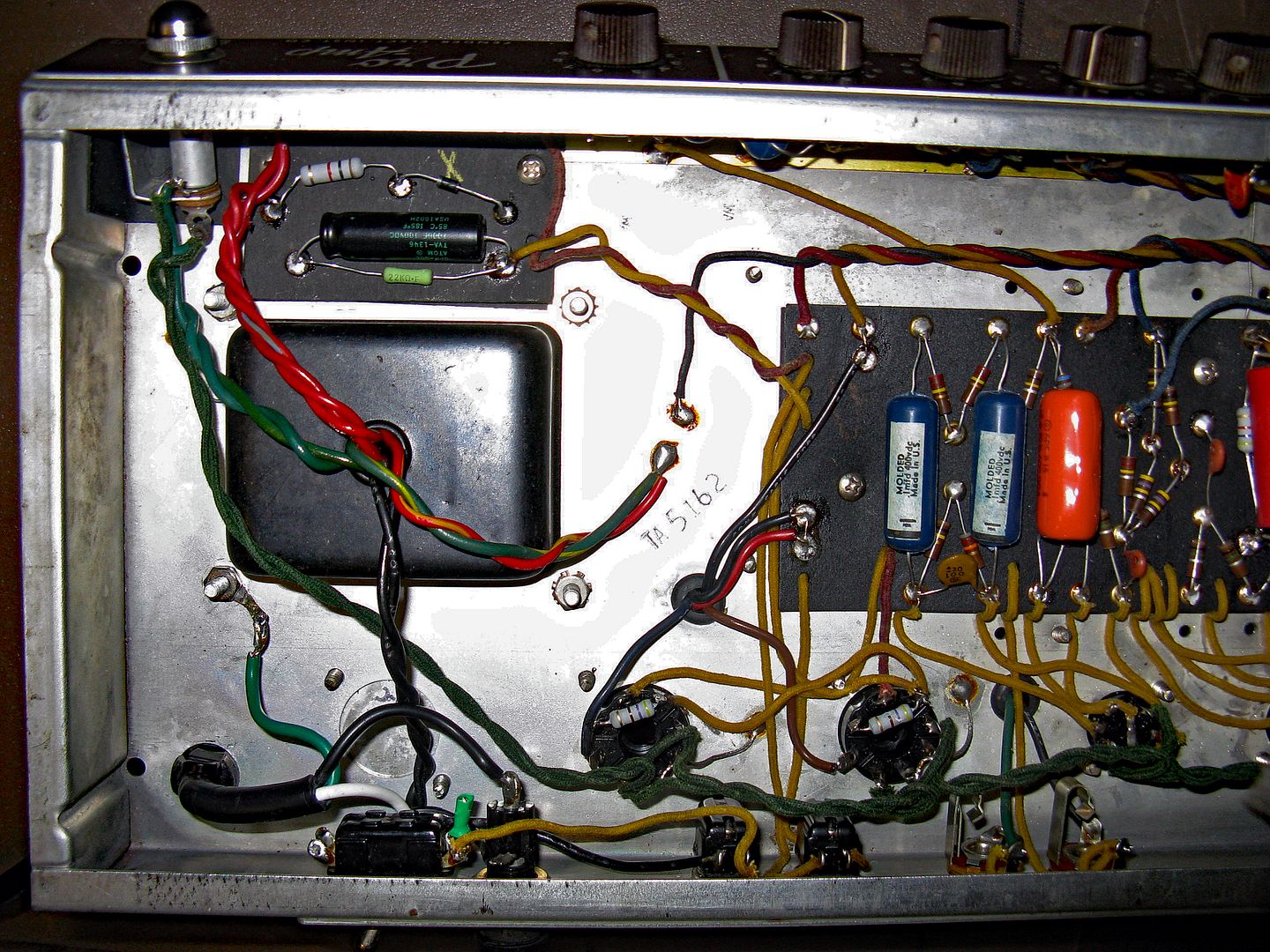
All 4 sections are in use, but note that two are paralleled, so its only 3 supply nodes, not 4 like the stock design used. Looks like they put the lower voltage supply cap on the VTA board instead of being in the can cap like the stock design uses. The board actually has two lower voltage nodes, R13/C13 and R15/C15.

thats also the 40/80/20/30 cap, looks like OP has a 30/20/20/20, so its got less supply filtering already, and with only 20uf after the choke vs the 100uf like the schematic above indicates (80+20) its going to be noisier. Add in the board not being tied to the right supply node and its going to be very noisy.

Add the jumper and it becomes effectively a 30/40/20 which is better, and fix the connection to the board and it may sort the problem without having to re-invent the wheel here.


though if its really messy it may be worth re-working just so its not a mess. Lead dress can cause noise problems, and if its messy it becomes that much more annoying to work on.
 
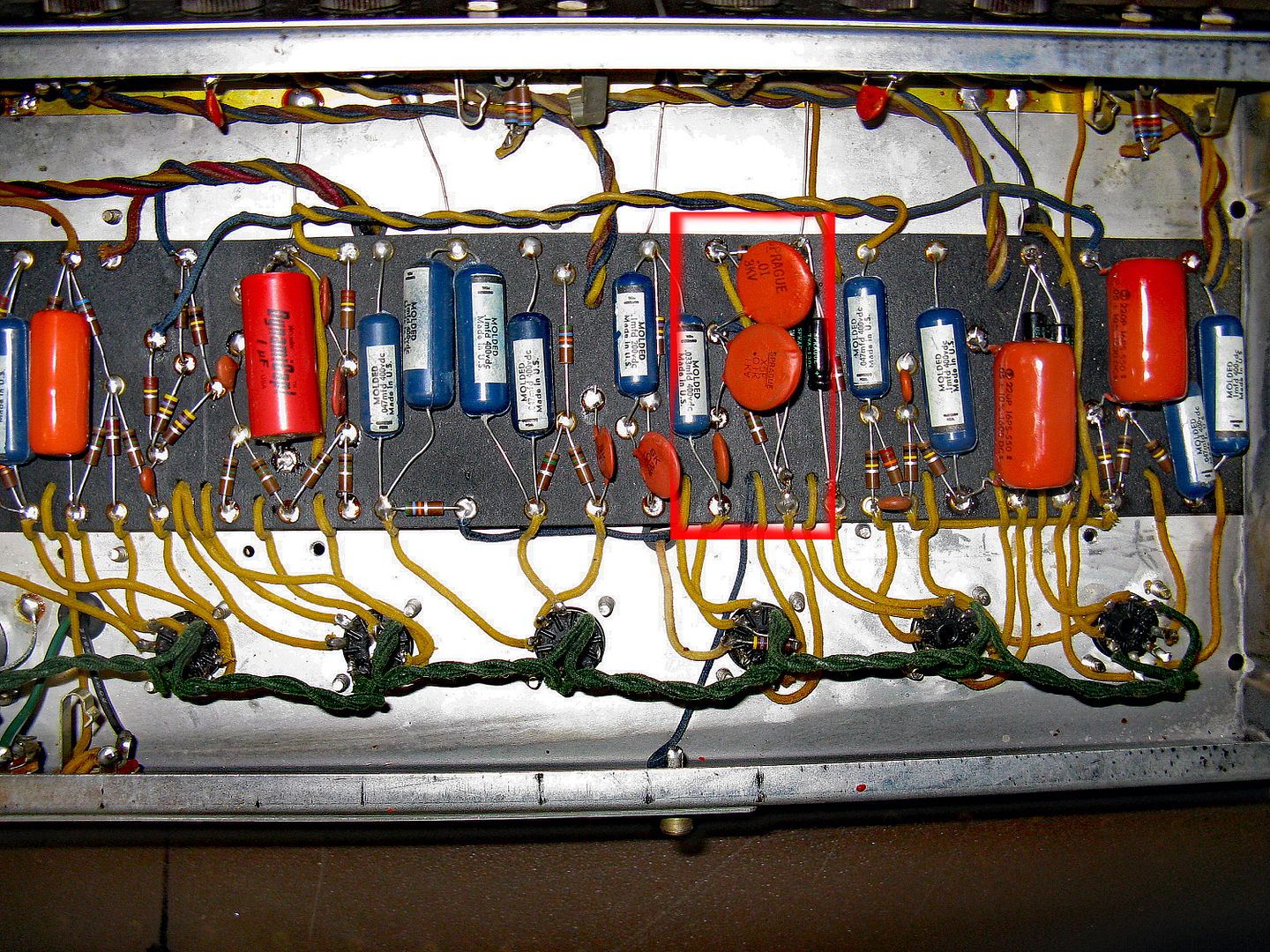
I can do that, but she is a MESS. I think there were three iterations of this amplifier. 1) the initial build 2) an upgrade with a new board removal of rectifier tube 3) my new cap and tubes
Maybe try posting several close-up photos of the chassis's quadrants — and one overall photo? :idea:
 
Make sure to inspect the rest of the unit before reconnecting that cap. You mentioned it was highly modified (maybe even beyond the VTA board?), perhaps they left that disconnected for a reason?
 
Thanks for posting the photos!.


index.php

Check those solder points. If you feel that you can safely work and be comfortable with a live circuit, try tapping the solder points with a WOODEN or fully PLASTIC chopstick or probe. Listening with headphones is the best. Listen for scratchy or pop noises.

Keep your free hand off the chassis! :thumbsup:

Good luck!
 
Looks like the jumper is in there, and the feed to the driver board is actually from the correct place but the wire routing is questionable in some spots, and it looks like odd selections of wire gauge which make things a little more difficult to deal with too. The run to the board looks like overly thick stranded wire. Spitball, 12 AWG THHN, which is the sort of stuff you run through conduits for power circuits. Its too thick to be easily routed and its longer than needed.

the solder work around the quad cap also looks questionable.
 
Wow! What a mess.
Funny thing is the octal socket in your image appears to be attached by rivets...which I think means the unit was "factory" assembled rather than a consumer assembled kit, which used screws and bolts.
You might consider gutting the amp back to the transformers and reassemble while reading "Building Valve Amplifiers" by Morgan Jones. You'll learn about wire routing, wire dressing and best layout practices.
1765052402086.jpeg
I restored my ST70 using the VTA board. Reading Morgan Jones' book while assembling my amp was like taking a college level class with lab. I learned so much and really enjoyed the experience.
The Dynaco ST-70 is a great learning platform. Good luck and enjoy!
IMG_3296.JPG
IMG_3297.JPG
 
^^very nice. Even just rebuilding it using the assembly manual and layout drawing from Tubes4hifi the amp should be nice and quiet.
But paying extra attention to wire routing always helps to insure a quiet amp in the end.
 
The HTS label on the power transformer indicates it is a Heyboer replacement. Probably is the upgraded version as such is a good thing.
 
I think the smart move is to completely start over. I will need to grab some 400V wire in thinner gauges. Whoever was in here, used what was laying around. I think they knew enough to get it to work, but it leaves a little to be desired. I feel comfortable wiring most things. I have quite a bit of background in electronics, but this animal needs some help.
 
I think the smart move is to completely start over. I will need to grab some 400V wire in thinner gauges. Whoever was in here, used what was laying around. I think they knew enough to get it to work, but it leaves a little to be desired. I feel comfortable wiring most things. I have quite a bit of background in electronics, but this animal needs some help.
The nice thing about these amps is the assembly manuals are readily available along with the schematic, layout drawing and a high rez photo of the wired underside.
Looking at the pictures you posted it lols like the original bias pots are connected. What purpose do they serve since the VTA board already has a bias trimmer for each output tube?
 
I will need to grab some 400V wire in thinner gauges
You don't need 400 v wire for everything. The heater supplies don't require 400 v wire.
I like to use high temperature wire and different colors for different parts of the circuit. Red for example is B+.
I think the Morgan Jones book I mentioned in an earlier post may have a color code standard.
 
You don't need 400 v wire for everything. The heater supplies don't require 400 v wire.
I like to use high temperature wire and different colors for different parts of the circuit. Red for example is B+.
I think the Morgan Jones book I mentioned in an earlier post may have a color code standard.
I buy the color wire assortments on spools. Mostly solid wire 20 and 22 ga. with a few different colored 18 ga. spools. The first assortment I bought came with a metal spool holder I have screwed to the shelf above my bench.
 
Ok, I bought the necessary wire, I pulled anything that looked wrong out and I have it all nice and neat. It had a diode rectifier network that was built to replace the GZ tube and a series of capacitors that seemed to play a role in that as well. Anything that was not on the provided diagram from Tubes4hifi, was eliminated and reworked. I get great sound out of it and I will post pictures hopefully later today.
 
Several good pics should be helpful. You likely still have Dynaco iron, but it sounds like the circuit is VTA...though possibly a modified version of that.
 
Ok, I bought the necessary wire, I pulled anything that looked wrong out and I have it all nice and neat. It had a diode rectifier network that was built to replace the GZ tube and a series of capacitors that seemed to play a role in that as well. Anything that was not on the provided diagram from Tubes4hifi, was eliminated and reworked. I get great sound out of it and I will post pictures hopefully later today.
One piece of advice — leave just enough length of wire so you can move them around, once the soldering is completed. Not long pieces of wiring, but enough to alter the geometry and closeness of one wire to another.

I always listen through headphones and move the wiring to the quietest position. Then secure them with small tie wraps.

93789090-ed6d-4423-8ccc-5006b959eff1.jpg


e0f0bf03-a5ea-4617-9cb9-4f06d3964889.jpg

Try to make the wires cross close to 90 degrees, if possible. Especially wires carrying a small signal current.

I like single-stranded wire for circuit work, because it holds its shape better than multi-stranded wire.

Good luck! :thumbsup:
 
Last edited:
Back
Top Bottom