• The move to the new server is done. There are some software and database maintenance updates in process. This has us passing the hat around to help out. We appreciate any donations. Seriously, even a dollar helps. The payment page may be found here - https://www.audiokarma.org/support.html

ESS Bookshelf AMI

LBPete

Rolling Along
Subscriber
Can anyone ID these speakers? They are marked ESS Bookshelf. The grill badge says AMI but I don't see any reference to this model. They have what looks like 12" woofers with die cast frames and large ribbon tweeter with a 12" radiator on the back. They are very heavy for their size. I'll try to post pictures later.

- Pete
 
Register to hide this ad
Could it possibly be AMT. On some ESS badges the "t" in amt was a lower case letter not completely crossed, just a small mark on the right side. Perhaps the gold paint has worn off there.
 
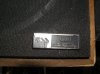
It may say amt. It's in lower case letters and the "I" is taller than the rest. It also looks like it has a small faint cross mark. The badges are pretty worn. The badges also say "Heil Air-Motion Transformer System." Did ESS make an AMT bookshelf speaker?

- Pete
 
I'm pretty sure I saw a pair of what you are describing over the summer at a thrift store. They were trashed so I didn't pick them up. They had ESS and AMT on them.
 
Yes, AMT1B for bookshelf.

If you fix them up they will run with the other top designs of the time.

Thanks,
Ron-C
 
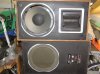
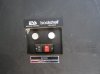
Here are some pictures. Are they AMT1Bs?

- Pete
 

Attachments

  • ESS Speakers.jpg
    ESS Speakers.jpg
    72.3 KB · Views: 114
  • ESS Badge.jpg
    ESS Badge.jpg
    101 KB · Views: 52
  • ID Plate.jpg
    ID Plate.jpg
    44.8 KB · Views: 48
Yep, that is them. The Heil can be rotated if you run them on their sides. I think you will need new surrounds and a little veneer work....

Thanks,
Ron-C
 
Fix 'em up!

Those look very similar to my ESS AMT-10b speakers. If the AMT tweeters are intact, those speakers are well worth the effort and minimal expense to refoam the woofers and passive radiators to get them up and running. These are great speakers and are far better than most of the stuff around today.
The AMT tweeters are one of the few GENUINE audio breakthroughs. They bear comparison with the best electrostatics. Don't let these get away!
2chanman
 
Thanks guys. I will fix them up and see how they fit in with my other systems. The cabinets are in reasonably good shape with the exception of the chips on the front edge. The grills will need some work too.

I haven't tested the drivers yet. Are the tweeters rebuildable if they need it?

- Pete
 
Thanks guys. I will fix them up and see how they fit in with my other systems. The cabinets are in reasonably good shape with the exception of the chips on the front edge. The grills will need some work too.

I haven't tested the drivers yet. Are the tweeters rebuildable if they need it?

- Pete
Yes, diaphragms are available for most of the Heil tweeters. They can be found: here. I'm working on a home-brew system with the Heil AMT-1's, at present. When you get the woofers up and running, post back with your impressions, please.
Since the Heil tweeters were so efficient and fast, matching woofers to them is a chore. This is if you wish to keep a two-way design, which I do. I have a pair of Dynaco woofers, en route. Will post back with results when I have the woofers and cabs done. Good luck with the Heil's.
 
If you need a diaphragm for those, let me know. I think I can still get them for a damn sight cheaper than $110 ea.
 
I have those! Same exact model, in about as bad or worse condition when I got them. WIth new surrounds on the woofers and passive radiators, you'll find you have very nice speakers... BUT here is what you must do to them, if you want REALLY good sound from them:

(1) Get those AMTs OUT of that box. Half (or more) of what makes that "Great Heil" driver sound so wonderful is the back-wave that comes out the back of it, in an open dipole manner. With it stuffed in the bookshelf with the back side all damped down, there is no back-wave. Just moving the AMT up on top of the box, in the open (like the other early ESS speakers) will do wonders to open up the sound and give a sense of spaciousness and sound-stage. Big, big improvement, and easy to do.

(2) Seriously consider changing the crossover or using an external crossover that allows you to convert these 2-way speakers into 3-ways. The sound is more balanced and better, if you move the low end of the Heil up a bit, and let the woofer stay a bit lower, where it belongs.

I can't tell you exactly WHAT makes the best mid-range for this, as there are numerous opinions about it out there (search online and you'll find lots of ideas), and I'm still experimenting, but from listening to several different 2-way and 3-way ESS speakers, I think the 3-ways sound better.

Even if you decide not to go through all the hassle of converting it to 3-way, AT LEAST get that AMT mounted ON TOP OF the box, vertically aligned with the dust cover of the woofer, and cover over the hole on the front where the AMT was. You'll be amazed at how big an improvement this makes.

If you go 3-way, put the midrange driver in the hole where the AMT was, instead of the AMT which then is on top. You can mount various mid-range drivers on boards cut to cover that space, with a gasket to make them air-tight, and it becomes easy to swap the drivers around for comparison, even if they are different diameters. The space behind it is a reasonable size for most mid-ranges you'd put there, and you can re-use the original damping material that was packed there behind the AMT.

Oh, and if it sounds like too much work and/or you don't like the speakers, I'd me more than willing to take those AMTs off your hands (I'm "on the warpath" to find a few more. I want to try a vertical line-array like set of them!).

 
To augment what Arkay mentioned, I recall that ESS had a nearly identical bookshelf model that ported /vented the AMT on the backside of the cabinet via a tube, so that the backwave and passive worked together. If you're going to keep them and play around with them, you might consider devising a rear port for the backside of the AMT, rather than pulling it out of the cabinet.

Also, the AMTs in those cabinets seem to be the updated ones first which first appeared on the AMT-1d floor towers, with the wider spaced black teeth. Those alone are worth much more than whatever you paid for the pair. Refoam them, recap them, and put them to work. I doubt very much that you'll be disappointed...
 
Thanks for the ideas guys. Arkay, I like the ideas but I've got too many projects lined up already. The next step is to check them out to see if the driver work. Then I'll consider what to do with the cabinets.

Since these are bookshelf speakers, I assume they are designed to sit on a bookshelf. That means the radiator on the back is facing the back of the cabinet and usually in a confined space. That has to affect their sound. I really want to hear them to see what they can do.

- Pete
 
The passive radiator shoud not be radiating into a confined space like a bookshelf. I have my AMT10B's sitting vertically on speaker stands which are located in the corners of the listening room. There is free space behind the speaker cabinets so the passive radiators can contribute significantly to the Bass response of the speakers. These speakers are really too big and heavy to be crammed into a bookshelf. If the passive radiator is jammed up against the back surface of a bookshelf, It cannot do it's job and Bass response will be sharply curtailed.
You can check whether the AMT's are ok by disconnecting them from the crossover network and applying 1.5 volts from a aa, c, or d cell. You should hear a click from the driver each time you make contact and complete the circuit. Make contact only for an instant! Leaving a battery connected for any length of time could damage the AMT. A better test would be to use an analog ohmmeter. If you use a solid state digital V.O.M., it applies such a low voltage that you might not hear any click. Either type of V.O.M. will give you a low resistance reading when connected to the AMT. It should read less than 10 ohms, and the readings should be the same or very close for each AMT. You can check the voice coils in the woofers the same way. Assuming that they are 4 ohm, you should see about 3.2 ohms. Any driver you are checking should be disconnected from the crossover network so that you don't get false readings due to the crossover components. Don't operate the woofers with audio while the surrounds are shot, as you could damage the voice coils by doing so. If the AMT's and woofer voice coils are intact, you can go ahead and refoam the woofer and passive radiator surrounds. You can consider yourself very fortunate if the AMT diaphragms do not have to be replaced. Your best hope is that the speakers were sold because the woofer and passive radiator surrounds were shot rather than the AMT's being damaged.
I'm not sure that operating the AMT's out of the cabinet with no damping behind them is a safe idea as was suggested in another post here. I would try them in the cabinets first and see if you find the sound satisfactory before experimenting. The diaphragms may be overdriven without damping.
2chanman
 
Agreed on everything 2chanman says except that last part about the Heils needing to be used inside the speaker to avoid damage. That part is pure frogwash.

By the way, the b in amt-1b doesn't stand for "bookshelf" -- there was a floorstanding amt-1b as well. I own a pair.
 
Thanks for the ideas guys. Arkay, I like the ideas but I've got too many projects lined up already. The next step is to check them out to see if the driver work. Then I'll consider what to do with the cabinets.

Since these are bookshelf speakers, I assume they are designed to sit on a bookshelf. That means the radiator on the back is facing the back of the cabinet and usually in a confined space. That has to affect their sound. I really want to hear them to see what they can do.

- Pete
Foe experimentation I ran the AMT-1's on one channel of a receiver with a Solen 18mfd cap and ran a pair of Klipsch 2.0's (they have a passive radiator on back) on the other channel. The cap crossed the Heils a little too high but results were stunning. I had the Heils atop the small Klipsch 2.0s with some pieces of whatever to decouple them from the Klipsch boxes.
I was impressed enough to pursue these as a new main speaker setup. I now have some Dynaudio 10" woofers and plan to set them up to see if I can reach a suitable crossover point for both.
Perhaps adding a passive radiator, as the original ESS models will control the bass to get the speed necesary to combine with the Heils.Also, that would take advantage of the dipole character of the Heil. Lacking that, the addition of a mid is the only other solution. That would need a more complex crossover and that's something I'd like to avoid.
 
I once stacked two large Heil's on an AMT-1.
Was afraid to keep connected that way long. Thought something would happen to the crossover.
 
Back
Top Bottom