

-
Feeling lucky? Check out the AK 24th Anniversary Giveaway thread and join in the fun!
You are using an out of date browser. It may not display this or other websites correctly.
You should upgrade or use an alternative browser.
You should upgrade or use an alternative browser.
Exactly what is a "Studio Monitor?"
- Thread starter realjimjim
- Start date
- Status
- Not open for further replies.

djmtascam
Active Member
Pink Floyd would be just as big a waste as the Moody Blues at 100 db from 22 to 22,000hz..
I suppose any material you "listen" to is relative to what type of speaker you use...
I don't record and mix film scores with full orchestra's...so if I win the lottery maybe I would buy a pair of those for $24,000 and build a recording studio and control room around them...

JimPA
Distinguished Member
I don't think a recording studio would be necessary. Just a large listening area.
A very accurate speaker even with it's limitations reveals the quality of the recording.
A Saucerful of Secrets compared to the Wall. Lucifer Sam is limited to the technology of it's time. The Moody Blues In Search of the Lost Chord compared to Strange Times in playback spl and clarity.
A very accurate speaker even with it's limitations reveals the quality of the recording.
A Saucerful of Secrets compared to the Wall. Lucifer Sam is limited to the technology of it's time. The Moody Blues In Search of the Lost Chord compared to Strange Times in playback spl and clarity.
djmtascam
Active Member
I don't think a recording studio would be necessary. Just a large listening area.
A very accurate speaker even with it's limitations reveals the quality of the recording.
A Saucerful of Secrets compared to the Wall. Lucifer Sam is limited to the technology of it's time. The Moody Blues In Search of the Lost Chord compared to Strange Times in playback spl and clarity.
True, but if I was buying those B&W I might as well have the control room.
Thanks sm19422 for those tune ideas, I am listening to those with cans now because it's late and my speakers are off the grid for the night.
Saucerful is so much older and less refined. Dark Side of the Moon is still my fav..
But technology moves on!
Diamond tweeters and Kevlar cones...

Rapidan
Well-Known Member
Getting to the OP's question, you can tell the Les Paul owner that L100's are exactly the same as 4311's - The consumer version just hid the L-pads behind the grill for aesthetic reasons. If he's working/listening in mostly analog formats, they might work fine. Many great recordings were tracked and mixed on them.
Sorry, I totally disagree with this. If this were true, we'd only need one type/brand of monitor, and every engineer would use it. And every mix would sound good. (or at least "accurate")
Others have pointed out the reality of the situation - But I'll try to summarize. "Control" or "Reference" or ""Tracking" monitors are usually used to record, balance and evaluate what's being put on tape(or other media) , edited, overdubbed, or punched in. As mentioned, they need to deliver/withstand high SPL's and dynamics, and brutally evaluate sounds before they are committed to. Certainly they have a role in playback and mixing, but generally the modern trend is to use separate mixdown monitors, often near- or mid-field. These HAVE to be voiced in a similar fashion to consumer hi-fi, so that mixes "translate" to the final listener.
Mixdown monitors have an inverse relationship to the final playback system, which is why flawed monitors like NS-10's, Mackies and others work so WELL. As mentioned, the painful mid spike in NS-10's will cause a mixdown engineer to back down the mids a little, resulting in a more open, less cluttered sounding mix for many listeners. That said, they still need to sound good with a wide variety of sources.(Which is why I always disliked NS-10's in all their iterations). I would never consider a pair of mixdown monitors or nearfields which weren't good for home listening. And many engineers use a variety of home hi-fi speakers for mixing and evaluation - look around.
Actually, the first across the board rule in pro audio/ recording is, "never use more than one mic". The second rule is "always ignore rule one".
wow. quoted for posterity.
the single greatest across the board rule in pro audio and studio work is TO NOT MIX ,MASTER OR TRACK on home audio and consumer speakers because of enhanced frequency curves.
this is a known fact.industry wide.
AGAIN lol :
monitors= designed for flat freq response for accurate mixing and mastering
homeaudio speakers= playback devices with pleasing curvs on the low and high end frequencies for nice sounding playback for the home listener.
Sorry, I totally disagree with this. If this were true, we'd only need one type/brand of monitor, and every engineer would use it. And every mix would sound good. (or at least "accurate")
Others have pointed out the reality of the situation - But I'll try to summarize. "Control" or "Reference" or ""Tracking" monitors are usually used to record, balance and evaluate what's being put on tape(or other media) , edited, overdubbed, or punched in. As mentioned, they need to deliver/withstand high SPL's and dynamics, and brutally evaluate sounds before they are committed to. Certainly they have a role in playback and mixing, but generally the modern trend is to use separate mixdown monitors, often near- or mid-field. These HAVE to be voiced in a similar fashion to consumer hi-fi, so that mixes "translate" to the final listener.
Mixdown monitors have an inverse relationship to the final playback system, which is why flawed monitors like NS-10's, Mackies and others work so WELL. As mentioned, the painful mid spike in NS-10's will cause a mixdown engineer to back down the mids a little, resulting in a more open, less cluttered sounding mix for many listeners. That said, they still need to sound good with a wide variety of sources.(Which is why I always disliked NS-10's in all their iterations). I would never consider a pair of mixdown monitors or nearfields which weren't good for home listening. And many engineers use a variety of home hi-fi speakers for mixing and evaluation - look around.
Actually, the first across the board rule in pro audio/ recording is, "never use more than one mic". The second rule is "always ignore rule one".
Last edited:

dnewma04
The Healer
JohnVF,
I think it's pretty hopeless, this argument with the man with "10 years of professional experience". Clearly the people with 20-40 years of experience don't know what they are talking about. Clearly the NS-10M is very flat and accurate despite, well, not being very flat or accurate. Even more clearly, home audio speakers all look like a smiley face EQ, just look at all those measurements and you can see it if you draw a new frequency response over the top of the measured ones and make it a smiley face.
There are a number of reasons why some home audio speakers woulnd't make good studio monitors, but I don't think our amazing pro audio guru has named one of them, yet. And the reason he did list don't really have any merit.
I think it's pretty hopeless, this argument with the man with "10 years of professional experience". Clearly the people with 20-40 years of experience don't know what they are talking about. Clearly the NS-10M is very flat and accurate despite, well, not being very flat or accurate. Even more clearly, home audio speakers all look like a smiley face EQ, just look at all those measurements and you can see it if you draw a new frequency response over the top of the measured ones and make it a smiley face.
There are a number of reasons why some home audio speakers woulnd't make good studio monitors, but I don't think our amazing pro audio guru has named one of them, yet. And the reason he did list don't really have any merit.
dnewma04
The Healer
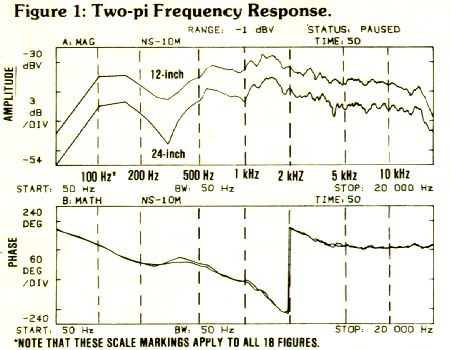
Just for fun, here are a few samples of older speakers that were used as studio monitors.
L100 (4311)

Altec 604-8G

Tannoy Monitor Gold 12"
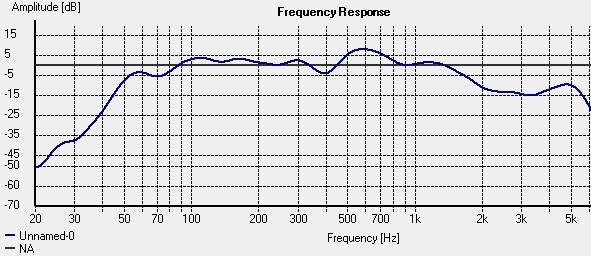
NS-10M
Steve Hoffman uses some Venture Audio Perfect MkIVs, which I can't find a frequency graph for. He also uses Rogers LS3/5a.

Focal Grand Utopia is used in one of the better studios around:

L100 (4311)
Altec 604-8G
Tannoy Monitor Gold 12"
NS-10M
Steve Hoffman uses some Venture Audio Perfect MkIVs, which I can't find a frequency graph for. He also uses Rogers LS3/5a.
Focal Grand Utopia is used in one of the better studios around:
bowtie427ss
Lunatic Member
Bob Ludwig's studio monitors at Gateway Mastering:

bowtie427ss
Lunatic Member
The mains appear to be Ivy's from a couple years ago, center is an Andra II.
I hope to own a pair of Eggleston Works Andras someday, finest loudspeakers i've heard at length. I can only imagine what those Ivy's are like, six 12 inch woofers in each cabinet.
I hope to own a pair of Eggleston Works Andras someday, finest loudspeakers i've heard at length. I can only imagine what those Ivy's are like, six 12 inch woofers in each cabinet.

Real studio monitors are designed to be flat +/-0.5db from 40-25k.
Can you provide an example of a speaker that is +/-0.5db from 40-25k?
dnewma04
The Healer
Can you provide an example of a speaker that is +/-0.5db from 40-25k?
I can't, if that means anything. Genelec, JBL, Urei, Tannoy, and ATC can't either.
Genelec does come close with their 8250A with it's built in DSP. It's able to get to +/-1dB from the high 30s to ~21khz.
Last edited:
dnewma04
The Healer
Never send a boy to do a man's job... oh there's that man thing again! And you know I'm just kidding dNewma!
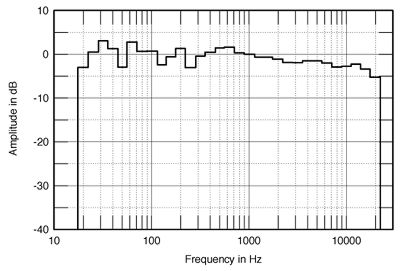
Fig.10 KEF R107/2, spatially averaged, 1/3-octave, free-field response in JA's listening room.
In-room, these quasi-anechoic measurements translate to a flat frequency balance, with excellent low-frequency extension, as shown in fig.10. This measurement, which I have found to correlate well with the perceived tonal balance of a speaker in my room, shows the 1/3-octave in-room response spatially averaged across a 6' by 2' window at the listening position to minimize the effect of room standing waves. No wonder the R107/2 sounds so smooth, so neutral!

The list of home audio speakers that measure as flat as most studio monitors and lack the coloration that is described by one poster is probably hundreds of models long. I just randomly took a few bits from one source of measurements that I was aware of. KEF, Snell, JBL, ADS and a long list of others were making home audio speakers without the smiley EQ since the 70s.

Bob Fine did OK with these making the Mercury Living Presence recordings. His recordings are highly regarded and sought after more than 50 years after they were made.


Funny too how glorious those RCAs of Reiner and the CSO sound. How'd they do that? Talent?

Funny too how glorious those RCAs of Reiner and the CSO sound. How'd they do that? Talent?
Rapidan
Well-Known Member
Ive seen and know the plots. Those are designed for playback. Great home audio speakers YES. Suitable for mixing on?....negating everything ive said? Not really. Audiophile reference sure. As an example i would be hesitant to really crank a urei compressor, or a ssl channel strip or any other peice of outboard effects gear when mixing on audiophile equipment.
Gearslutz,harmonycentral,futureproducers,homerecording forums...even the duc. Yes ive been on them for years but what matters is real world experience right?
You know as well as i do how important it is to have a set of dedicated near feild monitors to mix properly on and what a difference they can make.
Hoo boy. I just caught this post.
First, as Dnewma points out, some pretty serious monitors have some pretty serious "flaws". How, oh how, were the brave engineers of the past able to record and mix some of the greatest pop music of all time on these dogs?
One answer is, they knew what they were doing, and how to compensate for the shortcomings ALL speakers have. Also, they got lucky in that the flaws in the best monitors actually HELPED them to produce better mixes. Inverse relationship, remember? It's likely better to stay in the middle of the pack if you want to reach the widest audience, audiophiles to iPods.
When I was doing this kind of work full time, a "UREI" compressor was badged UA or Teletronix. And an SSL channel strip was the input module on a Solid State Logic console. Neither one would be "cranked" as an "outboard effect". (Well, ok, maybe we used an LA-2A to fatten up some guitars and lengthen their sustain). Maybe I'm too old to understand, but why that wouldn't sound like ass on any playback system has escaped me.

SimplySound
Kent Engineering & Fondry
Focal Grand Utopia is used in one of the better studios around:
Now THERE is a set of speakers! And I don't think they have "monitor" in the name!


Jon_Logan
Addicted Member
Yeah, that's terribleIf Wiki is where you are getting all of your information from, sure you might as well post it.
dropping names to sound important?
Eggleston, Focal, etc, etc. Everyone seems to be doing it, so...
dnewma04
The Healer
I think the only thing that anyone disputed was the blanket and largely untrue statements that jrevo was making. Home audio speakers, generally speaking, don't aim for accentuated bass and highs. And some of the most popular studio monitors aren't particularly flat themselves.
- Status
- Not open for further replies.