• The move to the new server is done. There are some software and database maintenance updates in process. This has us passing the hat around to help out. We appreciate any donations. Seriously, even a dollar helps. The payment page may be found here - https://www.audiokarma.org/support.html

For Mech... LS3/5a Prototype... $600

SimplySound

Kent Engineering & Fondry
Seems pretty rare... price is very fair... but are they real or a DIY job? There's no tags or identifiers, but the drivers appear right and the cabinets seem to be well built and vintage(?)...

What say ye LS3/5a heads? Real or Memorex?

No affiliation, yada, yada, yada...

For Prosterity....

$(KGrHqR,!qwE-Y6DPhPHBP1skIH2uQ~~60_12.JPG


$(KGrHqNHJBEE+P7UkSqlBP1skIyFmg~~60_3.JPG


$(KGrHqZHJDoE+PSb,ylsBP1skKlbuQ~~60_3.JPG


$(KGrHqZHJCoE-v8DQDFJBP1skKmbW!~~60_3.JPG


$(KGrHqRHJC4E-+qZ6wO!BP1skKnYg!~~60_3.JPG
 
Register to hide this ad
I just realized that those are ports on the bottom, which begs the question; were there stands? :scratch2:
 
I would dare say that these are definately DIY. The woodwork looks to be solid and good but these are certainly not LS3/5a, even DIY versions of those.

For the BBC design, the woofer needs to be mounted to the back of the front baffle. Deadening material should be applied around the tweeter.
Also, the LS3 design is a sealed, high Q alignment. These boxes appear to be significantly larger compared to the LS3 design. Also the tweeter should be mounted closer to the woofer and on the same vertical axis - to follow the original design.
And the pictured crossover looks like a generic KEF DN13 for a two way system used with a 3 way slot connector (!!) so it probably wasn't meant for the B110/T27 pair.

Now, the pics of the enclosures don't really help understand those holes in the bottom but a ported design needs to have a port length inside the enclosure. These simply appear to be holes - as far as I can tell from the single pic showing the inside part of the holes.

Finally, the enclosures should be stuffed. Ideally they should be laminated with deadsheet (bitumen sheets) or dynamat and stuffed with porous material. This can certainly be retrofitted but the lack of these tells me that this is an unfinished DIY contraption with a poor mix-and-match of drivers and crossover.

Certainly not worth the asking price.
 
Last edited:
You Rang?!? (best Lurch voice)

As for the speakers, absolutely not an LS3/5a prototype but rather, as the auction mentions, an offshoot exploration of a ported version of the LS3/5a.

Saw the auction and pics, someones well built box using thick plywood, completely glued shut except for the back screw on wall. As SaSi said, no BBC thin wall construction, no damping material, no internal acoustic foam damping, non-sealed box (BBC didn't much like reflex systems till later 1980's), off the shelf generic KEF constructor type crossover, much bigger box.

Looks to me almost like a DIY KEF Coda, KEF's first small speaker using the B110 and T27 combo.

KEF_CODA_0101154136.jpg
KEF_CODA_2_0101154136.jpg


I saw a DIY LS3/5a cabinet made from solid Rosewood once, heard that it didn't sound very good. Most people trying to "improve" on the LS3/5a found that the box played an integral part and that a deader box was not necessarily "better" but different, which then required a lot of crossover tweaking.

However, lots of small speakers in the mold of the LS3/5a, some quite good.

Worth $600?? Nah, not in my book. Value to me is only in the drivers if they are in good condition, I'd only pay $250 tops, they may fetch $300+ on the bay from somebody.

 
Oh, BTW, the "Quadrex" grille (which was JBL's trademark for the open filter foam material and pattern used famously on the JBL L100 Century) appears suspiciously looking like the cheap RatShack block foam grille replacement that was available in the 70's and 80's.

http://www.radioshackcatalogs.com/catalogs/1979/

See page 23 of the 1979 Radio Shack catalog.

This speaker was a nice DIY concept study, but sure didn't seem to use many decent speaker design techniques except quality cabinet construction, I guess.
 
Oh, BTW, the "Quadrex" grille (which was JBL's trademark for the open filter foam material and pattern used famously on the JBL L100 Century) appears suspiciously looking like the cheap RatShack block foam grille replacement that was available in the 70's and 80's...

Yeah, and it doesn't even look cut very well. I'm with you guys, probably a cock and bull story. The guy would have to have a lot more "provanance" to even convince me that they came from KEF or any other LS3/5a manufacturer.

And help me with this one... what is the reference to "Chipton"? :scratch2:

PS.... nice looking pair of Coda's there Mech!
 
Last edited:
I don't know how anyone could tell the difference between a DIY job and a random prototype slapped together at the mfg., unless you know someone that was working there at the time. Worth the value of the drivers, IMO, which I assume is not $600.
 
I don't know how anyone could tell the difference between a DIY job and a random prototype slapped together at the mfg., unless you know someone that was working there at the time. Worth the value of the drivers, IMO, which I assume is not $600.
IMHO, If it was a genuine prototype, it wouldn't have used an off-the-shelf generic crossover plugged to a 3-way KEF slot connector. It would have used a prototype, more complex, crossover.
 
Wasn't the LS3/6 Ported? That was early 70's no? Anything before that?

The LS3/6 was ported, but used a very early developed be bextrene coned BBC driver which had pretty poor reliability (early adhesives and former materials). It wasn't built in large numbers as its limitations spurred additional development and use of the Spendor BC1 and Rogers Export / Studio 1 monitor lines outside of the BBC and then the BBC created the LS5/8 and LS5/9 which were both ported.
 
The LS3/6 was ported, but used a very early developed be bextrene coned BBC driver which had pretty poor reliability (early adhesives and former materials)...

Yeah, that's what I've read... but I've also read that although they don't handle power well (25W Max) they do sound "magical" under Tube Power if the Bass Driver is functional!

Hey Mech, were all the /8's active? And the /9 was a passive version? Right?

And I'm sticking with my quest for a Rogers Studio 1... or perhaps an IMF Compact 3. Man, the wish list never ends...
 
Yeah, that's what I've read... but I've also read that although they don't handle power well (25W Max) they do sound "magical" under Tube Power if the Bass Driver is functional!

Hey Mech, were all the /8's active? And the /9 was a passive version? Right?

And I'm sticking with my quest for a Rogers Studio 1... or perhaps an IMF Compact 3. Man, the wish list never ends...

The LS5/8 was the larger of the two, built off designs by the BBC and provided by Rogers and Chartwell, and came in passive and active versions, the active version powered by Quad SS amps.

The LS5/9 was built by Rogers, and later by Harbeth, IIRC and was only passive.

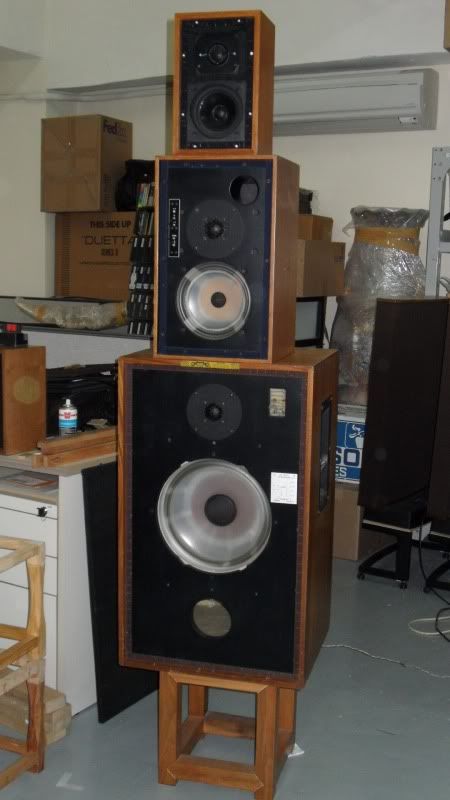
Here's a pic of some LS5/8's in a Far Eastern (HK/Chinese) collectors environment. Note they are just as fanatical as we are!

BBCLS58004.jpg

P1060235.jpg
BBCLS58005.jpg


This is how LS5/8's get shipped to the Far East, these guys are very, very serious!

Massivedestruction004.jpg


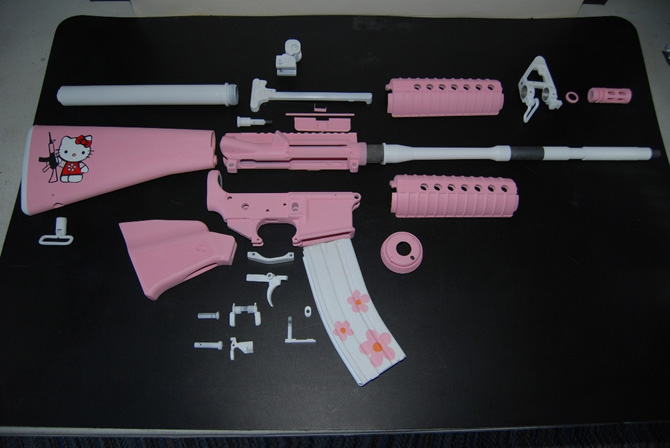
Course they also have stuff like this too:
hello-kitty-ar-15-rifle-2.jpg
 
Wow, that's some serious stuff there, including what I assume is a REAL AK47!

I liked the 5a/9/8 stack... bet that sounds sweet! :music: Didn't realize the 9's were THAT much smaller than the 8's.
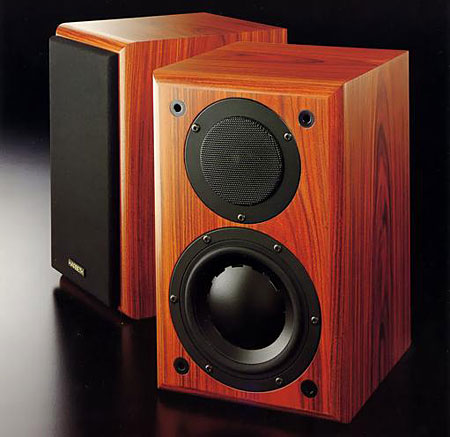
 
Yeah, essentially the LS5/9 is an outgrowth of the LS3/5a requirement for a "small" speaker but higher quality still and better SPL output. To do so, a new larger polypropylene driver in a bigger vented cabinet was needed for the bass output to keep up with rock 'n roll and then new digital sources.

Interestingly, the last of the BBC designed studio monitors was the LS5/12a (don't know what happened to /10 and /11), designed in cooperation with Dynaudio and Harbeth who then supplied them to the BBC. Used Dynaudio components. Most reviewers felt it was too bright sounding.

Today, my understanding is the BBC uses mostly Harbeth and some PMC monitors, both of which can trace lineage to BBC engineering techniques.

The LS5/12a:

512harbeth12a.jpg
 
Back
Top Bottom