Grundig Super HiFi Box speakers - Any users or experience out there?

Asza

New Member
I've got a reserve down on a pair of Grundig Super HiFi Box 850a Professional that I am listening to and hoping to take home this week, all being well. Does anyone here have any experience with these, or perhaps other models from the same line up? I'd like to know if there's anything I should be looking out for, or any advice, as these are also my first pair of passive speakers I've ever bought! They will be paired with a MF E100 Integrated.

Thank you
 
Register to hide this ad
I've got a reserve down on a pair of Grundig Super HiFi Box 850a Professional that I am listening to and hoping to take home this week, all being well. Does anyone here have any experience with these, or perhaps other models from the same line up? I'd like to know if there's anything I should be looking out for, or any advice, as these are also my first pair of passive speakers I've ever bought! They will be paired with a MF E100 Integrated.

Thank you
I have not had any 850's but have had several sets of 650's and 650b's.

My thoughts in general:
For my tastes most Grundig speakers are not all that attractive.
However, they sound pretty darn good.

They have well made crossovers with air core coils. recap them and use film caps for the smaller values where size and cost allows.
The old solder connections all need to be redone. Not re-flowed! De-soldered, cleaned with acetone and resoldered. Each and every one including the connection wires and driver connections.

The tweeters are the weak point. Drive them into clipping and the tweeters will burn, and they are getting harder and more expensive to find on ebay. That means do not under-amp. Use an amp that outputs 10% to 20% more RMS power @4 ohms than the speaker is rated at. For the 850a I would be looking at 75w or a bit more. Then just be careful about how far you turn it up.

The driver faceplates for the "normal" and "Professional" series are not the same, so, not interchangeable in the cabinets. This is important when sourcing replacement drivers.

Enjoy them, properly restored they will be some pretty good sounding speakers.

:beerchug:,
James
 
I have not had any 850's but have had several sets of 650's and 650b's.

My thoughts in general:
For my tastes most Grundig speakers are not all that attractive.
However, they sound pretty darn good.

They have well made crossovers with air core coils. recap them and use film caps for the smaller values where size and cost allows.
The old solder connections all need to be redone. Not re-flowed! De-soldered, cleaned with acetone and resoldered. Each and every one including the connection wires and driver connections.

The tweeters are the weak point. Drive them into clipping and the tweeters will burn, and they are getting harder and more expensive to find on ebay. That means do not under-amp. Use an amp that outputs 10% to 20% more RMS power @4 ohms than the speaker is rated at. For the 850a I would be looking at 75w or a bit more. Then just be careful about how far you turn it up.

The driver faceplates for the "normal" and "Professional" series are not the same, so, not interchangeable in the cabinets. This is important when sourcing replacement drivers.

Enjoy them, properly restored they will be some pretty good sounding speakers.

:beerchug:,
James
Hi James,

Thank you for your brill response. I am heading to the Hi Fi shop tomorrow to inspect closely and listen, so this is all very useful info. Luckily, I really quite like the look of the speakers; I'd prefer a wood veneer, rather than the black graphite colour, but hey. here is a picture of them below.

I'm not sure anything has been done to them other than the old DIN connectors have been replaced with more modern connectors (they have banana plugs going into the back of them). Should I be doing anything BEFORE using them to avoid damage??

I found the below spec sheet for my amplifier and it states 2 x 110w @ 4 ohm. Should be OK as long as i go steady with the volume.... ?

It is likely that I will try and add a subwoofer to this set up, but I am unsure on "how". I'm assuming I could use one of the following methods? The amp does not have a sub out:
1. Use an RCA Y adapter from the pre-amp out to split the signal to the active subwoofer on line-in and amp line-in. Or,
2. Find an active subwoofer with line-in/out to go between the pre-amp and amp.
3. Find a passive subwoofer with speaker input, then run speaker cable from the same terminal out to the mains. Given these grundig's are 4 ohm, i think I would need to make sure this is wired in series with a 4 ohm subwoofer, correct? Creating an overall 8 ohm load?
 

Attachments

  • IMG_2863 Copy.JPG
    IMG_2863 Copy.JPG
    86.1 KB · Views: 27
  • musical-fidelity-elektra-e100-spec.jpg
    musical-fidelity-elektra-e100-spec.jpg
    53.8 KB · Views: 26
I think that you should be fine with that amp. Just be careful with the knob. Other than never connecting speakers with the amp plugged in There shouldn't be much to worry about. Best choice would be to test them where you buy them. Take a cardboard center tube from a roll of paper towels with you and use it at low volume to check that every driver is making sound.

True, the black finish looks better than some of the others, those ones look pretty decent.

As far as a sub goes I would go with your choice #2. Most good active subs should have pass-through connections to do what you want.

Every Grundig, Braun, Canton speaker from that era that I have seen had degraded electrolytic caps in the crossover, values off and high ESR. Refer to my first post for that. Are you are in the UK? If so then HiFi Collective is where I would look for caps.

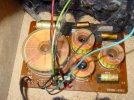
Your crossovers should look similar to this:
DSC01635.JPG
This is from a first generation 650. Note the rectangular yellow cap center top. The early models came with MKT film caps on the tweeter.

The 650b had an elco in that position, like this one.
DSC00910.JPG
If you are lucky your models will have a film cap there, they generally never go bad.

:beerchug:,
James
 
I think that you should be fine with that amp. Just be careful with the knob. Other than never connecting speakers with the amp plugged in There shouldn't be much to worry about. Best choice would be to test them where you buy them. Take a cardboard center tube from a roll of paper towels with you and use it at low volume to check that every driver is making sound.

True, the black finish looks better than some of the others, those ones look pretty decent.

As far as a sub goes I would go with your choice #2. Most good active subs should have pass-through connections to do what you want.

Every Grundig, Braun, Canton speaker from that era that I have seen had degraded electrolytic caps in the crossover, values off and high ESR. Refer to my first post for that. Are you are in the UK? If so then HiFi Collective is where I would look for caps.

Your crossovers should look similar to this:
View attachment 3424608
This is from a first generation 650. Note the rectangular yellow cap center top. The early models came with MKT film caps on the tweeter.

The 650b had an elco in that position, like this one.
View attachment 3424610
If you are lucky your models will have a film cap there, they generally never go bad.

:beerchug:,
James
that's super useful. Thank you so much! It may be a bit much to ask the shop to expose inner workings, so assuming I get un-distorted clean sound from each of the drivers I'll assume all is working effectively. Once home, I will probably do some digging inside the cabinets to find the board and make upgrades where necessary. I notice that the reverse of these boards have thick metal solder - would i need to remove all of this and replace with new or do I simply need to look at where the connections are?
 
that's super useful. Thank you so much! It may be a bit much to ask the shop to expose inner workings, so assuming I get un-distorted clean sound from each of the drivers I'll assume all is working effectively. Once home, I will probably do some digging inside the cabinets to find the board and make upgrades where necessary. I notice that the reverse of these boards have thick metal solder - would i need to remove all of this and replace with new or do I simply need to look at where the connections are?
I remove all of the old solder at the connections and clean the pads with acetone. Every connection, but only the connections. But you do not need to remove the solder that was applied along the traces.

Often when putting my iron on one of these old connections they spit and hiss like an angry cat from the old flux in the solder.

You will find the crossover mounted to the back wall behind the woofer. Normally there will be a couple of brass screws through the middle of 2 of the coils holding the crossover in place.
Brass is preferred in this regard because it won't have a magnetic effect on the coil. My pair of older 650's had brass screws, but the newer 650b had cheaper steel screws that I replaced with brass.

:beerchug:,
James
 
I brought them home. Will set up today. They are very clean with almost no marks on them. The only thing I can tell that is not original is that the old wired DIN connector has been removed, leaving a 2x3cm hole at the back where the old cable used to come out. There has been a more modern red/black connectors fitted at the back to accept banana plugs. Probably a good thing? I may try and block the hole up with something to make the cabinets sealed again, as technically it is ported through a small hole in the cabinet at present - I'm not sure how this will effect the sound at this stage.
 

Attachments

  • IMG_2870.jpg
    IMG_2870.jpg
    102.1 KB · Views: 18
  • IMG_2872.jpg
    IMG_2872.jpg
    88 KB · Views: 18
I brought them home. Will set up today. They are very clean with almost no marks on them. The only thing I can tell that is not original is that the old wired DIN connector has been removed, leaving a 2x3cm hole at the back where the old cable used to come out. There has been a more modern red/black connectors fitted at the back to accept banana plugs. Probably a good thing? I may try and block the hole up with something to make the cabinets sealed again, as technically it is ported through a small hole in the cabinet at present - I'm not sure how this will effect the sound at this stage.
Nice!

You will definitely want to plug those holes. Bass response will suffer otherwise. I always replace those DIN connectors with 5-way binding posts but I also always plug the old holes.

:beerchug:
 
Nice ! Is there a preference on how to plug the holes? I’m thinking either a rubber or cork tapered bung. The hole is not perfectly circle and is ellipse in shape.. therefore a blacking plate may be better here.
 
Perhaps I could replace the whole thing with a new 5-way binding post recessed plate that will hopefully cover the main hole and the more recently added small holes for existing binding posts
 
Perhaps I could replace the whole thing with a new 5-way binding post recessed plate that will hopefully cover the main hole and the more recently added small holes for existing binding posts
This is what I did.

Photos here:

:beerchug:
 
How large is the hole? I had some speakers that were suspended with custom brackets. They drilled holes in the back of the cabinets. I used screws like these of the appropriate size and screwed them into the cabinet. Just used a larger drill bit to make the countersink. The boxes were dark brown so I used black screws.

You can also drill the hole out larger to make the hole round and again use appropriate screw size.

20250213_070724.jpg
 
How large is the hole? I had some speakers that were suspended with custom brackets. They drilled holes in the back of the cabinets. I used screws like these of the appropriate size and screwed them into the cabinet. Just used a larger drill bit to make the countersink. The boxes were dark brown so I used black screws.

You can also drill the hole out larger to make the hole round and again use appropriate screw size.

View attachment 3426030
The hole is oval and is roughly 3/4" x 1-1/4", I used some small plates, sealant and the new binding posts to plug them.

:beerchug:,
James
 
The hole is oval and is roughly 3/4" x 1-1/4", I used some small plates, sealant and the new binding posts to plug them.

:beerchug:,
James
I think this is the route I will go down. Need to measure the gap between the current drill holes where the connectors currently come out as I’ll ideally want a plate big enough to cover these
 
I've been enjoying these speakers with CD's for a few days now, and they're great. They have some really nice detailed high's giving a sense or clarity. I'm no expert but I would describe the mid's as forward/pronounced, rather than having a mid scoop sound. The bass response is accurate and detailed but it has slightly less oompf than I was expecting. However, the bass seems to become more "there" the higher the volume goes relative to it's high/mids. I am perhaps still attuned to the Sonos Play:5's I was using previously, as they are particularly bass-heavy.

I'm battling with room acoustics a little as I have a muddy drone noise hovering somewhere in the lower mids/upper bass, so I need to experiment some more with placement. Currently, they are sat on top of heavy wooden cupboards, 5m apart in the corners of the room with around 30 degrees of toe-in.
 
I've been enjoying these speakers with CD's for a few days now, and they're great. They have some really nice detailed high's giving a sense or clarity. I'm no expert but I would describe the mid's as forward/pronounced, rather than having a mid scoop sound. The bass response is accurate and detailed but it has slightly less oompf than I was expecting. However, the bass seems to become more "there" the higher the volume goes relative to it's high/mids. I am perhaps still attuned to the Sonos Play:5's I was using previously, as they are particularly bass-heavy.

I'm battling with room acoustics a little as I have a muddy drone noise hovering somewhere in the lower mids/upper bass, so I need to experiment some more with placement. Currently, they are sat on top of heavy wooden cupboards, 5m apart in the corners of the room with around 30 degrees of toe-in.
I'm sure that if you can temporarily plug those holes your bass response will improve, and with that the mids might sound a bit more balanced.

:beerchug:
 
I’ve stuck some of those self adhesive felt pads that are used for furniture over the holes for now. I can’t feel any air coming through now but it’s probably not the best seal.

You mentioned about potentially changing the capacitors so will look to see what I have in there when I install the new connector plates. Tweeters seem good to me on initial hearing.
 
Back
Top Bottom