• The move to the new server is done. There are some software and database maintenance updates in process. This has us passing the hat around to help out. We appreciate any donations. Seriously, even a dollar helps. The payment page may be found here - https://www.audiokarma.org/support.html

Hadley 621 VS Marantz 7 preamplifier Any experience?

Mine, at least, has germanium transistors. There is a lot of talk in vintage electronics circles that germanium sounds smoother and less harsh than the early silicon transistors. But if I remember correctly, the fact that it used germanium devices, was the argument the dealer used to explain how he could discount such a fine piece of gear so much.

Yeah, Germanium has a big following nowadays, specially in the electric guitar world. What the dealer failed to realize is that germanium in a preamp application has none of the drawbacks found in power amplification where a high Beta cutoff and wide SOA are desired. I guess it was simply because it was deemed "obsolete" in a rapidly changing field. The flavor of the month, so to speak...
 
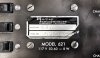
All this reminiscing caused me to haul out my preamplifier and start cleaning it up (spraying the pots & switches with contact cleaner & etc.). The serial number is “6000” I wonder what that means? Certainly they didn’t make six thousand.

45412AF1-48C6-4DA7-B020-BBA3407EFB7C.jpeg
 
Before addressing the Hadley, I noticed that some are referring to the Marantz stereo preamp as a model 7C. Marantz never made a model 7C, it is simply a model 7. The C designation was an internal designation at Marantz to indicate the unit did not include the wood cabinate.

Turning to the Hadley 621, there were two different models. Although I am not positive, I believe the first was a 621 C. It had germanium transistors and a potentiometer volume control. It was superceded by the 621 E which had silicon transistors and a hand wired attenuator volume control. I never owned the 621 C, but I heard both and prefered the 621 E. I recall liking both more than the Marantz 7T. One thing I recall about the Hadley was it sounded better if you left it on all the time and simply turned off the power amp. Therefore I had the power switch on the Hadley simply controll the AC sockets on the back.
 
Before addressing the Hadley, I noticed that some are referring to the Marantz stereo preamp as a model 7C. Marantz never made a model 7C, it is simply a model 7. The C designation was an internal designation at Marantz to indicate the unit did not include the wood cabinate.

Turning to the Hadley 621, there were two different models. Although I am not positive, I believe the first was a 621 C. It had germanium transistors and a potentiometer volume control. It was superceded by the 621 E which had silicon transistors and a hand wired attenuator volume control. I never owned the 621 C, but I heard both and prefered the 621 E and owned a 621 E. I recall liking both more than the Marantz 7T. One thing I recall about the Hadley 621 E was it sounded better if you left it on all the time and simply turned off the power amp. Therefore I wired the power switch on the Hadley to simply controll the AC sockets on the back.
I believe the so called ultimate system in Hafner's Chicago Playboy Mansion had a Hadley 621 E. The Hadley 621E may not have been the most detailed preamp I have heard, but it seemed to have a very liquid musical sound and I thought it was very good. However, I prefer the Marantz 7 to the Hadley. The Marantz remains to me to be a very special unit, especially when it is driving a power amp which has an input of 100,000 ohms.
 
  • Like
Reactions: CLM
Before addressing the Hadley, I noticed that some are referring to the Marantz stereo preamp as a model 7C. Marantz never made a model 7C, it is simply a model 7. The C designation was an internal designation at Marantz to indicate the unit did not include the wood cabinate.

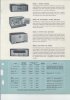
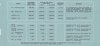
Marantz did refer to the preamp as both Model 7 and Model 7C, as their 1964 price list shown below attests...

3.JPG
3a.jpg
 
Last edited:
Marantz did refer to the preamp as both Model 7 and Model 7C, as their 1964 price list shown below attests...

View attachment 1175607
View attachment 1175610
I also have a service manual for the 7C, but you will not find a preamp with the model 7
C. Some years ago a Mr. Carl Geisier wrote to the Absolute Sound re the Marantz model 7, and his questions were forwarded to Saul Marantz (who was then president of Dahlquist). Mr. Marantz responded in part:
"Strictly speaking there is no such thing as a model '7C'. This term was used by Marantz Co. only as an internal designation for inventory purposes, the "C" simply indicating a preamp chassis, i.e. -- without the wooden accessory cabinate. Therefore, the correct and only model designation for this preamp is "model 7". Don't try to locate a '7C'; you will never find one. (bold in the original).

As you know Marantz stopped making the vacuum tube preamp before Saul Marantz sold the Company to Superscope. The Service Manual I have with the "7C" designation was put out after the company was acquired by Superscope.
 
I also have a service manual for the 7C, but you will not find a preamp with the model 7
C. Some years ago a Mr. Carl Geisier wrote to the Absolute Sound re the Marantz model 7, and his questions were forwarded to Saul Marantz (who was then president of Dahlquist). Mr. Marantz responded in part:
"Strictly speaking there is no such thing as a model '7C'. This term was used by Marantz Co. only as an internal designation for inventory purposes, the "C" simply indicating a preamp chassis, i.e. -- without the wooden accessory cabinate. Therefore, the correct and only model designation for this preamp is "model 7". Don't try to locate a '7C'; you will never find one. (bold in the original).

As you know Marantz stopped making the vacuum tube preamp before Saul Marantz sold the Company to Superscope. The Service Manual I have with the "7C" designation was put out after the company was acquired by Superscope.

I have the Absolute Sound issue where Saul Marantz clearly states that the preamp is a Model 7, and that the 7C was for shipping package designation for the combination of preamp, with cabinet. You will NEVER, EVER, find a preamp that says, 7C on it. NEVER. You don't have to trust me, but you should trust Saul Marantz.
 
When Marantz was making 7C I thought I wanted one. They sounded pretty good and the controls were well damped and smooth. Something Mcintosh never figured out or never wanted to do. But I much pre-ferred the MC 60's I had then 240's and then 275's. So I almost bought the last version of the C-20, but then a C-22 came to my knowledge and I bought one instead. The 7C was a little more forward sounding than the C-22 especially in the phono section. I had Altec speakers at the time and that was the last thing I needed. When I think back about it I wonder how I could tolerate the Altec Carmels and before that the Coronados. But with an amp only rated at 22 watts and only put out about 11 watts cleanly the Carmels were plenty loud for me. I guess with modern electronics and modern processing they would be much better today with new diaphragms, the magnets recharged and new cones for the woofers. I also liked the front jacks on the C-22. I wish the C-22 had the two position HF filter the 7C had.

The 7T ws a great pre-amp. It could easily out perform a C-26 and 27. But it coudn't match the C-28
 
I am experienced. I had a Hadley 621. I'd never heard of it. I bought it for the knobs, because it was only $20. The knobs were great! I was going to use them on something else.

Then, when I got it home, I looked inside. My eyes popped out! This was a very serious piece of gear!

All hand-wired point-to-point. The resistor-ladder attenuator was fabulous — even better, it had a separate switch that let you set the volume level halfway between any of the fixed-steps in the attenuator, in effect doubling the number of steps, giving twice as much control over the sound level. And the transistors had little gold-plated legs that plugged into little ceramic bases, like baby tubes, so you could swap 'em out when better transistors came along. Looked really cute.

The sound was warm and pleasant, but to my ears fuzzy, vague imaging, lacked drive, punch and dynamics, with limited frequency extremes... didn't care for it much. Sold it for a crazy high price way out of proportion to its quality.

Legend has it, Hadley was Sony's first US distributor (or California distributor; he was based in LA) and made his own preamps because he didn't think much of Sony's. Maybe urban legend... but it was told to me by a tech who said he knew Hadley.
Sony's first solid-state item sold in the United States was the TA-1120... an integrated amplifier. SONY'S first standalone solid-state preamplifier was the TA-2000... which came well after the Hadley preamp. So, perhaps urban legend.
 
Back
Top Bottom