Hafler circuit/hookup... with rear subwoofer?

hnash53

Super Member
David Hafler came up with a way to simulate 4-channel/surround sound by placing the difference between front L & R speakers in the rear speakers (or a single speaker).

Various companies implemented the Hafler circuit, each with their own name for it... Dynaquad, Quatravox, Quadaptor and lots of other 3rd parties.

Question: Would having a rear subwoofer along with the rear pair of speakers in a Hafler circuit offer any benefit?

Thanks.

Hal Nash
Waldport OR
 
Register to hide this ad
I'm sure someone will correct me if I'm wrong, but the Haffler circuit feeds just the "difference" from both front channels to the rear and rephases that to simulate dual channels there. Not sure how much real bass material that would include ...

That said, I've only ever used smallish bookcase type speakers as rears on my Dynaco Quadaptor.
 
you would need a control for the volume. and maybe even a crossover to funnel the
bass to the unit. and not send treble out to a subwoofer.

and be very careful about sharing grounds between channels that may or may not
be bridged/bridgeable-with-a-switch. you should look at the hafler amps that allow
this and compare to your non-Hafler amp.

Also, the circuits for doing this are somewhat different and have "pre-reqs"
and this is far simpler with an AVR with a zillion output channels and bass
management.

the bass from the front channels to be "pushed" to the rear? I would think this
messes with classical music's placement of percussions (drums).
I recall them being in the far left field.

if you are building this or modding a existing unit, I would "add' superfast blow
small current fuses everywhere. to prevent damaging the amp, existing speakers,
newly added speakers, and the quad adapter.

if you do want to try this, get a crossover, route the bass signals out to amps
and then run those cables out to subwoofers in the rear of your listening area.
(avoid the solutions that Siamese the signals even if they add a subwoofer circuit)

if you go this far, then you have a great solution for using two pairs of speakers
one for the treble (any small set) and one for the bass (any large floor standers)\
the sound maintains its treble/bass coherency across all volumes and the
SQ is cleaner.

then enjoy the music.
 
Early stereo recordings were 3 channel (hard left, center, hard right) and the Hafler circuit plays into that scope, at least for older recordings. The true circuit features all 4 speakers being identical, and having 3 in front (left, center, right) and 1 single rear speaker. The center channel being a summation of left and right, the rear consisting of content that is ambient, subtractive by nature. The rear channel was fed by the positive of the left speaker and the positive of the right speaker (the speaker's coil being the isolation), however, this requires a common (-) amplifier (both channels share the (-). BTW, Hafler started Dynaco.
 
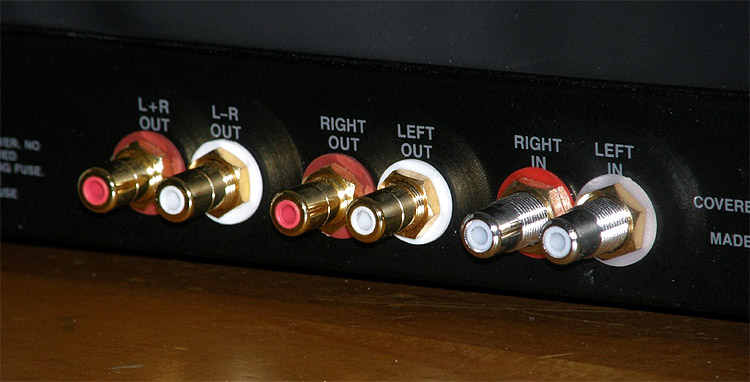
One of the favorite extras in my Carver H9AV ...

back-panel.jpg


Never did label the jacks as ambient front or rear - left that up to us to decide what worked best in each particular setup.
 
Thanks to all who have commented. What prompted my original question is that I have an early/mid-70s quadraphonic/4 channel receiver that will die some day (I already had a second one of these quad receivers that died). Rather than continuing to stick with vintage receivers, I'm trying to plan for the future when this receiver dies.

The Hafler hookup is the closest thing I've heard to quad/4-channel sound. I've tried the Dolby ProLogic stuff and found it wanting (I've tried about 3-4 home theater receivers and have returned each one). I currently have a second subwoofer connected to the rears in my quad system... and like the way it sounds. I was hoping the rear speakers/sub in the Hafler hookup could approximate the quad sound.

I understand the need, perhaps, of a volume pot to adjust the rear sound to one's liking.

Thanks for the input.
 
My results years ago while experimenting with the Hafler hook-up, suggests that the difference signal doesn't derive enough bass to make a subwoofer very effective for that purpose.
 
Back
Top Bottom