How do I connect a center channel speaker to an old receiver?

Plenty of small speakers out there that will be an improvement, Infinity Infinitesimal, and the original Infinity Modulus just to name a couple.

Not cheap but well worth the price of admission.
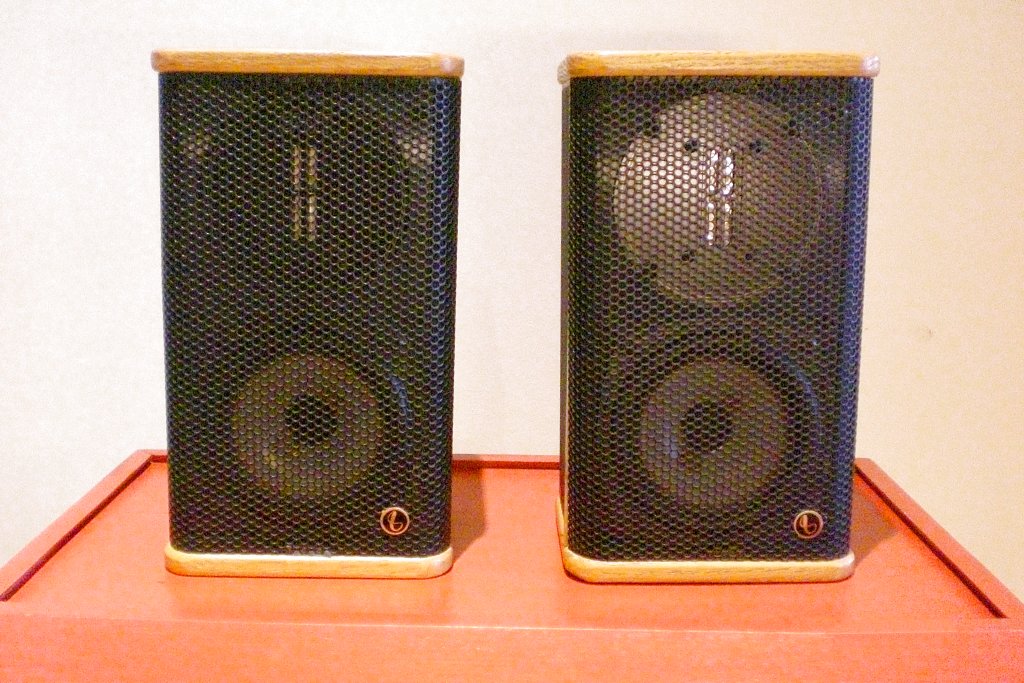
InfiniTesimal0.1-4.jpg

infinity-modulus-90-foto-bild-79165612.jpg
I will look into these for sure. Thank you!!
 
I used to do the old Phantom channel. Use one speaker at the rear of the room. Connect both (+)'s from the "B" or remote speaker terminals to one speaker. It will play the differences of both channels. Some albums, ect. You don't hear too much, others you do. Realistic used this wired for two rear speakers and called it Quadravox. I looked at the circuit in a Realistic amp I have and it consisted of wiring and a switch, that was it!
 
Toxcrusadr is right when he says that a passive center channel hookup will reduce the stereo effect. If you want to try it anyway, connect the receiver's left channel red terminal (L+) to the red terminal on the left speaker and the right channel's red terminal (R+) to the red terminal on the right speaker. Wire the black terminals on the two speakers together and to the red terminal on the center channel, and wire the black terminal on the center channel to either one of the black terminals on the receiver.

Another idea would be to hook the center speaker up as a rear ambience channel. To do this, connect the left and right speakers to the receiver in the usual way -- red to red and black to black on each channel. Connect the ambience speaker to the left and right red terminals. This allows it to reproduce the difference between the two channels and can add more spaciousness to the sound. This idea was the basis of the Hafler passive matrix that was popular in the late 1960s and early 1970s.

So I combine the two red outputs on the receiver into the one "input" on the center?
 
So I combine the two red outputs on the receiver into the one "input" on the center?

NO! Never connect the red terminals together on a solid-state amp or receiver. You'll most likely blow up output transistors on both channels. As Lavane said, connect one red receiver terminal to the red (+) terminal on the ambience speaker and the other red receiver terminal to the black (-) terminal on the speaker.
 
NO! Never connect the red terminals together on a solid-state amp or receiver. You'll most likely blow up output transistors on both channels. As Lavane said, connect one red receiver terminal to the red (+) terminal on the ambience speaker and the other red receiver terminal to the black (-) terminal on the speaker.
:thumbsup: With some recordings you will hear things you never did before, like toe tapping, people talking in the background ect.
 
NO! Never connect the red terminals together on a solid-state amp or receiver. You'll most likely blow up output transistors on both channels. As Lavane said, connect one red receiver terminal to the red (+) terminal on the ambience speaker and the other red receiver terminal to the black (-) terminal on the speaker.
Thank you both. Excited to try this
 
:thumbsup: With some recordings you will hear things you never did before, like toe tapping, people talking in the background ect.
working well. It disappears behind me but the sound is fuller and seems more complete. I still hear the different channels in front of me, which is important, but I like what this did. Thanks so much, Lavane (and Dr Tinear).
 
I used to do the old Phantom channel. Use one speaker at the rear of the room. Connect both (+)'s from the "B" or remote speaker terminals to one speaker. It will play the differences of both channels. Some albums, ect. You don't hear too much, others you do. Realistic used this wired for two rear speakers and called it Quadravox. I looked at the circuit in a Realistic amp I have and it consisted of wiring and a switch, that was it!

I used to do this in the late 60's. I ran it through an L pad to control volume of rear speaker. Wasn't it a Hafler circuit?
 
Many of the old tube receivers in the past would run center speakers, and it wasn't a sub, they actually had a switch and a terminal for the center speaker. All my Fisher tube amps have it.
 
Here give this a try. This is the old Dynaco center channel setup from the 1970's.

http://www.updatemydynaco.com/HistoricDocuments/DynacoCenterChannel.pdf

Beat me to it ... worth a try if you've got the right speakers and taps to keep the impedance in range.

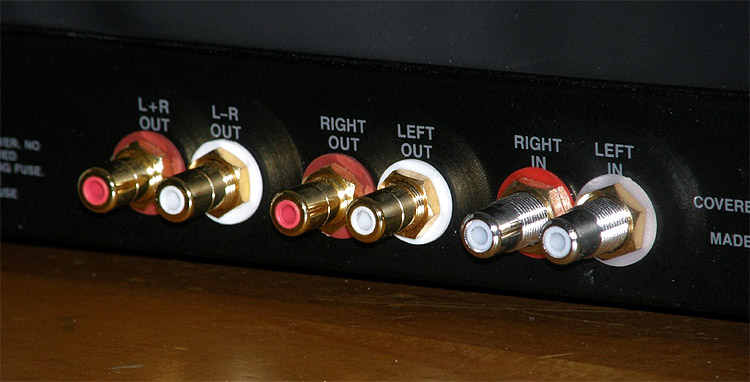
I use a Carver H9AV holographic generator here. That has dedicated taps for L+R (center out) and L-R (sub out). Much safer using line levels to feed a separate amp.

back-panel.jpg


I feed the L+R to an Eico HF12A mono amp and drive a Bose VS100 with that. Works real slick.

And no, contrary to popular opinion, a well implemented center will NOT degrade the stage if you don't overdrive it. As with everything audio, moderation is your friend here. Mine punches the vocals nicely while keeping the original spatials intact.
 
Many of the old tube receivers in the past would run center speakers, and it wasn't a sub, they actually had a switch and a terminal for the center speaker. All my Fisher tube amps have it.
One of my preamps has a center channel out with a gain control. Its mono though, combines both channels. ita a nice place to connect a sub. There are two pre outs as well.
 
The only real way to use a vintage pre-surround sound receiver with a center channel is to buy an external 5.1 decoder and send the center channel out to a designated amp or powered speaker.
Or....get a matching center channel and use The Pair for stereo speakers. Centers can be very good speakers. Nice receiver!!
 
Only caveat about center speakers is they tend to be located near your other equipment. Mine is right in the rack, so I went with a "video" rated speaker that has the extra shielding to protect against stray RF. Mostly a monitor or screen issue, but may ... or may not ... be an issue with your other electronics.
 
Here give this a try. This is the old Dynaco center channel setup from the 1970's.

http://www.updatemydynaco.com/HistoricDocuments/DynacoCenterChannel.pdf

Transmaster is correct. His link to the Dynaco document shows the proper way to add a center speaker, to a stereo set up. Connecting to the L- and R- receiver outputs, feeds the center speaker with the mono content (music common to both channels) contained in the recording. Which is what you'd want for a front center speaker.

Using the L+ and R+ for a connection, wires your speaker to play back the difference signal between left and right channels; the musical content that is unique to each individual channel. This L+/R+ wiring method is the simplest version of the Hafler Matrix. But, this wiring method was used for adding rear surround channels, to a stereo system, and shouldn't be used for a front center connection. I've tried both methods in the past, and they sound good, but each depends on what the user is trying to achieve.
 
I am not sure how the Klipsch 3-Speaker Master Stereo System from the 1950's was wired but this setup has always fascinated me, especially the tiny, by modern standards, power levels required to make such a system play.

10b6289e983df850bdcbae2e1fece0ba.jpg
 
If setting up a 3.1 music only system, I would have loved to have tried (heard) a Spread Spectrum Technologies Trinaural processor. A Jim Bongiorno designed ambiance processor, than won a 'Best of CES' award. Usually demoed with VMPS speakers, the processor required a LCR speaker set up. I bet it sounded awesome!

http://www.stereophile.com/musicintheround/904music/#cHygY8Zdz12mLhgw.97

The CES award winning room. The processor is the top right blue box.

rm-xCES.jpg
 
Back
Top Bottom