


swechsler
Frog Whisperer
Or: how can I improve this sub?
I recently purchased an Aperion Audio Bravus 8D sub (original, not series II) with a dead amp. The sub has two 8" aluminum woofers with good excursion and very large magnets on opposite sides of an approx 1' cube (internal volume is a bit less). The woofers are connected in phase and in parallel. The original (BASH) amp was rated at 150 watts and included an internal adjustable parametric EQ (which, according to the manual, is turned off when initially shipped). Construction quality is good, with the internally braced cabinet made of HDF with a high gloss piano-black finish. The original amp had too many missing custom parts, so repair is out of the question.
I'm currently driving the sub with a 100 watt (into 4Ω) commercial Crown amp. I've now got the cabinet sealed up good and tight, and with a frequency generator app, the output starts to drop off below about 60hz. Now, I'm aware of Hoffman's Iron law, so I'm not expecting super efficiency, but originally the manufacturer rated it to 35hz at -3dB. I couldn't find any reviews online of anyone who had tested this, but 60hz and 35hz is a huge difference. One thing I did notice, when opening up the sub to fix the leaks, is that there was no stuffing inside. I couldn't find any indication that there was any before, but I knew that the previous owner had modified it to be used as a passive sub, so there was a decent chance that he removed the stuffing for whatever reason. Every acoustic suspension speaker I've ever opened was fully stuffed, so this seemed strange to me.
So I guess my questions are:
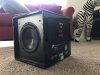
I recently purchased an Aperion Audio Bravus 8D sub (original, not series II) with a dead amp. The sub has two 8" aluminum woofers with good excursion and very large magnets on opposite sides of an approx 1' cube (internal volume is a bit less). The woofers are connected in phase and in parallel. The original (BASH) amp was rated at 150 watts and included an internal adjustable parametric EQ (which, according to the manual, is turned off when initially shipped). Construction quality is good, with the internally braced cabinet made of HDF with a high gloss piano-black finish. The original amp had too many missing custom parts, so repair is out of the question.
I'm currently driving the sub with a 100 watt (into 4Ω) commercial Crown amp. I've now got the cabinet sealed up good and tight, and with a frequency generator app, the output starts to drop off below about 60hz. Now, I'm aware of Hoffman's Iron law, so I'm not expecting super efficiency, but originally the manufacturer rated it to 35hz at -3dB. I couldn't find any reviews online of anyone who had tested this, but 60hz and 35hz is a huge difference. One thing I did notice, when opening up the sub to fix the leaks, is that there was no stuffing inside. I couldn't find any indication that there was any before, but I knew that the previous owner had modified it to be used as a passive sub, so there was a decent chance that he removed the stuffing for whatever reason. Every acoustic suspension speaker I've ever opened was fully stuffed, so this seemed strange to me.
So I guess my questions are:
- How likely is it that this sub was originally stuffed?
- How much would re-stuffing it improve the lower end?
- With only a 150 watt amp, is it possible that it originally used equalization to obtain that 35hz -3dB point (the manual doesn't mention)?
- Anything else I can try?


