I think I'm done using a record brush...

You mean you don't see a difference between the swifter-wiped and un-wiped side? I do.

I do too but the results/implications arent completely clear (LP 3 should be more defined than 1 for example) Plus I havent done the subsequent wet, dry, and dust bag test on those LPs. Also an imporant data point.

Plan also to test again wiping even harder than above, also wiping like I would normally do, which is much less than using a carbon brush or the above tests, and also testing to see how long it lasts.

BTW, one of the patents for some of these products, and there are many, talks about possibility of residue dependent on temp and pressure (admission!) and about biodegradability. Then again, you dont know what P&G is using or changing what they use over time.
 
Last edited:
Like many others I`ve used carbon-fibre brushes since back then and they have served me well. Using an ionizing-machine though, to control static electrisity and I clean my records by hand in water if needed. But of course, I know better than to use a felt-mat on a glass-platter
 
Any of you Swiffer lovers do the dust test I recommended? I have:
View attachment 898805
A previously cleaned record (right out of a Mofi sleeve) was placed on a countertop and the left half was protected with white printer paper while the right side was wiped down once with a fresh Swiffer. The paper was removed and the bottom of the record was dipped into the dust collecting can of my central vacuum system. The record was removed then tapped once on it's edge to remove large debris. Still love this product for record cleaning? Try it yourself if you are doubtful. Then hit it with a Zerostat and find the debris still stuck.
The water test I recommended was less productive. I took this same treated record and blasted it with a stream of dH20. While you can see some beading at the interface of the two treatments, the test was inconclusive, likely because there is no wetting agent around.
View attachment 898806
I think I will just skip the part about dipping the record in the dust bin. But I am still using a swifter.
 
So an interesting development. I recently replaced my stop-gap m93e with an AT7N and thought I'd give the Audioquest Brush another try. I also attempted the AQ Brush again after reading in stereophile that the body had a coating on it that prevented your hand from grounding the static electricity so I found a worn spot on the handle to grip. So strangely enough now, As I brush the record, I hear a few pops (I imagine the static electricity discharging?) and now...no static build up. I take the record off the platter and there is no snap-crackle-pop. I can only assume there is a better ground connection to the cart with the Audio Techica? Any Ideas?
 
I am certainly no expert in the vinyl area but I have been using the Hunt EDA Mark Six brush and it really removes a lot of dust.

The fibers are so soft that I don't see how they can damage a record.

When I buy an used or old album I wash it with Dawn soap and water one time.
 
So an interesting development. I recently replaced my stop-gap m93e with an AT7N and thought I'd give the Audioquest Brush another try. I also attempted the AQ Brush again after reading in stereophile that the body had a coating on it that prevented your hand from grounding the static electricity so I found a worn spot on the handle to grip. So strangely enough now, As I brush the record, I hear a few pops (I imagine the static electricity discharging?) and now...no static build up. I take the record off the platter and there is no snap-crackle-pop. I can only assume there is a better ground connection to the cart with the Audio Techica? Any Ideas?

It's the brush and less charge if you didn't play it before lifting the record off the platter. Playing is what charges the record. There is no electrical path from record to cartridge. Diamonds are non-conducting as is vinyl. It's the friction across two non-conductors that allows the static to charge, think balloon and hairy arm or shoes on carpet.
 
It's the brush and less charge if you didn't play it before lifting the record off the platter. Playing is what charges the record. There is no electrical path from record to cartridge. Diamonds are non-conducting as is vinyl. It's the friction across two non-conductors that allows the static to charge, think balloon and hairy arm or shoes on carpet.

natural, dug up diamonds are non conducting, however man-made diamonds are..........which are probably 99.999% of the market.
 
natural, dug up diamonds are non conducting, however man-made diamonds are..........which are probably 99.999% of the market.
from wiki:

Electronics[edit]
Synthetic diamond has potential uses as a semiconductor,[82] because it can be doped with impurities like boron and phosphorus. Since these elements contain one more or one less valence electron than carbon, they turn synthetic diamond into p-type or n-type semiconductor. Making a p–n junction by sequential doping of synthetic diamond with boron and phosphorus produces light-emitting diodes (LEDs) producing UV light of 235 nm.[83] Another useful property of synthetic diamond for electronics is high carrier mobility, which reaches 4500 cm2/(V·s) for electrons in single-crystal CVD diamond.[84] High mobility is favourable for high-frequency operation and field-effect transistors made from diamond have already demonstrated promising high-frequency performance above 50 GHz. [85][86] The wide band gap of diamond (5.5 eV) gives it excellent dielectric properties. Combined with the high mechanical stability of diamond, those properties are being used in prototype high-power switches for power stations.[87]

Synthetic diamond transistors have been produced in the laboratory. They are functional at much higher temperatures than silicon devices, and are resistant to chemical and radiation damage. While no diamond transistors have yet been successfully integrated into commercial electronics, they are promising for use in exceptionally high-power situations and hostile non-oxidizing environments.[88][89]

Synthetic diamond is already used as radiation detection device. It is radiation hard and has a wide bandgap of 5.5 eV (at room temperature). Diamond is also distinguished from most other semiconductors by the lack of a stable native oxide. This makes it difficult to fabricate surface MOS devices, but it does create the potential for UV radiation to gain access to the active semiconductor without absorption in a surface layer. Because of these properties, it is employed in applications such as the BaBar detector at the Stanford Linear Accelerator[90] and BOLD (Blind to the Optical Light Detectors for VUV solar observations).[91][92] A diamond VUV detector recently was used in the European LYRA program.

Conductive CVD diamond is a useful electrode under many circumstances.[93] Photochemical methods have been developed for covalently linking DNA to the surface of polycrystalline diamond films produced through CVD. Such DNA modified films can be used for detecting various biomolecules, which would interact with DNA thereby changing electrical conductivity of the diamond film.[94] In addition, diamonds can be used to detect redox reactions that cannot ordinarily be studied and in some cases degrade redox-reactive organic contaminants in water supplies. Because diamond is mechanically and chemically stable, it can be used as an electrode under conditions that would destroy traditional materials. As an electrode, synthetic diamond can be used in waste water treatment of organic effluents[95] and the production of strong oxidants.[96]

Relative to this application, not so much. If they were effective conductors in this application then the static charge of playing and vinyl record would not build. Even if they were conductive, there really isn't a path to ground through the cartridge via the air gap that allows the cantilever to move the magnets, iron or coils and generate a signal. If there were a path to ground through the cartridge it would be shorted to ground at some point in the chain and there wouldn't be a signal to amplifiy.
 
from wiki:

Electronics[edit]
Synthetic diamond has potential uses as a semiconductor.

funny how a static charge can jump from my finger an inch, but somehow can't cross the minute distance between a magnet and a coil in a cartridge.........

back to conductivity of synthetic diamond...........

Try this instead..........wiki is often times a bit confused.


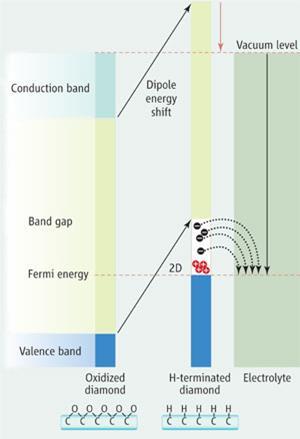
Surface film electrochemistry responsible for making diamond electrically conductive

US researchers have cracked one of the most baffling mysteries in materials science - why diamond, the supreme insulator, becomes a conductor under certain conditions.

Diamond produced by chemical vapour deposition is typically coated with a layer of hydrogen atoms. Around 20 years ago, scientists noticed that if such diamond is exposed to air its surface becomes electrically conductive - but no-one has been able to explain why.

Now, a group led by John Angus at Case Western Reserve University in Ohio has solved the puzzle. The phenomenon arises because of an electrochemical reaction on the surface that occurs in a thin layer of water only a few molecules deep.

’An electrochemical explanation was put forward by a German group a few years ago,’ Angus told Chemistry World. ’But it was controversial because diamond is extremely hydrophobic, making the presence of water unlikely, and the energetics of the electrochemistry were not entirely convincing.’ However, Angus thought the German researchers were onto something and the new work has confirmed this.

124992_diamond-300_tcm18-108164.jpg


Source: © Science

The energy of valence band electrons can be increased with respect to the electrolyte by changing the surface coverage from oxygen to hydrogen. Valence band electrons transfer into the electrolyte if their energy is above that of electronic states of the electrolyte that can be occupied. This transfer gives rise to surface conductivity.

The US researchers have shown that water can form a film on diamond due to various surface phenomena including electrostatic interactions. When exposed to air, oxygen and carbon dioxide dissolve in the water. A redox couple (O2+4H++4e-

char_2194_tcm18-63189.gif


2H2O) is established in the aqueous phase consisting of the dissolved oxygen and protons arising from the acidification of the water by CO2 present in air.

Under favourable conditions, the reaction sucks up electrons from the diamond below. As electrons vacate the diamond they leave positive charge carriers - ’holes’ - behind, which are able to conduct.

The researchers demonstrated that the effect is not confined to diamond. It also occurs in single-walled carbon nanotubes, where conductivity is known to change when the nanotubes are exposed to air, and on the semiconductor gallium nitride.

’It seems that these thin films of water are everywhere and this effect is likely to be widespread,’ said Angus. ’I think that the important implication of this work is that it could account for some of the unpredictability of the behaviour of surfaces in certain environments. It opens up a whole new series of avenues for scientific investigation.’

Commenting on the work, Neil Fox of the CVD diamond group at the University of Bristol, UK, told Chemistry World, ’The effect reported in the paper offers some interesting insights into charge transfer processes occurring between a diamond surface and an aqueous phase. This may go some way towards explaining why some nanoparticle systems containing diamond or other wide band gap semiconductors behave in unexpected ways when cast into aqueous suspension.’

Simon Hadlington
 
Marc, I hear what you're saying, but doesn't it take about 20,000 V of potential to arc? If so, how does that charge build while playing a record if it's continually being drained off through the cartridge?
 
Marc, I hear what you're saying, but doesn't it take about 20,000 V of potential to arc? If so, how does that charge build while playing a record if it's continually being drained off through the cartridge?

to arc, maybe. however the zerostat gun will blow a spark at 11-14K. Spark plugs, even though they may have 50K behind them at the coil usually arc in the 6-9K region during normal running. check the surface charge of an album, then set the cart down on the album, check surface charge again, it should read lower. Static drains without having to arc. If the diamond rubbing the vinyl causes a charge, where are those electrons coming from? Not to change the subject, but ever wonder what % of arm bearing failure is due not to load wear, but micro-welding? I pick up Technics arms to use the tubes for XA arm modification. I've looked at the original bearings under scope. The ones that do exhibit bearing issuses, most of them have evidence of micro welding. electricity will find path to ground.
 
If the static charge isn't coming from the stylus then it's coming from what? The disc to air interface at 33.33 rpm? Interesting, I'm going to have to do some reading on micro-welding.
 
congrats??? my vinyl is fine, there is no oil coming off the Swiffer on to my albums, nor is the oil my albums are made from seeping on to my swiffers. Nor do I need to wear a gas mask while playing vinyl due to all the chlorine gas contained in them.
Well after reading some of the comments here, I started to reuse my swiffer instead of my carbon fibre brush. I have to say that there is no static build up what's so ever and better still, less dust on my turntable. And if a record comes out the moffi sleeves with static a quick swipe inside the sleeve with the swiffer eliminates the charge, win win.
 
Well after reading some of the comments here, I started to reuse my swiffer instead of my carbon fibre brush. I have to say that there is no static build up what's so ever and better still, less dust on my turntable. And if a record comes out the moffi sleeves with static a quick swipe inside the sleeve with the swiffer eliminates the charge, win win.
same here. I don't however "scrub" my vinyl with it as was done in an experiment. light dusting to suck the dust off so the stylus doesn't break it down and embed it into the grooves. My "disk-washer" albums have additional surface noise, my swiffer albums do not.
 
You guys might want to check out the article entitled "Charges on the Record--A Study of Static Electricity on Phonograph Records" by C. R. Anderson" from the Engineers at Shure.
Interesting reading.
Cool something to read on my next long flight.

I've read this many times over the past ............I like this part..............Of course, for static electricity, even a resistance of one megohm is effectively a short circuit.

That's a good one. Still enjoying this discussion.
 
I am certainly no expert in the vinyl area but I have been using the Hunt EDA Mark Six brush and it really removes a lot of dust.

The fibers are so soft that I don't see how they can damage a record.

When I buy an used or old album I wash it with Dawn soap and water one time.

Dawn dishwashing liquid has chlorine and phosphates.....try Ajax, the clear yellow one that uses lemon oil. It's used by people that have severe allergies. Just look on the back of the bottle of Dawn, those chemicals will alter the surface even more so than time already has.
 
Back
Top Bottom
