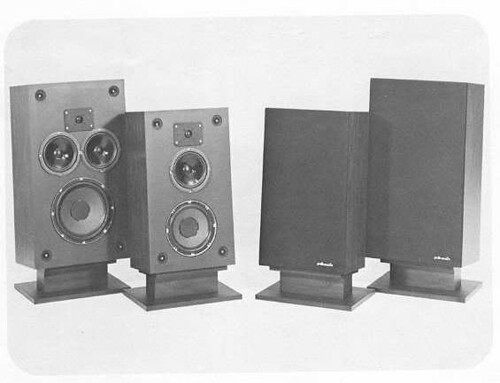
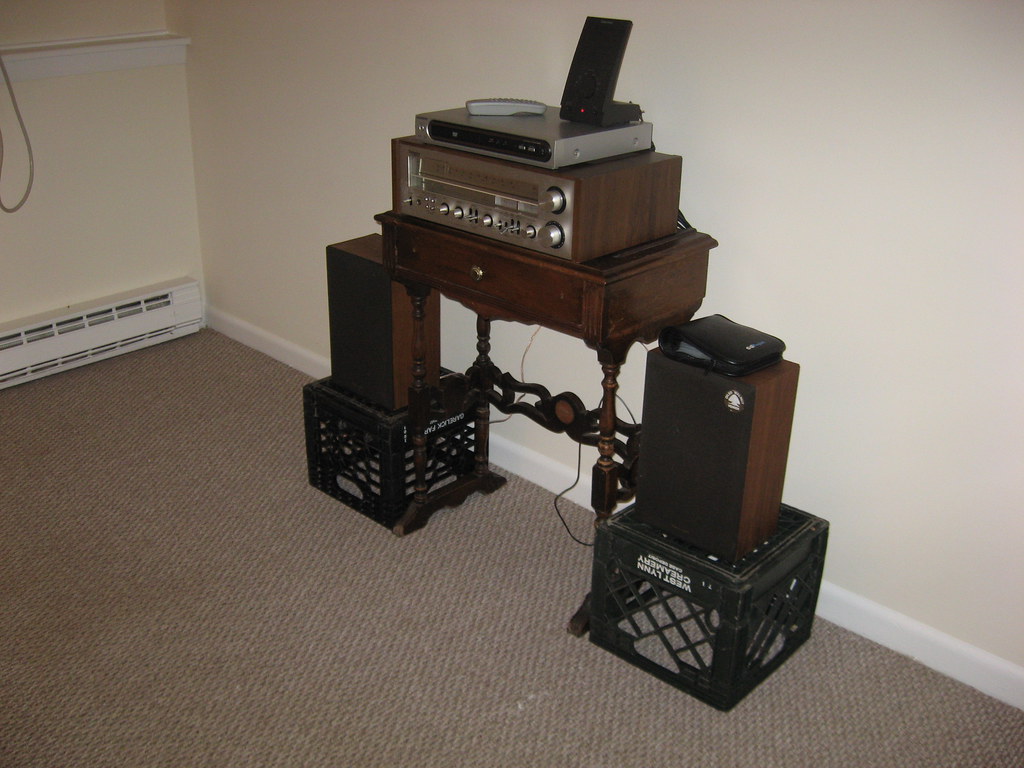
It's easiest to adjust speaker positions if you think of it as two separate processes. {I'll ignore time alignment here, as some speakers accomplish that electronically adn others physically.}
First, the bass (low tones): This is most influenced by the distance between the woofer and surrounding surfaces, usually the floor. If you sit the speaker in the corner, the floor and two side walls act like three walls of a horn. (The ceiling will be too far away to act as the fourth wall.) The bass is increased in volume, but may be a bit muddied by the reflections. Slide the speaker out, away from the sidewalls, and only the floor is affecting the sound. In effect, you now have a one-sided horn. Start raising the speaker up away from the floor, and as you do so, the impact of the floor on the sound is diminished. Move the speaker well away from all surfaces, and there will be no horn-like effects. The bass may now seem too weak. So in effect, as long as you are not too close to the side walls, you are adjusting the amount of "horn" simply by adjusting the height of the speaker above the floor.
Many bookshelf speakers will sound good at a height of 10"-20" above the floor. Only careful listening at different heights will tell you what height is optimal for your particular speakers. Listen carefully to the bass sounds. You want to find the height where the amount and impact of bass is good, but not muddied.
The second aspect of speaker positioning comes from the tweeters. Usually these are more directional. Move too far off-axis (that is, away from being directly in front of them) and their sound drops off markedly. So you want the speakers at the same height as your ears, or at least pointing at your ears.
[Note: in a few cases, the treble is relatively a bit too strong, so you may not want to point the tweeters directly at the ears. You can rotate the speakers inwards towards the listener ("toe in"), straight ahead towards the back wall, or (very rarely) outwards towards the side walls ("toe out") to adjust for this.]
In positioning your speakers on stands, you are trying to find an optimal balance between these two main factors. Sometimes the speakers are big enough that having them a certain distance above the floor puts the woofers in a good spot above the floor AND puts the tweeters at ear height. Then you're lucky!
But sometimes putting the tweeters up at ear height means the woofers are too far away from the floor, and the bass is attenuated too much. In these instances, the best thing is to find (or make) a stand that puts the woofers at the right height above the floor, and then angle the speaker back a little, keeping the height where the woofers sound best, and pointing the tweeters at the ears. It's a subtle compromise between the two competing effects, that will produce the best overall sound.
In rare instances, you want the opposite effect. With the Infinity Betas or Delta/Gammas, for instance, the speakers are quite tall and the tweeters are well up ABOVE the ear level when you are seated. The optimal sound quality from them occurs when you are standing up! The solution here is to angle the speakers slightly DOWNwards, to point the tweeters more towards your ears. Of course, this slightly increases the bass response, because it brings the woofers more towards the floor, too. A carpet laid in front of the speakers helps compensate for this. Only a very small angle is required, though. Too much and you are getting an undesirable degree of "reverse time alignment", and muddying of the bass, etc... Slipping a couple popsicle sticks under the back edges of the speakers is sufficient to optimize the sound. In a very large room, you can simply sit back far enough that the angle from the tweeters towards your ears is sufficiently diminished. In fact, I think that is the very best approach, but in more modest-sized rooms a little forward tilt is good.
For much smaller speakers like the Rogers LS3/5 or Infinity Modulus speakers, there is little bass to be concerned about, so the main aim is to get the tweeters up around ear height. That's why you'll often see these kinds of smaller speakers on taller stands, perhaps 30" high. Usually with such systems, a separate subwoofer fills in the bass end.
Of course, most subwoofers are vey low to the floor, and some even have downward-firing woofers that play straight "into" the floor. They are making use of the "horn wall effect" of the floor itself, to increase the bass. These often sound best when put on special sub stands that help reduce muddying effects. (Those effects often come via resonance of the floor itself, but that's a separate topic.)
Placement of speakers and subs can get more complicated, but the basic two principles are always at work: bass gets adjusted mostly by adjusting the height of the woofers above the floor (and the distance away from side walls), and tweeters by putting them at ear level and/or aiming them at the ears. Remember and apply those two principles, and you'll be about 90 percent "there" when it comes to speaker positioning.