Imf tls 80 ii

canuckaudiog

On a quest for high fidelity
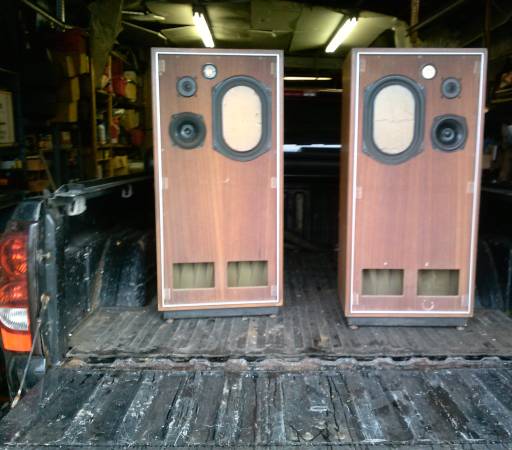
Here is my review of the IMF TLS 80 II.

Before I begin, some information and some pictures.

Inside cut-out
IMF%20TLS80%20MkII%20reclame%201978.JPG


Actual pictures
dsc00749kd.jpg

dsc00808rb.jpg


Technical specifications
Years manufactured: 1977-1981
Original MSRP: 630 british pounds
Drivers: KEF B139, KEF B110A, Celestion HF1300, Celestion HF2000
Recommended Power: 50-100 Watts
Efficiency: Approximately 85dB depending on tilt control
Crossover: 375Hz, 3.5kHz, 13kHz
Vented, Sealed: Transmission Line (info)
Frequency Response: 20hz to beyond audibility
Dimensions (on supplied stands): 41.75" (H) x 18" (W) x 15.75" (D)
Weight: 37kg each, 45kg with stands

Review
First of all let me say that this has been somewhat of a dream speaker for me. My first vintage pair of speakers I have ever owned was a pair of IMF TLS 50 II's that aren't restored. Regardless of their condition I loved the sound that came out of them - lush, inviting, accurate and the bass is incredible. I knew that after hearing such an incredible loudspeaker I had to seek out its bigger brother, the IMF TLS 80.

Now this particular model came in two versions, the earlier version marked as IMF TLS 80 on the badge of the back of the speaker and the later version marked as IMF TLS 80 II. When IMF came out with the second version they borrowed some of the features of their more advanced line of speaker, the RSPM or Reference Series Professional Monitor. They took the foam as well as the stands from this line-up and put it on their TLS 80. Considering how well the RSPM is received (just ask anyone who owns a pair), it made a lot of sense and also brought a lot of value to this line of IMF's. Unfortunately there is not a lot of information on comparisons between the older iteration and the new one, except for a review from the Gramophone who reportedly was able to hear both side by side (source). From the review there seems to be some good improvements made to an already impressively designed speaker. So, these changes are welcome in the second version.

As for the speakers themselves (which are freshly recapped with proper original replacements), the impression they give you is exciting, coherent, accurate and dynamic. Paired with a powerful amplifier, they will fill out their full frequency response down to 20hz and you can feel it. It's quite something else to hear such a large amount of bass coming from just speakers, usually you need to have a subwoofer to perform down to this low of a frequency and have it be felt (as it is, when it gets that low you cannot hear it but only feel it). However in order to properly experience this you must have the speakers distanced properly and also the room plays a large role. Most of the time you will only be able to experience down to perhaps, low as 40hz if you are lucky. Room acoustics are key. But, regardless of that the potential is there and the bass sounds absolutely smooth and effortless. One thing you may question is, will this bass be controlled or overwhelming? In all of my listening tests and experience I have found the bass to be well controlled when paired with a good amplifier. I have had the chance to experience these speakers with several amplifiers, the Sansui G4700, Sansui AU555A, Sony STR-V5 and the current unit they are hooked up to, the Sansui G7700. The Sony was a very heavy sounding unit and made the bass a little uncontrolled. However I was rather surprised at how balanced it sounded regardless, but the Sansui G series amplifiers were much better at controlling it.

Another thing impressive about these speakers is their sheer size. Sitting on their stands they sit at almost 42" tall which is large in the speaker world. Not as large as say, an Infinity QLS-1 (which stands 5' tall!), but still very impressive in that department. With a transmission line, size definitely does matter. Its smaller brother the IMF TLS 50 II, although it is also a nice sized speaker, sounds small in comparison to its bigger brother.

Being a 4-way speaker you may think that the stereo imaging is going to be compromised. I find that after positioning the speakers properly, imaging is very coherent and precise. A 3-way design will have its merits over this design, but the crossover network was designed very carefully by IMF to allow the 4 drivers to complement each other and they most certainly do. An impressive feat is the ability of these speakers to simply disappear and not sound like boxes - just pure music. This is where the transmission line design comes in handy most of all. The bass is not reproduced inside the speaker, but in the room instead so you do not feel as though you are in front of a pair of speakers. You can close your eyes and be transported away to where the music is being recorded, as though the artists are there in front of you.

Another observation I have noted is that these speakers perform well on all types of music. I found from rock, to pop, to disco, to jazz and classical, and to even rap, these speakers performed and executed the recordings with excellent accuracy and great excitement. I thought that like the IMF TLS 50 II's, they would be preferential to types of music, but actually I am finding more and more that these speakers do well with just about any style of music.

Now that is a lot of positive talk for these speakers. Every speaker design has a compromise and the IMF TLS 80 II is not without them. I would say the only compromise of this speaker is the midrange. While very lush and clear, the bass does tend to overpower the midrange a tad bit. Regardless though it's not that it eats it up, it's more that the midrange is a little relaxed.

All in all this speaker was designed with little to no mind of costs. Transmission line speakers are not an easy nor cost-effective model to design and produce, especially considering the fact they are supplied in mirror matched pairs. The drivers used are some of the best drivers to use in a transmission line design as you can tell by other manufacturers who decided to try their hand on t-lines. Ask anyone here who has tried to make a DIY transmission line, it is no easy task. In fact, many say the IMF is what inspired them to try this design (info).

Ratings:

Sonics - 4/5
Design - 4/5
Rarity - 3.5/5
Cosmetics - 4.5/5

An impressive british speaker that is not that well known and most definitely worth a listen if you ever get the chance!
 
Last edited:
Register to hide this ad
I remember auditioning a pair of these in the late 70's in Richmond Hill, On. At the time I had just bought a pair of transmission line Infinity Monitor Jr's ($600) and the IMF's just ate them for breakfast, but of course they cost a whole bunch more. They sure sounded great. Thanks for the review and the memories.
 
Did you end up keeping these? A set is for sale locally, and yes even though I just got The Sudio's can't seem to resist.
 
I prefer the Studios to the 80's. But, that's just my opinion. Both fun and interesting speakers for sure, and a huge value used.
 
I might have a chance to get a pair of these. in rough shape. I dont think they have the original stands.

What should I offer?

here is a pic. The Grills are there but the name plates are cracked in the corners. He also said one spekaer is not working. Not sure what It is.


24663207762_ff06ac2095_o.jpg
 
A 3-way design will have its merits over this design, but the crossover network was designed very carefully by IMF to allow the 4 drivers to complement each other and they most certainly do. An impressive feat is the ability of these speakers to simply disappear and not sound like boxes - just pure music.
YES, the crossover was designed very carefully. Bud Fried was a staunch believer in series crossovers. Difficult to make work, and not fully understood by 99% of speaker manufacturers, the series crossover blends drivers better than any other when done right - Bud probably knew more about series crossovers than any man alive when he was designing the IMF brand when he was in England. Most, but not all, of his speakers in the more modern FRIED line made in the USA were also series. Include the sophisticated crossover with Buds transmission line bass enclosures, and the results could be something truly special, even amazing at times.

Good listening.
 
Here is my review of the IMF TLS 80 II.

Before I begin, some information and some pictures.

Inside cut-out
IMF%20TLS80%20MkII%20reclame%201978.JPG


Actual pictures
dsc00749kd.jpg

dsc00808rb.jpg


Technical specifications
Years manufactured: 1977-1981
Original MSRP: 630 british pounds
Drivers: KEF B139, KEF B110A, Celestion HF1300, Celestion HF2000
Recommended Power: 50-100 Watts
Efficiency: Approximately 85dB depending on tilt control
Crossover: 375Hz, 3.5kHz, 13kHz
Vented, Sealed: Transmission Line (info)
Frequency Response: 20hz to beyond audibility
Dimensions (on supplied stands): 41.75" (H) x 18" (W) x 15.75" (D)
Weight: 37kg each, 45kg with stands

Review
First of all let me say that this has been somewhat of a dream speaker for me. My first vintage pair of speakers I have ever owned was a pair of IMF TLS 50 II's that aren't restored. Regardless of their condition I loved the sound that came out of them - lush, inviting, accurate and the bass is incredible. I knew that after hearing such an incredible loudspeaker I had to seek out its bigger brother, the IMF TLS 80.

Now this particular model came in two versions, the earlier version marked as IMF TLS 80 on the badge of the back of the speaker and the later version marked as IMF TLS 80 II. When IMF came out with the second version they borrowed some of the features of their more advanced line of speaker, the RSPM or Reference Series Professional Monitor. They took the foam as well as the stands from this line-up and put it on their TLS 80. Considering how well the RSPM is received (just ask anyone who owns a pair), it made a lot of sense and also brought a lot of value to this line of IMF's. Unfortunately there is not a lot of information on comparisons between the older iteration and the new one, except for a review from the Gramophone who reportedly was able to hear both side by side (source). From the review there seems to be some good improvements made to an already impressively designed speaker. So, these changes are welcome in the second version.

As for the speakers themselves (which are freshly recapped with proper original replacements), the impression they give you is exciting, coherent, accurate and dynamic. Paired with a powerful amplifier, they will fill out their full frequency response down to 20hz and you can feel it. It's quite something else to hear such a large amount of bass coming from just speakers, usually you need to have a subwoofer to perform down to this low of a frequency and have it be felt (as it is, when it gets that low you cannot hear it but only feel it). However in order to properly experience this you must have the speakers distanced properly and also the room plays a large role. Most of the time you will only be able to experience down to perhaps, low as 40hz if you are lucky. Room acoustics are key. But, regardless of that the potential is there and the bass sounds absolutely smooth and effortless. One thing you may question is, will this bass be controlled or overwhelming? In all of my listening tests and experience I have found the bass to be well controlled when paired with a good amplifier. I have had the chance to experience these speakers with several amplifiers, the Sansui G4700, Sansui AU555A, Sony STR-V5 and the current unit they are hooked up to, the Sansui G7700. The Sony was a very heavy sounding unit and made the bass a little uncontrolled. However I was rather surprised at how balanced it sounded regardless, but the Sansui G series amplifiers were much better at controlling it.

Another thing impressive about these speakers is their sheer size. Sitting on their stands they sit at almost 42" tall which is large in the speaker world. Not as large as say, an Infinity QLS-1 (which stands 5' tall!), but still very impressive in that department. With a transmission line, size definitely does matter. Its smaller brother the IMF TLS 50 II, although it is also a nice sized speaker, sounds small in comparison to its bigger brother.

Being a 4-way speaker you may think that the stereo imaging is going to be compromised. I find that after positioning the speakers properly, imaging is very coherent and precise. A 3-way design will have its merits over this design, but the crossover network was designed very carefully by IMF to allow the 4 drivers to complement each other and they most certainly do. An impressive feat is the ability of these speakers to simply disappear and not sound like boxes - just pure music. This is where the transmission line design comes in handy most of all. The bass is not reproduced inside the speaker, but in the room instead so you do not feel as though you are in front of a pair of speakers. You can close your eyes and be transported away to where the music is being recorded, as though the artists are there in front of you.

Another observation I have noted is that these speakers perform well on all types of music. I found from rock, to pop, to disco, to jazz and classical, and to even rap, these speakers performed and executed the recordings with excellent accuracy and great excitement. I thought that like the IMF TLS 50 II's, they would be preferential to types of music, but actually I am finding more and more that these speakers do well with just about any style of music.

Now that is a lot of positive talk for these speakers. Every speaker design has a compromise and the IMF TLS 80 II is not without them. I would say the only compromise of this speaker is the midrange. While very lush and clear, the bass does tend to overpower the midrange a tad bit. Regardless though it's not that it eats it up, it's more that the midrange is a little relaxed.

All in all this speaker was designed with little to no mind of costs. Transmission line speakers are not an easy nor cost-effective model to design and produce, especially considering the fact they are supplied in mirror matched pairs. The drivers used are some of the best drivers to use in a transmission line design as you can tell by other manufacturers who decided to try their hand on t-lines. Ask anyone here who has tried to make a DIY transmission line, it is no easy task. In fact, many say the IMF is what inspired them to try this design (info).

Ratings:

Sonics - 4/5
Design - 4/5
Rarity - 3.5/5
Cosmetics - 4.5/5

An impressive british speaker that is not that well known and most definitely worth a listen if you ever get the chance!
Can anyone link me up with a good cabinet restoration for my TLS 80 mk2 speakers, i did find a good system which dealt with overhauling sealing internals but can not locate same. Thanks Tony.
 
Thought this little gem of advice may be useful to Arcam owners with Mode Selector switch fault.
Regards Tony.
I would love to supply all my Alpha customers with the switch, however, nobody wants to pay the crazy price of $300 which Cole now charges for it.


So, here are 2 workarounds:
1.

Cables from TAPE 1 OUT to TAPE 2 IN. Then press the PROCESSOR switch. Use the other source switch (record), which is usually working fine!


2.

To “hardwire” any of the circuits, say CD, in order to bypass the Arcam selector switch, and use an external selector such as this, connected to the Arcam CD input.

http://www.ebay.com/itm/122181232337


It’s actually a lot cheaper ;-), and works very well!


Regards


Menahem Yachad

www.condoraudio.com

Israel
 
Here is my review of the IMF TLS 80 II.

Before I begin, some information and some pictures.

Inside cut-out
IMF%20TLS80%20MkII%20reclame%201978.JPG


Actual pictures
dsc00749kd.jpg

dsc00808rb.jpg


Technical specifications
Years manufactured: 1977-1981
Original MSRP: 630 british pounds
Drivers: KEF B139, KEF B110A, Celestion HF1300, Celestion HF2000
Recommended Power: 50-100 Watts
Efficiency: Approximately 85dB depending on tilt control
Crossover: 375Hz, 3.5kHz, 13kHz
Vented, Sealed: Transmission Line (info)
Frequency Response: 20hz to beyond audibility
Dimensions (on supplied stands): 41.75" (H) x 18" (W) x 15.75" (D)
Weight: 37kg each, 45kg with stands

Review
First of all let me say that this has been somewhat of a dream speaker for me. My first vintage pair of speakers I have ever owned was a pair of IMF TLS 50 II's that aren't restored. Regardless of their condition I loved the sound that came out of them - lush, inviting, accurate and the bass is incredible. I knew that after hearing such an incredible loudspeaker I had to seek out its bigger brother, the IMF TLS 80.

Now this particular model came in two versions, the earlier version marked as IMF TLS 80 on the badge of the back of the speaker and the later version marked as IMF TLS 80 II. When IMF came out with the second version they borrowed some of the features of their more advanced line of speaker, the RSPM or Reference Series Professional Monitor. They took the foam as well as the stands from this line-up and put it on their TLS 80. Considering how well the RSPM is received (just ask anyone who owns a pair), it made a lot of sense and also brought a lot of value to this line of IMF's. Unfortunately there is not a lot of information on comparisons between the older iteration and the new one, except for a review from the Gramophone who reportedly was able to hear both side by side (source). From the review there seems to be some good improvements made to an already impressively designed speaker. So, these changes are welcome in the second version.

As for the speakers themselves (which are freshly recapped with proper original replacements), the impression they give you is exciting, coherent, accurate and dynamic. Paired with a powerful amplifier, they will fill out their full frequency response down to 20hz and you can feel it. It's quite something else to hear such a large amount of bass coming from just speakers, usually you need to have a subwoofer to perform down to this low of a frequency and have it be felt (as it is, when it gets that low you cannot hear it but only feel it). However in order to properly experience this you must have the speakers distanced properly and also the room plays a large role. Most of the time you will only be able to experience down to perhaps, low as 40hz if you are lucky. Room acoustics are key. But, regardless of that the potential is there and the bass sounds absolutely smooth and effortless. One thing you may question is, will this bass be controlled or overwhelming? In all of my listening tests and experience I have found the bass to be well controlled when paired with a good amplifier. I have had the chance to experience these speakers with several amplifiers, the Sansui G4700, Sansui AU555A, Sony STR-V5 and the current unit they are hooked up to, the Sansui G7700. The Sony was a very heavy sounding unit and made the bass a little uncontrolled. However I was rather surprised at how balanced it sounded regardless, but the Sansui G series amplifiers were much better at controlling it.

Another thing impressive about these speakers is their sheer size. Sitting on their stands they sit at almost 42" tall which is large in the speaker world. Not as large as say, an Infinity QLS-1 (which stands 5' tall!), but still very impressive in that department. With a transmission line, size definitely does matter. Its smaller brother the IMF TLS 50 II, although it is also a nice sized speaker, sounds small in comparison to its bigger brother.

Being a 4-way speaker you may think that the stereo imaging is going to be compromised. I find that after positioning the speakers properly, imaging is very coherent and precise. A 3-way design will have its merits over this design, but the crossover network was designed very carefully by IMF to allow the 4 drivers to complement each other and they most certainly do. An impressive feat is the ability of these speakers to simply disappear and not sound like boxes - just pure music. This is where the transmission line design comes in handy most of all. The bass is not reproduced inside the speaker, but in the room instead so you do not feel as though you are in front of a pair of speakers. You can close your eyes and be transported away to where the music is being recorded, as though the artists are there in front of you.

Another observation I have noted is that these speakers perform well on all types of music. I found from rock, to pop, to disco, to jazz and classical, and to even rap, these speakers performed and executed the recordings with excellent accuracy and great excitement. I thought that like the IMF TLS 50 II's, they would be preferential to types of music, but actually I am finding more and more that these speakers do well with just about any style of music.

Now that is a lot of positive talk for these speakers. Every speaker design has a compromise and the IMF TLS 80 II is not without them. I would say the only compromise of this speaker is the midrange. While very lush and clear, the bass does tend to overpower the midrange a tad bit. Regardless though it's not that it eats it up, it's more that the midrange is a little relaxed.

All in all this speaker was designed with little to no mind of costs. Transmission line speakers are not an easy nor cost-effective model to design and produce, especially considering the fact they are supplied in mirror matched pairs. The drivers used are some of the best drivers to use in a transmission line design as you can tell by other manufacturers who decided to try their hand on t-lines. Ask anyone here who has tried to make a DIY transmission line, it is no easy task. In fact, many say the IMF is what inspired them to try this design (info).

Ratings:

Sonics - 4/5
Design - 4/5
Rarity - 3.5/5
Cosmetics - 4.5/5

An impressive british speaker that is not that well known and most definitely worth a listen if you ever get the chance!

Hi,
I have a pair of TLS 80 Mk 2 and would like to have the original stands for them. Does anyone have a pair or have the design specification of the stands?
I would be very happy to receive any information about it.
Regards
 
Vintage 999 - Bud Fried didn't actually design the IMFs. In the early days of HiFi - the late 50s - Fried had an electronics store in Philadelphia, Center City Lectronics (I think that was the name). He got interested in British audio, and started writing an influential column in High Fidelity called Letter from London, and ended up becoming the importer/distributor of a variety of British audio products including Goldring, Quad (I think, and only for a while), and maybe Decca and Lowther cartridges. While in England, he came upon John Wright who had started A&D, which made a pioneering tonearm, but who was interested in John Bailey's Transmission Line speaker patent, and was producing a speaker with an odd center suspension and a plastic cone, which, if memory serves, was called the Styrene Pressure speaker. Fried, who clearly was a energetic guy, persuaded Wright to let him sell the speakers in the US (by very far the biggest market in the world at the time) and to use his initials for the company name. There is disagreement about how much input Fried had in the design of the classic IMF speakers, but later on, Wright was adamant that it was very limited.
Fried did what Wright hoped he would do in terms of making IMF a significant name in the high end of the audio market - I thought his advertising was second only that of the early AR in terms of engaging the potential buyer in clear, informative, and straightforward prose and with attractive graphics - and almost any informed listing of best speakers had the IMFs ranked very high. In the late 70s, though, Fried started pushing IMF to build cheaper, smaller, less expensive to ship, speakers, and when Wright wasn't willing, Fried started making his own speakers in the US. Most of these used a simplified version of the transmission line, the resistive line tunnel, which was a deep port stuffed with foam. Obviously this was a conflict of interest, which lead to a legal kerfuffle, and Fried and IMF parted ways.
The audio market was a difficult one at the time, and without an established distributor in the US, IMF ran into difficulties, at some point being owned by swimming pool chemical company (? - can this be true? I read it in HiFi Answers or Practical HiFi, British audio magazines which you would expect would know what was going on, but who knows?), and then the company folded. John Wright then started TDL, which produced both large TLs in the IMF tradition (though I think they used purpose built ELAC drivers, not the KEFs that IMF had used), and smaller column speakers with shorter lines. Well reviewed, but eventually they went belly up.
Fried then went whole hog into producing speakers (under his own name, which may have been ill advised - who wants a fried speaker?). Despite the name, they were excellent well reviewed speakers with many of the qualities of the IMFs, but in smaller, more affordable enclosures (also alas, vinyl rather than veneer). Fried used KEF drivers in some models, but also used Charbonneau and HiQphon, and other drivers. Classic TLs were still offered, as sub/satellite systems, but most of the speaker were resistive line or leaky box acoustic suspension designs (which, in my view, are like unto aperiodic enclosures, not TLs, though I am not sure that there is any downside to the difference). Fried did use series crossovers in most/all of these speakers. Eventually, they, too, went belly up.
I've had the IMF TLS 50 and the IMF Q, A, and Beta. All are/have been very good speakers, but currently I don't use any of them, not for any failing on their parts, but because I've sold them in search of something else - the curse of audiophilia.
I wonder if the series crossover is more affected by capacitor choice than the standard parallel crossover - if everything goes through all the capacitors, those capacitors had better be good...
 
Here is my review of the IMF TLS 80 II.

Before I begin, some information and some pictures.

Inside cut-out
IMF%20TLS80%20MkII%20reclame%201978.JPG


Actual pictures
dsc00749kd.jpg

dsc00808rb.jpg


Technical specifications
Years manufactured: 1977-1981
Original MSRP: 630 british pounds
Drivers: KEF B139, KEF B110A, Celestion HF1300, Celestion HF2000
Recommended Power: 50-100 Watts
Efficiency: Approximately 85dB depending on tilt control
Crossover: 375Hz, 3.5kHz, 13kHz
Vented, Sealed: Transmission Line (info)
Frequency Response: 20hz to beyond audibility
Dimensions (on supplied stands): 41.75" (H) x 18" (W) x 15.75" (D)
Weight: 37kg each, 45kg with stands

Review
First of all let me say that this has been somewhat of a dream speaker for me. My first vintage pair of speakers I have ever owned was a pair of IMF TLS 50 II's that aren't restored. Regardless of their condition I loved the sound that came out of them - lush, inviting, accurate and the bass is incredible. I knew that after hearing such an incredible loudspeaker I had to seek out its bigger brother, the IMF TLS 80.

Now this particular model came in two versions, the earlier version marked as IMF TLS 80 on the badge of the back of the speaker and the later version marked as IMF TLS 80 II. When IMF came out with the second version they borrowed some of the features of their more advanced line of speaker, the RSPM or Reference Series Professional Monitor. They took the foam as well as the stands from this line-up and put it on their TLS 80. Considering how well the RSPM is received (just ask anyone who owns a pair), it made a lot of sense and also brought a lot of value to this line of IMF's. Unfortunately there is not a lot of information on comparisons between the older iteration and the new one, except for a review from the Gramophone who reportedly was able to hear both side by side (source). From the review there seems to be some good improvements made to an already impressively designed speaker. So, these changes are welcome in the second version.

As for the speakers themselves (which are freshly recapped with proper original replacements), the impression they give you is exciting, coherent, accurate and dynamic. Paired with a powerful amplifier, they will fill out their full frequency response down to 20hz and you can feel it. It's quite something else to hear such a large amount of bass coming from just speakers, usually you need to have a subwoofer to perform down to this low of a frequency and have it be felt (as it is, when it gets that low you cannot hear it but only feel it). However in order to properly experience this you must have the speakers distanced properly and also the room plays a large role. Most of the time you will only be able to experience down to perhaps, low as 40hz if you are lucky. Room acoustics are key. But, regardless of that the potential is there and the bass sounds absolutely smooth and effortless. One thing you may question is, will this bass be controlled or overwhelming? In all of my listening tests and experience I have found the bass to be well controlled when paired with a good amplifier. I have had the chance to experience these speakers with several amplifiers, the Sansui G4700, Sansui AU555A, Sony STR-V5 and the current unit they are hooked up to, the Sansui G7700. The Sony was a very heavy sounding unit and made the bass a little uncontrolled. However I was rather surprised at how balanced it sounded regardless, but the Sansui G series amplifiers were much better at controlling it.

Another thing impressive about these speakers is their sheer size. Sitting on their stands they sit at almost 42" tall which is large in the speaker world. Not as large as say, an Infinity QLS-1 (which stands 5' tall!), but still very impressive in that department. With a transmission line, size definitely does matter. Its smaller brother the IMF TLS 50 II, although it is also a nice sized speaker, sounds small in comparison to its bigger brother.

Being a 4-way speaker you may think that the stereo imaging is going to be compromised. I find that after positioning the speakers properly, imaging is very coherent and precise. A 3-way design will have its merits over this design, but the crossover network was designed very carefully by IMF to allow the 4 drivers to complement each other and they most certainly do. An impressive feat is the ability of these speakers to simply disappear and not sound like boxes - just pure music. This is where the transmission line design comes in handy most of all. The bass is not reproduced inside the speaker, but in the room instead so you do not feel as though you are in front of a pair of speakers. You can close your eyes and be transported away to where the music is being recorded, as though the artists are there in front of you.

Another observation I have noted is that these speakers perform well on all types of music. I found from rock, to pop, to disco, to jazz and classical, and to even rap, these speakers performed and executed the recordings with excellent accuracy and great excitement. I thought that like the IMF TLS 50 II's, they would be preferential to types of music, but actually I am finding more and more that these speakers do well with just about any style of music.

Now that is a lot of positive talk for these speakers. Every speaker design has a compromise and the IMF TLS 80 II is not without them. I would say the only compromise of this speaker is the midrange. While very lush and clear, the bass does tend to overpower the midrange a tad bit. Regardless though it's not that it eats it up, it's more that the midrange is a little relaxed.

All in all this speaker was designed with little to no mind of costs. Transmission line speakers are not an easy nor cost-effective model to design and produce, especially considering the fact they are supplied in mirror matched pairs. The drivers used are some of the best drivers to use in a transmission line design as you can tell by other manufacturers who decided to try their hand on t-lines. Ask anyone here who has tried to make a DIY transmission line, it is no easy task. In fact, many say the IMF is what inspired them to try this design (info).

Ratings:

Sonics - 4/5
Design - 4/5
Rarity - 3.5/5
Cosmetics - 4.5/5

An impressive british speaker that is not that well known and most definitely worth a listen if you ever get the chance!
Okay the year was 1982, and my roommate put the Infinity monitor jr. outside on top of the porch. The Urbana IL police came by and tried to confiscate the Infinity Monitor Jr. with its transmission line loading. The complaint was that neighbors from 2 to 3 blocks away did not like the extreme deep bass. When I came back from class I heard the story and believed it.
 
I am not sure that you are right in describing the Monitor Jrs as having transmission line loading. Infinity did use a form of TL loading but (in my experience) it was a length of dryer hose inside the enclosure of the 1001a. The images I see on Google show damping in the dryer hose, but I was surprised to see it since my memory (from 1974 or 75) didn't involve visible damping. Damping the hose would make sense, since all TLs are damped, but I am not sure that a small hose/port is really a transmission line.
Of course, it is worth noting that quite a few very knowledgeable people have questioned whether TLs are actually just heavily damped reflex speakers. So this may be cavilling.
 
Okay the year was 1982, and my roommate put the Infinity monitor jr. outside on top of the porch. The Urbana IL police came by and tried to confiscate the Infinity Monitor Jr. with its transmission line loading. The complaint was that neighbors from 2 to 3 blocks away did not like the extreme deep bass. When I came back from class I heard the story and believed it.
Yes the end of the transmission line was indeed damped with what appears to be a huge amount of cotton wadding white in color
 
Yes the end of the transmission line was indeed damped with what appears to be a huge amount of cotton wadding white in color
Furthermore if one carefully looks at the woofers, they are doped to be tuned to the enclosure or transmission line. Not all transmission lines are constructed as tubes in the enclosure. One has to keep up with Arnie Nudell, and realize that not all transmission lines will look the same.
 
Advice re IMF “Reference Standard” speakers

Hi there!
IMG_6280.jpegIMG_6279.jpeg
I’m new to this community and joining because a close relative has recently passed away in South Africa. They have bequeathed me many items from their estate including three pairs of very large floor standing IMF speakers. These are all currently in South Africa and I am arranging shipping to the UK.

I grew up listening to these fantastic speakers, and I know they were very desirable and expensive in their time. One pair is the “Reference Standard” in a dark grey veneer, the other pair is a walnut or similar veneer standing as high as the Reference Standard pair. They were used in a quadrophonic setup originally. Another slightly smaller pair which I think is also IMF, was used in a home office/study. In the photos below (these are all I currently have) the smaller pair has a lit lamp on the top.

Unfortunately I don’t have the room for any of these in my home and as can be seen, they need restoration, possibly replacement drivers which I have discovered are available and are circa £750 a full set (full paired set of all drivers). New correct speaker cloth is available too.

Is it worth me paying to ship these back with other items I am bringing to the UK, and is anyone in this community interested or experienced with these speakers?

I have inherited at least two 2 vintage very high-end Technics Power Amplifiers and matching control amplifiers, plus a Thorens turntable.

I’d appreciate any advice you can offer about whether these are worth saving. I know they are still functional and sound great. Please DM me or reply here if possible. Thank you.
 

Attachments

  • IMG_6281.jpeg
    IMG_6281.jpeg
    91.4 KB · Views: 6
Last edited:
I have no idea how much shipping would be from South Africa to the UK, but I suspect that, unless you are shipping a container worth of stuff and can shove these guys in, it's probably unlikely to be be cost effective, since apparently you intend on selling them when you get them to the UK. Selling locally would make much more sense, if at all possible. Not only is there the financial cost of shipping, but there is the possibility of damage unless everything is packed very carefully - another expense.
Is there something like Ebay or Facebook Market Place in South Africa? Can another relative help you dispose of the equipment?
And you are new here - welcome - and may not have noticed that solicitations to sell are only allowed in Barter Town. Part of the reason AK is so useful is that it hasn't been taken over by buyers and sellers (sometimes stealthily so) and the vast majority of opinion and advice is untainted by pecuniary motives.
 
Last edited:
I appreciate your reply. The shipping is already in hand and as there are other items coming over, might not be that expensive. I am not soliciting a sale here, merely advice, particularly as to whether these are desirable speakers. If anyone then expresses an interest that’s OK, but my primary interest is information about these from those who know. I’ve edited my post to make that clearer. Thanks again!
 
I would assume that there would be interest in all of your equipment - though voltage and frequency issues may be a problem with amps and turntables. Despite their size, which isn't in the modern minimalist mode, IMFs have an avid following, so you will probably find buyers.
 
Back
Top Bottom