Kenwood KA-9100 relay won't engage despite protection circuit rebuild

Andrew Page

Member
Hi everyone,

After much searching throughout this board, I decided to rebuild the protection circuit on my Kenwood KA-9100 after the relay stopped engaging.

I turned the Amp on a few months ago, it played for about one minute, the relay cut out and that was it.

On the diode board, I replaced the electrolytic capacitors and the transistors Q1 2SC945 i replaced with KSC1845 and Q2 2SC1212A(C) i replaced with KSC2690A.

I have also replaced the relay itself on the power supply board.

I did all of this after searching and reading some past posts on this board as almost for sure and for certain it seemed this would be the issue. Obviously not.

I'm very keen to get this up and running again.

Does anyone have any suggestions on where I might start troubleshooting? If anyone could talk me through a testing sequence that would be great. Have a multi metre, esr/transistor checker ready to go and the service manual etc.

I just need to know where to next.

Cheers,

Andrew from Nowra Australia.
 

Attachments

  • 20170602_193140.jpg
    20170602_193140.jpg
    91.9 KB · Views: 53
Register to hide this ad
I feel your pain - accessing and working on the protection circuit is a pain....I hope you double and triple checked those pinouts before soldering the big caps back in!

Have you measured DC voltage on both channels? Too much DC present at the output of one or both channels will prevent the relay from closing.

Since your relay is not closing, you can't check at the speaker terminals - you have to check at the output from each amp board, which is pin #7 on the left channel and pin #8 on the right.

In case you haven't alreday checked, set your DMM to read milivolts DC. Connect the red lead to pin #7 on left amp board and the black lead to a clean part of the chassis.Power it up and observe the reading. I'm not sure exactly how much DC will prevent the relay from closing - probably somewhere north of a half volt. Adjust the trimpot on that board so your meter reads as close to 0V DC as you can get it.

Power down and move your red lead over to pin #8 on the right amp board and repeat the process.

If on either channel you get a crapload of DC voltage - like 50 or more - you have other problems.
 
Also did you replace the diode along side the relay? It's a good idea to do that to. They do go bad.
Check the offsets that may be the problem. (did you check your work on the protect/diode bd?)
The output of the protect should slowly drop to zero to turn the relay on, I believe.
 
Thanks Gort and Sicman, will check and get back to you guys. Haven't checked the diode along side the relay. I can pull that and check. Will measure DC offset at the pinouts and get back to you guys.
 
Well guys, that diode that SicMan suggested to replace (D5 alongside the relay) decided to snap clean in half when I was pulling it out! I sure hope it's the culprit now. See attached photo.

As I'm in Australia, I really don't want to have to do another expensive Digikey order to get just that one part, but while we're at it, are there any other diodes I should change? I didn't bother with any of the diodes on the diode board as from what I could see, these tend to be ok, or did I overlook something? Might as well order anything I need, so what are the modern equivalents? Especially with that D5. I'm quite prepared to bull out the diode board again if I have to to get this beast up and running.

The DC offset at pin 7 and pin 8 is now .01mv give or take a few .01mv. I installed multi-turn pots to make life easy.

Oh and by the way, 100 percent certain that I didn't put anything in the wrong way. I always obsessively check these things. I have a transistor checker as well which tells me the polarity, so I make sure it corrosponds to the board. I always check 3 times (even more most times) to avoid mistakes. And by the way, none of the transistors or electrolytic's I've pulled from this amp so far tested bad. They've all been 100 per cent within spec, including the notorious trouble transistors on the diode board with the protection circuit.
 

Attachments

  • 20170604_144801.jpg
    20170604_144801.jpg
    26 KB · Views: 46
I don't think that diode being open (broken) will cure your problems. That diode is a flyback diode (absorbs excess voltage when the relay is kicked on or off) and is non critical (ie a 1n4002 (or 4003-4007) should work fine. And the relay should kick in without it 9hence, my pessimism about it being the problem)
if it still won't work, start by checking some voltages on the power supply board Check for +27 on the intersection of rz8, rz10, rz17. Check both ends of dz10. one should be 27, the other should be 10 or 13 both values are in the schematic - as long as this voltage is higher than around 3 Volts. Then check pin 27. This is the pull down for the relay. With the relay engaged, it is about 1. If the relay is not then it should be 57 volts. These checks should narrow down the problem. Good luck with it.....
 
Sregor and everyone,

I have amazing news! I was just getting ready with the test probes to start checking the readings on the points you mentioned, powered up the Amp and within 2 seconds I hear a satisfying CLICK! Hook up the speakers and audio source and I hear music! Amazing sounding music! Almost forgot how amazing the Kenwood KA-9100 sounds! Been playing for hours with absolutely no worries at all! I don't know if it was that D5 or maybe when I directly adjusted the DC offset by measuring on the output modules, but in either case, working really well.

I will order the replacements above you've suggested. Seeing as though all of the capacitors I've pulled so far have tested really well, I've deiced to leave the originals on the power supply for now, as the in-circuit ESR tester also showed very positive results on there. I'll do them one day, but for now, I've spent enough ours on this to mainly get the multi-turn trimmers in, new filter caps and protection circuit rebuild.

Thanks so much to everyone on this board, you guys are all so amazing. I do far more reading on this board than I do posting as I tend to be the type to be quiet, listen and learn. But I really do admire all of you guys.

I might start up another post in the next couple of days on "Why does the KA-9100 sound so amazing?" I've collected many amplifiers and receivers over the years and there is something pretty special about these Kenwoods. I would love to understand more about the electronic theory as is to how they achieved such amazing sound.
 
Glad to hear it's working. Enjoy.

When I change the relay I usually change the diode
along with it. New parts, you know. That's why I asked. If it was shorted it probably would have popped.
Cheers
JOHN
:beerchug:
 
…accessing and working on the protection circuit is a pain....I hope you double and triple checked those pinouts before soldering the big caps back in.

FWIW, I use jumpers to connect the cap lugs to the board pins to test out before reassembling.
 
I don't think that diode being open (broken) will cure your problems. That diode is a flyback diode (absorbs excess voltage when the relay is kicked on or off) and is non critical (ie a 1n4002 (or 4003-4007) should work fine. And the relay should kick in without it 9hence, my pessimism about it being the problem)
if it still won't work, start by checking some voltages on the power supply board Check for +27 on the intersection of rz8, rz10, rz17. Check both ends of dz10. one should be 27, the other should be 10 or 13 both values are in the schematic - as long as this voltage is higher than around 3 Volts. Then check pin 27. This is the pull down for the relay. With the relay engaged, it is about 1. If the relay is not then it should be 57 volts. These checks should narrow down the problem. Good luck with it.....
best info I've read yet on my 9100, went and checked diode and sure enough, 27 and zero, now the fun !
 
I don't think that diode being open (broken) will cure your problems. That diode is a flyback diode (absorbs excess voltage when the relay is kicked on or off) and is non critical (ie a 1n4002 (or 4003-4007) should work fine. And the relay should kick in without it 9hence, my pessimism about it being the problem)
if it still won't work, start by checking some voltages on the power supply board Check for +27 on the intersection of rz8, rz10, rz17. Check both ends of dz10. one should be 27, the other should be 10 or 13 both values are in the schematic - as long as this voltage is higher than around 3 Volts. Then check pin 27. This is the pull down for the relay. With the relay engaged, it is about 1. If the relay is not then it should be 57 volts. These checks should narrow down the problem. Good luck with it.....
still can't figure out why there is 0 volts after the diode, it should be 13
 
still can't figure out why there is 0 volts after the diode, it should be 13
Start by verifying 57 volts on pins 23 and 28. Then check pin 27 for positive voltage - this is the output DC sense line. If there is no DC voltage (that's a good thing) then most likely QZ3 is shorted (or bad solder connection, broken trace, CZ9 is shorted, or RZ15 open but these are not likely).
If there is a positive voltage, then you have DC on one of the channels and the protection circuit is doing its job. Pin 25 is the signal from the right channel or you can check pin 18 of board with the relay. The left channel is on pin 17 of the relay board. Or you can check pins 7 (left) and 8 (right) on the output module board.
 
Start by verifying 57 volts on pins 23 and 28. Then check pin 27 for positive voltage - this is the output DC sense line. If there is no DC voltage (that's a good thing) then most likely QZ3 is shorted (or bad solder connection, broken trace, CZ9 is shorted, or RZ15 open but these are not likely).
If there is a positive voltage, then you have DC on one of the channels and the protection circuit is doing its job. Pin 25 is the signal from the right channel or you can check pin 18 of board with the relay. The left channel is on pin 17 of the relay board. Or you can check pins 7 (left) and 8 (right) on the output module board.
pin 27 has 19.5 vdc, pin 25 is 57 vdc. how do I see which board is bad w/out damaging those Darlingtons
 
Last edited:
Pin 25 is the right channel - pin 8 on the amp board.
Most testing of TA-100W (power darlington) is checking voltages, and if too far off, dthen it's bad for sure. If I don't see about 2.5 to 2.8 volts between pins 3 and 7, I would expect it to be bad. If in the range, it may be good but don't bank on it.
The amp can be checked (but no load or speakers!) with the module removed by taking a 2.2K ohm resistor between pins 3 and 5, and a second one between pins 7 and 5 (yes, same 5) to test rest of circuit (function and offset - no power testing.
A dim bulb tester (DBT) is recommended when reinstalling (or installing new) output modules.

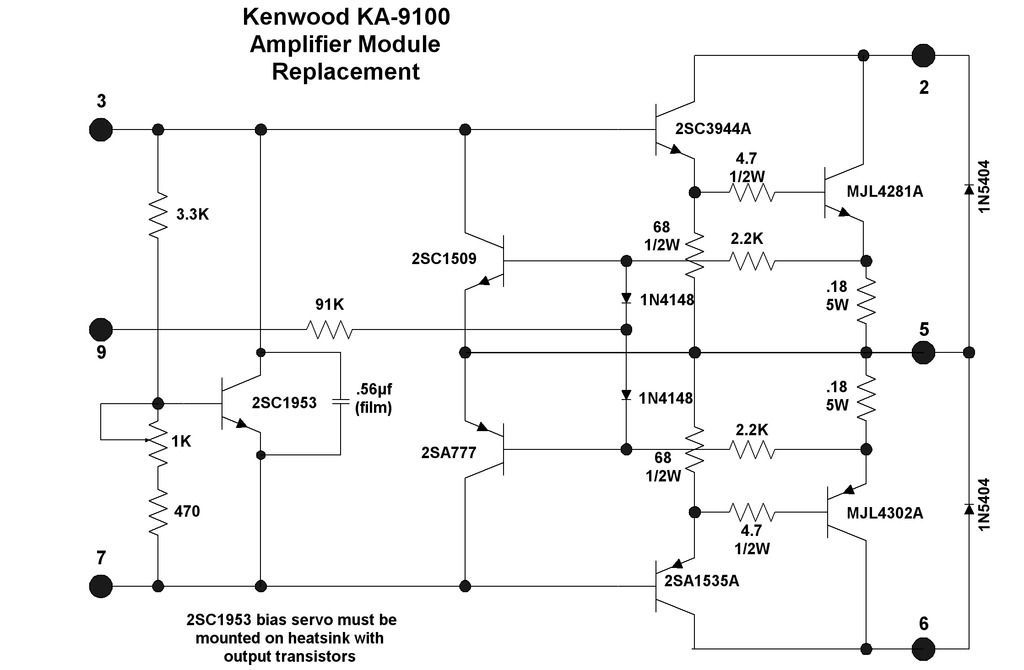
The output modules have been a major topic. A quick search turned up these threads, mostly about replacing the modules. The 2 schematics are work-arounds which work quite well. The second design is courtesy of Echowars, who knows these amps backwards and forwards, but is currently not active on AK.
http://audiokarma.org/forums/index....er-packs-out-of-circuit.780007/#post-10776356
http://audiokarma.org/forums/index....sicman-solution-ta-100w.778422/#post-10683355
http://www.audiokarma.org/forums/index.php?threads/ta-100w-follow-up-work-around.353919/

index.php


AmpModule_Rev2_zpspknrtlfo.jpg
 
Back
Top Bottom