• The move to the new server is done. There are some software and database maintenance updates in process. This has us passing the hat around to help out. We appreciate any donations. Seriously, even a dollar helps. The payment page may be found here - https://www.audiokarma.org/support.html

Lafayette LR-500B

thefraze1020

New Member
Hi,

A few weeks ago I purchased off eBay a Lafayette LR-500B receiver, which is part of a stereo system I'm setting up for my younger brother.
I've searched online everywhere, and cannot find any information on this unit. Does anyone know any details about this receiver, such as where I can find a manual, years built, and (dare I say it) is it any good?

Thanks!
 
Register to hide this ad
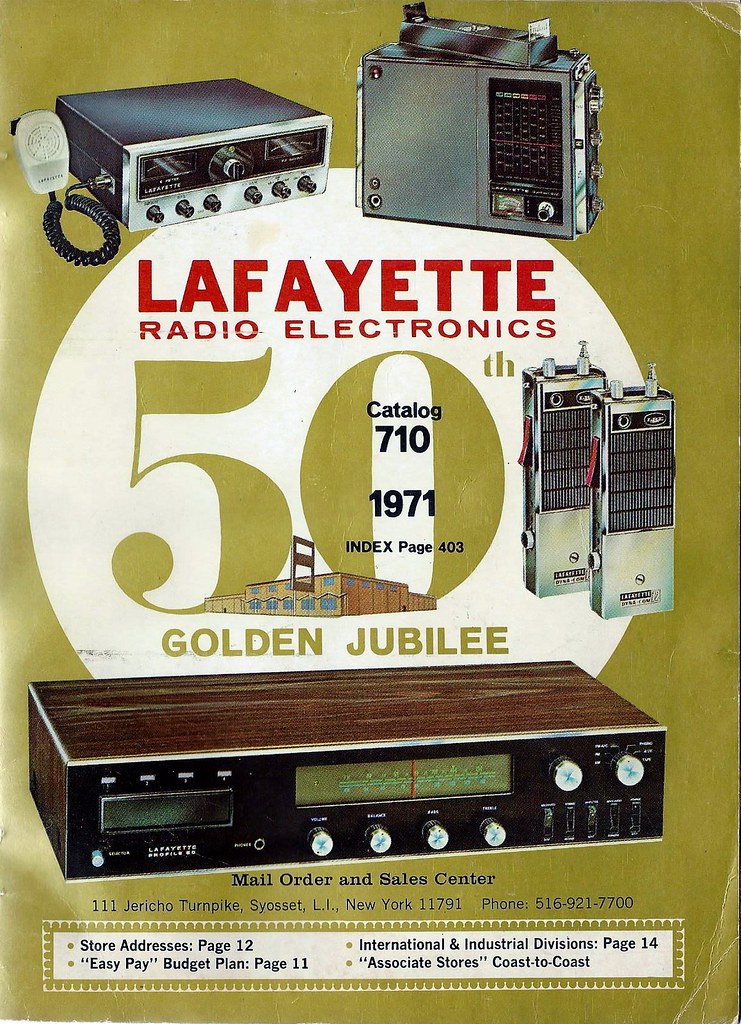
Scan0025 by Mark Hardy, on Flickr

So -- I just checked LRE catalogs from 1968 through 1973 and I see no LR-500B. I do see LR-500T and LR-500TA, but no "B".
1966 has only vacuum tube receivers (TRIO/Kenwoood OEM) and I, unfortunately, don't have 1967's catalog.

I'd be happy to scan & post LR-500T and/or TA catalog blurbs if you'd like.

No idea as to finding a manual, sorry.

EDIT: since I happen to have it handy :p here's the LR-1000B.

Scan_Pic0043 by Mark Hardy, on Flickr

Bear in mind with these old catalog scans, the FTC 1974 regulations on power output were not in effect. That "120 watts IHF into 4 ohms" power claim for the LR-1000B translates into ca. 22 wpc into 8 ohms (probably at 1 kHz).
 
Last edited:
Search for "Lafayette stereo manuals" several sights with manual downloads. Hifiengine is free, just sign up. Back in the 80's I used to buy Lafayette manuals from a company that bought them. Cant remember the name though. I had several of the large tube Lafayette shortwave receivers.
 
Yes, I've noticed that there is information out there for the LR-500T, but not for the LR-500B.

Attached are two photos of the unit I purchased.
 

Attachments

  • 20171028_084027.jpg
    20171028_084027.jpg
    44.2 KB · Views: 36
  • 20171028_084103_1.jpg
    20171028_084103_1.jpg
    52.2 KB · Views: 35
From pictures I found of the two units, they look the same. One for Japanese market, one for US, or other market? If one was for the Japanese market the FM dial markings would be different I think. If you can read and follow a schematic, it might be worth downloading one and take a look to see how similar they are. One integrated amp I have had a US, Canadian and German version of the same amp. Only slight differences, sliders instead of standard pots, ect. But the circuit was the same.
 
So my next question, is this receiver (or the similar LR-500T) a decent unit? I know Lafayette wasn't one of the power hitting brands in the 60's and 70's like Marantz, Sansui, etc. But from first impression, this appears to be a pretty nice little receiver.
 
That I wouldn't know. I was impressed with some of their shortwave radios though. Some features I just didn't see on other units. Very well built too. Its not a bad looking receiver. Any pictures with the top off?
 
So my next question, is this receiver (or the similar LR-500T) a decent unit? I know Lafayette wasn't one of the power hitting brands in the 60's and 70's like Marantz, Sansui, etc. But from first impression, this appears to be a pretty nice little receiver.
Good tuners in those receivers; mediocre audio quality. Not bad, not great - IMO, of course.
 
Good tuners in those receivers; mediocre audio quality. Not bad, not great - IMO, of course.
This is what I tend to read on other forums and such. But I haven't ever heard one before to judge for myself. I have an integrated amp that some really like, and others think is very average. If it sounds clear and not fatiguing to listen to, its all good. A picture of the inside could tell if it would be a simple job of restoring. Replacing tired old electrolytics could make it sound even better and last longer. It would be interesting to see if its direct coupled or cap coupled. Also how the amp, section is built. Adjustable bias and dc offset, ect.
 
Here are the innards. It is extremely clean inside. I have very thoroughly blown all the dust out of the inside.
 

Attachments

  • 20171028_131117.jpg
    20171028_131117.jpg
    97.7 KB · Views: 35
  • 20171028_131133.jpg
    20171028_131133.jpg
    88.1 KB · Views: 35
Thanks for pics. You can post the output transistors pn maybe we can an idea of wattage. Back then probably sold by Allied or in the transition to japan.
Nice tuner and these series continued to improve tuning as millions of people bought rotator antenna's with both fm and TV...ran a straight wire out for AM. (I did)

Lafeyette went on with good tuners.. unrelated but tuner is exceptional. https://www.hifiengine.com/manual_library/lafayette/lr-1500t.shtml
lot of watts for the 60's. They also dabbled a while with quality kits and sold a lot, but demand for DIY wasn't there and was easier to buy with some guarantees.
 
$10 gets you $20 it is real real close inside on topology to my LR1500TA. Lafayette built REALLY REALLY good sensitive tuners but they were prone to breaking due to some flunky early ICs in them. (damn near unobtanium) but they really did have 4 FM IF sections.

amp wise, they were similar to all 1965-ish-early 70's cap coupled NNSA amps (non-non switching amps ;-) )

I got a small pile of early kenwood the same (and indeed the style similarities are present)

They were built to pick up weak FM stations, play records (Laf. equipment generally has multi-adjustable phono input stages or controls) and play 1/4 in tapes - either R2R or 8 tracks
 
Thanks for pics. You can post the output transistors pn maybe we can an idea of wattage. Back then probably sold by Allied or in the transition to japan.
Nice tuner and these series continued to improve tuning as millions of people bought rotator antenna's with both fm and TV...ran a straight wire out for AM. (I did)

Lafeyette went on with good tuners.. unrelated but tuner is exceptional. https://www.hifiengine.com/manual_library/lafayette/lr-1500t.shtml
lot of watts for the 60's. They also dabbled a while with quality kits and sold a lot, but demand for DIY wasn't there and was easier to buy with some guarantees.
Would you think the two small boards to the right are the amp boards? Looks like two trimmers per board. One top right, another bottom left. It would make sense for bias and clipping adjustments.
 
This is what I tend to read on other forums and such. But I haven't ever heard one before to judge for myself. I have an integrated amp that some really like, and others think is very average. If it sounds clear and not fatiguing to listen to, its all good. A picture of the inside could tell if it would be a simple job of restoring. Replacing tired old electrolytics could make it sound even better and last longer. It would be interesting to see if its direct coupled or cap coupled. Also how the amp, section is built. Adjustable bias and dc offset, ect.
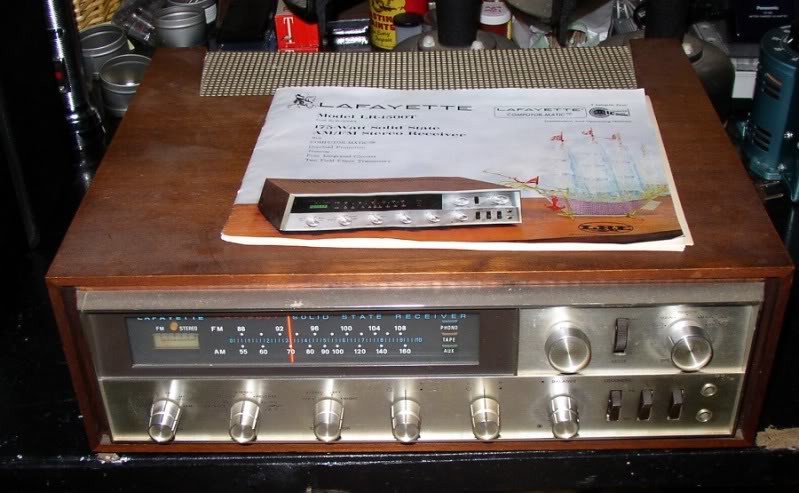
Had an LR-1500T here for quite a while, actually. It was -- nothing special.

LR-1500T by Mark Hardy, on Flickr

I do have photos of the innards someplace, but danged if I can find them at the moment...
 
Back
Top Bottom