Lafayette speaker - looking for info

reignbare

New Member
Long time lurker here...love this site, a wealth of information to say the least.

Anywho, I picked up this speaker at an estate sale, basically a shot in the dark as there was only one picture (local online auction) which only showed part of the cabinet. Long story short, I won :)...45$...now just trying to figure out what I have here.

Inside cabinet:

Lafayette LN-3 dividing network (made in Japan)
1 smaller Lafayette high fidelity speaker approx. 5" - 6"
1 Lafayette tweeter (looks like a lightbulb)
1 big ass speaker 15" if not a bit bigger- no label or markings I can see but I assume Lafayette?
Mid and High Frequency controls

All in a very cool mid century cabinet.
20171108_214553.jpg 20171108_214601.jpg 20171108_213748.jpg
I've done a bit of research, found some stuff on LN-5 LN-10 but no LN-3

I'm of the mind that this is sort of a do-it-yourself speaker.
And before I actually try it out is there anything i should be doing so i dont damage the speaker, it is in beautiful condition (guessing that I am the first to open that cabinet in a long time)

Any insights would be greatly appreciated.
 
Register to hide this ad
I worked for Lafayette for several years in the late 70s. Those speakers had come and gone by my time there.
 
I'd fire 'em up but keep in mind that speakers of that era can't handle power the same as today's speakers. I'm guessing that in the days those speakers were made, 25 watts was considered a super amp.
 
The light bulb is a light bulb it is being used as a resistive load for an old type of protection.
(I think) This is a two way; info on the green box should help. Nice looking box
 
The light bulb is a light bulb it is being used as a resistive load for an old type of protection.
(I think) This is a two way; info on the green box should help. Nice looking box

The light bulb-looking thing is just the back cup on the hi frequency driver. It's the Lafayette HW-7. This is a three-way box.

GeeDeeEmm

horn-tweeter-one-uno-lafayette_1_6577adc1b0f217720d13f9fa44a71906.jpg
 
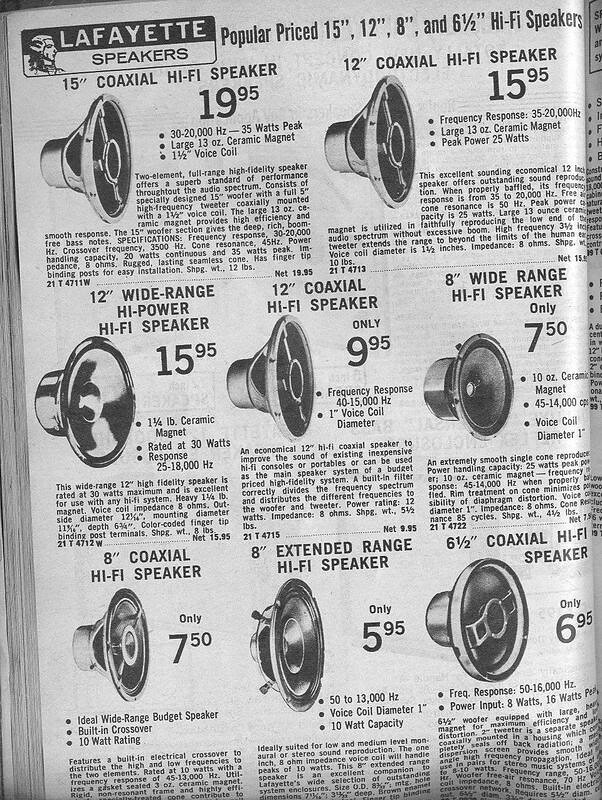
Woofer & MR are unremarkable (IMO). Early ones may have been domestic OEM; baskets resemble Utah drivers. Later ones were Asian-made.

Is the MR driver open back or sealed back? The 8" sealed back (lower of the two scans below) was sold as a MR driver; the open back (upper of the two scans below) was sold as a "wide range" driver.

lafayettemodrivers (1) by Mark Hardy, on Flickr
lafayettedrivers-1 (1) by Mark Hardy, on Flickr

That is a pretty well respected treble horn, Pioneer (Fukuin) OEM.

Pioneer_HW-7_a.jpg

image source, and more info: https://www.audioasylum.com/cgi/t.mpl?f=hug&m=152654

see also:

http://www.audio-heritage.jp/PIONEER-EXCLUSIVE/unit/pt-2.html
http://www.audio-heritage.jp/PIONEER-EXCLUSIVE/unit/pt-8.html

for similar Pioneer tweeters.
 
Expanding the picture it looks like the sealed back midrange speaker. Now you need to find a nice mono tube amp for it. :thumbsup: Years ago I built a custom console that looked like an old floor standing radio. I used an Eico mono tube tuner and a small push pull mono tube amp for it. 15" woofer, 6" mid and a small horn. It sounded nice and I used it in the bedroom for some time and then in my shop for a few years.
 
Thanks kids, great input for sure....so good in fact that I have started putting together a vintage Lafayette system! The more I have been searching the more I am finding that, albeit not super top end, Lafayette is for the most part well regarded especially the earlier gear. Just received a beautiful tuner in the mail tonight and, with any luck, the amplifier should show up in the next couple of days.
The tuner is a LT80B which there isn't much info on out there, found a bit on LT80 and LT80A which look similar. The Amp is an LA-2245 which from what I can tell should be able to switch from stereo to mono (correct me if I'm wrong ) while I search for a monoblock.
Now both sellers say they are functioning correctly but, being new to the world of tubes and mono for that matter, is there any precautions I should take before firing them up?
As always, thank you audio gurus
Screenshot_2017-12-04-18-21-03.png Screenshot_2017-12-04-18-20-43.png Screenshot_2017-12-04-18-20-51.png Screenshot_2017-12-04-18-23-18.png
 
You could ask questions or start another thread, about tube tuners or amps, in the tube threads. I know next to nothing on tube gear. I've been told to use a combo variac and dim bulb to slowly powerup unkown tube gear for first time. Get expert opinions before just plugging in. Be careful of shock with those circuits. You should find help there.
Edit: I wrote dead bulb instead of dim bulb. I'm such a dim bulb. BTW, nice speaker.
 
Last edited:
Thanks kids, great input for sure....so good in fact that I have started putting together a vintage Lafayette system! The more I have been searching the more I am finding that, albeit not super top end, Lafayette is for the most part well regarded especially the earlier gear. Just received a beautiful tuner in the mail tonight and, with any luck, the amplifier should show up in the next couple of days.
The tuner is a LT80B which there isn't much info on out there, found a bit on LT80 and LT80A which look similar. The Amp is an LA-2245 which from what I can tell should be able to switch from stereo to mono (correct me if I'm wrong ) while I search for a monoblock.
Now both sellers say they are functioning correctly but, being new to the world of tubes and mono for that matter, is there any precautions I should take before firing them up?
As always, thank you audio gurus
View attachment 1059416 View attachment 1059417 View attachment 1059418 View attachment 1059419

index.php


So -- are you sure about the model number of the amp?
There was an LA-224 series -- these were vacuum tube amplifiers, but the cosmetics of the ones I've seen are different.
This amplifier looks like the LA-224T, which was a solid state ("T" for transistor) amplifier.
Here's a scan from the 1968 LRE catalog.

LRE LA-224T 1968 (1) by Mark Hardy, on Flickr

Unfortunately, I don't have the 1967 catalog, so it is possible the amp you're asking about was a very late variant of the vacuum tube amplifier, but I suspect it's the LA-224T in the photo(???).
 
So, yes, the amplifier will switch to mono -- you could use it as a mono amplifier, but not really as a "monoblock" per se... it mixes the inputs to mono, but it delivers the mono program to both amplifier channels.

If your amp is indeed a vacuum tube amplifier, it will need to have both power amplifier outputs (speaker terminals) loaded. If it's solid state, it would still be a 'best practice' to load both outputs.

The easiest way to do that, of course, is to hook speakers to both outputs (L and R) -- if you preferred, however, you could hook a speaker to one output (e.g., to the "L" channel) and load the other output (the "R" channel, in this example) with a noninductive 8-ish ohm (e.g., 8 or 10 ohm) power resistor. The power resistor would need to be rated for power handling similar to the amp's output (e.g., 10 or 20 watts) and it could get hot if the amp is operated at high output power. The power resistor is a "dummy load" -- it will keep the power amplifier happy, but it will simply convert the amp's output power to heat. It's a wasteful way to keep the amp happy :(

There are purpose-built "dummy load" resistors designed, e.g., for bench-testing amplifiers -- these have the advantage (typically) of having built-in heatsinks to deal with the power (heat) dissipation... but they still will get warm, possibly hot, and so care must be taken into how and where they are installed.
Here's an example (8 ohm 100 watt dummy load resistor):
https://www.parts-express.com/8-ohm-100w-non-inductive-dummy-load-resistor--019-020
019-020_HR_0.jpg


I hope this makes sense (I am still hypocaffeinated)! If not, just ask more questions and I'll do what I can to answer them clearly! ;)

As to general guidance on the care and feeding of aged vacuum tube electronics of dubious condition/pedigree, see:
http://audiokarma.org/forums/index.php?threads/vintage-tube-gear-care.778/

this sticky may be useful, too(?):
http://audiokarma.org/forums/index.php?threads/how-does-a-tube-amp-work.443915/
 
mhardy-

I always look forward to your scans of the old RS catalogs and circulars. They bring back many, many memories of wearing out the pages of those things dreaming of a "good, better, best" audio system that I could not afford!

GeeDeeEmm
 
Slight thread veer: The speaker in the middle of the bottom row in the upper catalog scan is the same as the pair I used to assemble my first "component" stereo back in '65 or so. Elsewhere in the same catalog resides the "Stereo 10" amp I purchased, as well as the Lafayette-branded Garrard complete w/Astatic record plow. Hey...I thought I was pretty cool:)
 
FWIW, this is at least one morph of the vacuum tube LA-224 amplifier; in this case, the LA-224A from the 1966 LRE catalog.
Since I don't have a copy of the 1967 catalog :( so I don't know what happened between this amp in 1966 and the above-mentioned, solid state LA-224T in 1968.

LRE 1966 LA-224A by Mark Hardy, on Flickr

If one clicks on the image -- one may see it at 'full size' via Flikr... in case anyone reading this thread didn't know that.

LRE 1966 cover by Mark Hardy, on Flickr
 
FWIW, this is at least one morph of the vacuum tube LA-224 amplifier; in this case, the LA-224A from the 1966 LRE catalog.
Since I don't have a copy of the 1967 catalog :( so I don't know what happened between this amp in 1966 and the above-mentioned, solid state LA-224T in 1968.

LRE 1966 LA-224A by Mark Hardy, on Flickr

If one clicks on the image -- one may see it at 'full size' via Flikr... in case anyone reading this thread didn't know that.

RE 1966 cover by Mark Hardy, on Flickr
That LA-224a was my first "real" stereo amp.
 
Back
Top Bottom