Let The Subwoofer Debate Begin!

Any advice or experienced opinions on the JBL B380?
I also have the BX63 non-A unit. Installed a new surround, naturally. I've only tested briefly using a free-to-me Bogen HTA250. Thinking about selling the whole rig, maybe, but not before extensive demo-time.
Thoughts?
Suggestions?
 
I have a Hsu VTF2 II, a Dayton low profile 10", and a Yamaha. The Yamaha was a clearance find and is mediocre. The Dayton is a great bargain and sounds phenomenal way beyond the price point, and the value but not the specs are exceptional. The Hsu is a powerhouse. I've had it for 10(?) years and its still going strong in my HT with its sister surround/center speakers. I would not hesitate to recommend it. The only downside is its size, big as an end-table and used as one in a dual role in my room.

When the Hsus arrived, in the packing docs was a sample CD with live organ music. 16hz at medium volume literally shook the house, alarming my wife and cat. It goes down legitimately to 20hz flat per the maker.

In "Master and Commander", there is a battle scene with a realistic explosion. It was thrillling full body experience with even an adrenaline rush. If you haven't heard a great sub up close you will be in for a treat. "Flight of the Cosmic Hippos", my #1 bass testing song, was effortless and again, thrilling.

With all that said, there are many good subs out there, some much smaller. And, having said THAT, I don't use subs in my hif-fi systems, just because.
 
I have a Hsu VTF-15H MK2 also and it has not disappointed. It comes with two foam port plugs that let you fine tune to what you need. When researching subs I called Hsu and actually spoke with Dr. Hsu himself...and again a week or so later with more questions and to make an order. I dont think I've ever dealt with an owner of a company directly for anything. It has a 7 year warranty on the woofer and 2 on the electronics for peace of mind.

This sub is a 100 lb beast... but he has other smaller subs that may fit the bill.
 
I have a JTR-S1 sub and it does everything I need it to and then some, highly recommended if your budget is within this sub. It is large and approximately 140lbs but not too big considering it’s an 18in sub. I can also recommend Velodyne HGS, DD series subs they’re incredible subs for their size and can fit just about anywhere and sound excellent. You can find them used for very reasonable prices with the down side being the amps can give out however, there are services out there who refurbish those amps.


IMG_5509.jpeg


Audiofreak71
 
Last edited:
Steve Hoffman forum.

Subs, when implemented right adds body & soul. Their there-but you wouldn’t know it
The perfect description of a well implemented sub. You don't even notice a subwoofer unless you turn ot off. But when to use a sub?, I've found that kind of depends on the speaker. I do have one pair of speakers that dip low enough I just don't feel a need for one. But many speakers roll off around
30 to 40hz like, or even higher. Granted there isn't much below say 40hz, but adding a sub will add some body and depth to the bottom end.
 
Last edited:
The perfect description of a well implemented sub. You don't even notice a subwoofer unless you turn ot off. But when to use a sub?, I've found that kind of depends on the speaker. I do have one pair of speakers that dip low enough I just don't feel a need for one. But many speakers roll off around
30 to 40hz like, or even higher. Granted there isn't much below say 40hz, but adding a sub will add some body and depth to the bottom end.

Agree completely. My mains are rated down to 25hz (-3db), and even then there is no comparison than with the sub added in. All subs are a seamless invisible extension of low frequencies when properly tuned. Subs are easier even to make seamless and invisible the lower the mains go. Those who have found sub boomy have them mistuned (a lot).

I have about ten systems in the house, and all but 1 have and need a sub. The one that doesn't need a sub is a 1972 receiver with tiny (10" cube, with 8" upfacing woofer) Allison Six speakers. I use that system at low to medium volume levels, and with loudness engaged, it's perfect, even though the mains fall off around mid-40hz. I have a spare Velodyne sub that's sitting idle, and I have no inclination at all to use it. That's why I shake my head when people say "you don't need loudness anymore" for new equipment. The behavior of human ears has not changed, neither has the need for compensation at low volumes. We can make up for it with subs, as I have in 9 out of 10 systems, but not everybody should need a sub to get low end output for systems that are used at modest volume levels.
 
Last edited:
Agree completely. My mains are rated down to 25hz (-3db), and even then there is no comparison than with the sub added in. All subs are a seamless invisible extension of low frequencies when properly tuned. Subs are easier even to make seamless and invisible the lower the mains go. Those who have found sub boomy have them mistuned (a lot).

I have about ten systems in the house, and all but 1 have and need a sub. The one that doesn't need a sub is a 1972 receiver with tiny (10" cube, with 8" upfacing woofer) Allison Six speakers. I use that system at low to medium volume levels, and with loudness engaged, it's perfect, even though the mains fall off around mid-40hz. I have a spare Velodyne sub that's sitting idle, and I have no inclination at all to use it. That's why I shake my head when people say "you don't need loudness anymore" for new equipment. The behavior of human ears have not changed, neither has the need for compensation at low volumes. We can make up for it with subs, as I have in 9 out of 10 systems, but not everybody should need a sub to get low end output for systems that are used a modest levels.
over the years I tend to keep speakers that sound good at low volumes.
Some I've really liked at higher volumes, but just didn't cut it at lower volumes. That's where a loudness control can come in handy for sure.
I have had speakers that dipped into the 20+ hz range that couls.still deffenetly benefit from a loudness control.
My main system and all but two others don't have tone controls. So having speakers that can still sound great and with a decent low end are important.
 
I have a REL sub in my main system and enjoy it very much. I like REL's way of hook up too. You have the option of connecting the sub directly to the amps speaker outputs. Your main speakers still run full range as they were designed. I actually just purchased another identical sub for the main system so I can run two subs to load the room more uniformly.
 
I have a REL sub in my main system and enjoy it very much. I like REL's way of hook up too. You have the option of connecting the sub directly to the amps speaker outputs. Your main speakers still run full range as they were designed. I actually just purchased another identical sub for the main system so I can run two subs to load the room more uniformly.
That has become quite common and recommended...room dependent of course.
 
For years I had no SW, thinking they were rather for Home-Theater explosions and noises...

Finally, I decided to test some for Audio (no HT at home) - borrowed to friends : Klipsch, Celestion, Fostex, etc... But all of them showed more or less a localizable, boomy sound, over the bass extension that I only expected.

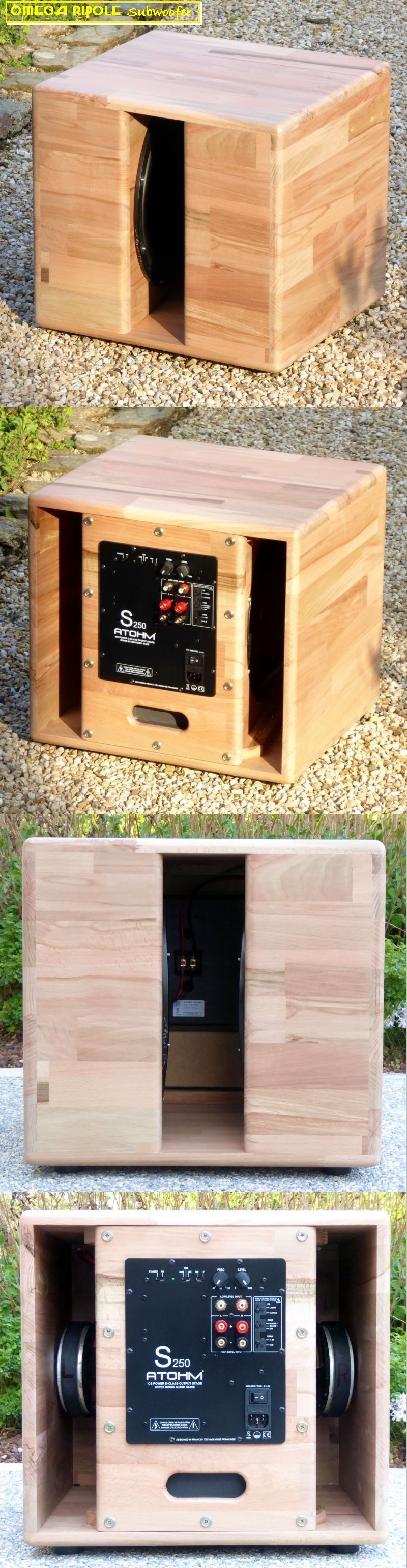
Then I discovered the Ripole principle, as invented and proposed by Axel Ridtahler, a German Audio engineer. I decided to build one - slightly modified internally to integrate the sub module in it, like most SW have :

zxtRNb-Omega-Ripole-25-04-22.jpg


I'm done with that principle, truly... Deep, floating infra-bass extension, omnidirectional but unobtrusive, which fills the room. No boomy sound nor box tone coloring, excellent damping similar to a large sealed enclosure. My Omega Ripole simply add what is missing under the natural bass cutoff of my enclosures : this is exactly what I expected.

T
 
Last edited:
I have a REL sub in my main system and enjoy it very much. I like REL's way of hook up too. You have the option of connecting the sub directly to the amps speaker outputs. Your main speakers still run full range as they were designed. I actually just purchased another identical sub for the main system so I can run two subs to load the room more uniformly.
For what purpose, seems counter-intuitive and deletes one of the advantages of even having powered subs.
 

Thanks @damacman ! ;)

If I did not tested the Ripole principle, Indeed I would never have believed in the description of its qualities...

Well OK, for the "Home-Theater gun/earthquake/thunder/crash/bang/boom-and-the-like" sounds played at high loudness, the Bass-Reflex principle is probably more suitable with its high efficiency.

But for (pure) Audio, the Ripole principle really stands out... Think that my Omega Ripole offers a cut-off below 16Hz, for a simple pair of Beyma 12" (12BR70) without any electronic control or equalization.

T
 
For what purpose, seems counter-intuitive and deletes one of the advantages of even having powered subs.
REL believes you should use your speakers crossover as it was designed for your speakers. Then just adjust the subs crossover to blend with your speakers. Doesn't pose any problem for the amp. A good analogy is..."it's like a flea on the back of an elephant". If you paid good money for your speakers which hopefully have quality crossovers in them, why compromise them by sending the signal to a crossover in a sub which may be of lesser quality.
 
REL believes you should use your speakers crossover as it was designed for your speakers. Then just adjust the subs crossover to blend with your speakers. Doesn't pose any problem for the amp. A good analogy is..."it's like a flea on the back of an elephant". If you paid good money for your speakers which hopefully have quality crossovers in them, why compromise them by sending the signal to a crossover in a sub which may be of lesser quality.

Ahh, errr, ok. That is not only making some pretty broad assumptions, but is not grounded in reality.
First, who is to say the sub is "of lesser quality".
Unleashing the need for the amplifier to produce sounds that the speakers are not doing a decent job producing (that is in fact why you got the sub in the first place) frees up headroom in the amp, and allows the speakers to do a better job at producing the sounds they can produce. This really has nothing to do with crossovers in the mains, so I am not even sure why you brought it up. Now, I am not saying there is any harm in doing what you say, but that is not the same as saying it is better. A lot of that would have to do with the speakers themselves. For instance, a reasonable bookshelf 2 way speaker, crossed over at 1.5-2k, in which the woofer is struggling to both produce sub 60 hz signals while also simultaneously playing vocals, well......... you get the picture.
 
I think what made REL's approach different (from looking at them a long time ago but never owning one (please correct me if I'm wrong)) is that you simultaneously connect their sub via both LFE (out of an AVR) and with the amp's speaker outputs. This meant that the sub both supported mains left & right content and the LFE content for theater use. In music, however, if you had pure direct on bypassing LFE output, it would still provide an extension to the main speakers via the speaker-level connection.

I always use the LFE (line level) sub input for theater use, but prefer driving subs via speaker-level for 2-channel music. The former (using LFE for theater) is pretty universal. The latter (using speaker-level rather than line-level/LFE for 2-channel music) is probably not the norm for most.

For 2-channel music, there are plusses and minus to either approach. Driving a sub by line-level has very slightly reduced distortion (since it is using preamp output, bypassing the amp section) but the sub doesn't pick up any of the "color" of the amp the main speakers are seeing. Driving the sub by the speaker outputs means that it has very, very slightly more noise (now the "amp" is added to the signal chain), but the sub sees the exact same signal as the mains.

My experience is that the latter makes the sub a more seamless extension of the mains for 2-channel music, because both the sub and the mains are driven by the exact same signal. The additional noise of the amp is infinitesimal in practical terms within operating limits.

Some feel that line-level is better for music. Neither approach is definitively better or worse, and it's probably situational depending on equipment.

The potential benefit of using speaker-level for 2-channel becomes more apparent if you think of having an SS preamp and a tube power amp. With line-level, the sub is seeing only the solid state preamp signal with no tube amp color. With speaker-level, both the main speakers and the sub see the exact same "SS pre + Tube Amp" signal.
 
Last edited:
Back
Top Bottom