Let's restore a Heathkit AR-15

Phil-from-Tn

Super Member
For those of us bit by the stereo bug back in the 60's, we all remember the Heathkit company. They produced some very fine units and one of their best was the AR-15. It was available in kit and pre-wired form,was released in 1967 as the first of the 15 series machines, and was a top performer in its day. I'm not too sure when it went out of production, but there are plenty around the garage sale circuit today. I remember my dad putting together one and blasting out the Big Band records he had.
Anyway, with the much better quality, selection and availability of modern components, a restore and a few select mods will bring any unit's performance levels back to original spec or even surpass them completely. For this rebuild I chose one of the basket cases that was waiting to hit the bench. I picked this one up from a garage sale for no cost. It was a "fire hazard" and put in the attic after it "went up in smoke". I figure it would be a good candidate for hard to find hardware parts, as it was a good looking unit. Instead of scrapping it, lets bring it back from the dead. Its essential to have a manual for all the details of removing and reinstalling sub-assemblies so I won't spend allot of time on the details of disassembly and subsequent reassembly. You can find manuals from time to time on ebay.

front.jpg
The evidence in the left hand corner of the problem..
back.jpg
After removing it from the cabinet, the top
top.jpg
and bottom
bottom.jpg
No apparent damage or burning so I'm not too sure what the seller was talking about. We will take precautions though as the cord cut is an ominous sign of problems. The first step is to remove the front of the unit. Simple enough, consult the manual and its pretty self explanatory, remove all the knobs and two screws at each end, release the dial pointer from its cord and desolder the meter leads after tilting the front panel. Be very careful with the front panel as there are very few bezel parts available for these.
meter-disconnect.jpg
Remove the two screws holding the switch bank
switch-bank.jpg
After removing the selector support, the light panel, the hi-temp and stereo indicator lights, the back of the preamp is visible. Here you can tell the quality of work the original kit builder exhibited and what you're getting into. This one is not too bad.
back-of-preamp.jpg
 
Last edited:
Register to hide this ad
Starting with the easy stuff first, the amp boards can be pulled one at a time after labeling the wires.
left-amp-pull.jpg

After putting the board in a holder and checking a few components, its not looking to good. All the caps will of course need replaced as they're 50 plus years old. However, measuring a few of the carbon resistors, the real damage can be seen. Most were about double to triple their value and some were just open. This unit suffered at least one power surge/lag in its life, probably more. The power supply board will be interesting. So out with the bad....the only survivors were the 5 watt resistors that were also replaced after load testing.
stripped-amp.jpg

And in with the new. I chose Elna Silmic II's for this build. Choice of driver transistors was ON substitutions. The results are pretty good. I went with Xircon metal film resistors and beta matched all transistors across channels in pairs. The two larger caps need to lean over so they don't get too close to the bottom once its screwed down.
restuffed-amp.jpg

Wash and repeat for the other amp board. Next is the power supply board. Every component on this board ending up being out of spec. Luckily the transformer was fine and measured right to spec. Even the wire wound power resistors were bad. This is the back of the board and evidence of the bad power problems are the crinkled foil. I may end up replacing the board too. Notice the tissue along the bottom. The board got a good bath in denatured alcohol to clean it. Be sure to wash wash each board down after assembly to clean all the flux off after rebuilding.

power-board-back.jpg
 
While the amp boards are loose and the power supply board is out of the way, pull the two output caps and drill the chassis to hold the new ones as they are so much smaller. Its a trial and fit mounting so just take the time to check everything and be sure the tuner board will be able to fold back down into position. I chose Nichicon Super Through's at 4700uF and 63V. I hook them up later while doing the output transistors.
output-caps.jpg

Back to power. Since this one had some power damage and after checking the power output transistor mounted next to the huge power filter cap, it was replaced with an ON 2N3055G which is basically an updated version of the original. I didn't get a shot of the new one just be sure to use thermal grease and a good mica shield and you'll be fine. Next is the phono preamp. Its an easy removal and is located on the back of the unit under the tuner board. The tuner board has a holder to place it in multiple positions so you can work on anything located under it without having to hold it up. This small attention to detail is what made Heathkit loved by its fan base. Anyways, tag the wiring connected to the phono board and pull the board. Be sure to clearly mark the two brown wires as if you get them reversed the channels will be reversed and your balance control will be reversed for the phono. Do the same strip and replace of all components on the board. The transistors are usually not bad but these were real flaky and would not stay on during testing. This is the stripped phono board and may reveal the original "up in smoke" cause. This board is located under the vent and it looks like either a coke spill or just an accumulation of furniture polish is the culprit for some of the damage. I had to pry some of the components off the board as they were glued down with this goo.

phono-goo.jpg

All cleaned and ready for reinstall.

phono-renewed.jpg

But, hold off for a while..
 
Last edited:
Heathkit like Dynakit (Dynaco) and others chose the cheapest interconnect sockets they could find. I sometimes see them in the shop all corroded and just really ugly and have to wonder if the bean counters didn't overrule the engineering. Regardless, we can correct this problem nowadays for cheap. First, pull the wiring off the interconnects after marking it. I like to only do one channel at a time so as to avoid the possibility of flipping the right and left interconnects. When you pull them, there is an insulator present. You simply just use that insulator as a pattern and hit the drill press with some thin steel or aluminum stock and make a five hole mounting bracket. Not too hard. Then, to get the fittings mounted I use a Dremel and a carbide bit to grind the separate interconnect flanges to fit in the chassis mounting holes. That way they appear stock. Then remake the grounding wiring like this.

interconnect-sockets.jpg

A couple of mentions, be sure to point the center post openings to where you can get too them to solder the wiring back in place. Its a cramped space and having them pointed in the wrong direction can be frustrating. Also be sure of the grounding connections because if they aren't good you'll be hunting down a mysterious hum. When done they'll look something like this. This first shot is also includes the second plate made from the insulator bracket pattern.

interconnects-mounted.jpg
Here is a shot of both sets installed. You can see how much grinding has to be done to get them in. They look like stock when done and this mod itself will be quite a distortion killer with anything like a turntable connection. Once you get into this mod you'll appreciate holding off on the phono board reinstall. That can be done much easier now that the interconnect sockets are in place.

interconnects-both.jpg
 
Last edited:
Now on to the preamp. This is the most challenging board to complete. It can be pulled and put in the board holder but there is a ton of wiring involved. There are over thirty connections scattered around the board and most are not too easy to get too. I've completed these boards both wired and pulled, and prefer leaving the wiring in place and just pulling the board away from the chassis to access the components. By working from one side as far as you can reach then flipping the chassis over and going from the other side, all components can be reached without too much problem. From the top of the machine you, can reach all the way down to the controls themselves which is most of the way across the board. I don't have any shots of the stripping as its just heat, remove, repeat. Here is a shot of all the wiring I was talking about. It doesn't look too bad with a component free board but believe me, its a challenge reconnecting all those connections in the center of the board with it full of components that are taller than the originals. That's why I choose to leave wiring intact. Just be sure to rebuild across the board lengthwise so you can reach all the components. I start with resistors first then transistors and caps in no special order. Just whatever is easiest to reach first. I always beta match all transistors in pairs so the right and left channels are performing as close to each other as possible.

preamp-stripped.jpg

Build it across the board.

across-the-board.jpg

Until completed

preamp-complete.jpg

A few notes about transistor substitutions in the preamp are in order as we can make some nice sound quality gains here. For the TZ1160 which is not available and has very little documented on it, I found that an ON KSC1008CYTA does a fine job. They're cheap enough to order a bunch and then beta batch them according to position on the board and channel. There is a total of three per channel in the first two stages of the preamp interconnected by electrolytic's at 10uF. The choice of either Nichicon FG's or Elna Silmic II's for these caps will do quite well and outperform the originals by a long shot. The quality we can now obtain just wasn't available back in the 60's. The third stage of the preamp is just a 2N3393 that is still available today(only better quality). The second substitution for the preamp is the final stage and is also not very well documented on part exchange. The ham radio guys use a 2N3906 to substitute for the X29A829 and after a bunch of curve tracing and testing it works well in the case of the preamp final. There is also a couple of small caps in the signal path that can benefit from an upgrade. One is the .0022uF cap just after the treble control. One of the complaints of the original build was the "brightness" of the highs in the AR-15. Putting a good polyester cap in this spot solves much of that problem. They're cheap too. Of course choosing good film polypropylene caps will sound much better than the old "mylar" and disc capacitors available back in the day. Any disc capacitor or tantalum in the signal path is a no no. These same kind of substitutions are done throughout the rebuild.
 
Last edited:
Excellent work Phil, watching as I have an AA-15 that I might tackle at some point.
It would be most helpful if you could build a parts list when all is said and done. Transistor subs would be awesome.
 
You could have problems with 2N3055 replacements for the output transistors. They are rated at 60 V and could see 72 volts at peak output. MJ802 has a higher rating, or better yet, MJ21194 or MJ21196 are modern replacements that will withstand anything this amp will give them. They also have less beta droop at high current.

Note on your input jacks, from the outside it appears that they could be contacting the chassis which would cause ground problems.

The unfortunate thing about these units is the single power supply, capacitor coupled output. It was used back in the day to avoid problems caused by shorted transistors but the technology has improved to the point that this is totally obsolete. You will notice a thump at turn on with approximately 5 volts hitting the speakers. The speakers are the charging path for the output capacitors that have to charge to half the supply voltage. They also cause a number of less obvious problems. I looked at various ways to eliminate them but the transformer has no center tap. The only solution appears to be a full bridge output circuit but there is no room for the additional output transistors and the output would be floating at half the supply voltage.
 
The 2N3055 isn't being used for any outputs. In the original AR-15 design they used it for the power supply only. The actual out puts I chose were ON MJ802G's. I considered the MJ21194 but heat becomes an issue.
 
In my state you can't buy an AR-15. Very nice. This is why I work on my own units, not only meticulous care but also clean everything as you go so that it looks like a new unit.
 
Because we are doing a full on rebuild and the power problems this unit suffered I replaced all the carbon resistors on both the tuner and multiplex boards. Doing this will prompt a tuner and multiplex realignment but at least the transistors will be biased properly and the realignment will have the best chance of not drifting as it ages. So with that, the tuner board and multiplex boards are handled next. Again its just a mater of heat, remove, replace. If you "lucky" enough to get an early AR-15 you'll have a smattering of tantalum caps throughout these two boards just pull them and replace with new electrolytic's.

tuner.jpg

multiplex.jpg

To do a really thorough job the the green mylars could be replaced but these were within spec and to tell the truth I don't think it will gain anything in FM performance. It could be done but time and patience being what it is, this is as far as I'm going at this time. If the unit has problems aligning or has distortion during FM playback It will hit the bench anyway and then it will get the full bore restore. So moving into the home stretch, the outputs need replaced and the huge filter cap needs replaced. Starting with the large cap, nobody makes a 3.25 inch diameter capacitor anymore so I hit the hardware store to do some "engineering". The first unit I rebuilt I used a 10,000uF 100V computer grade cap that rings in at a cool $68 so I decided to head another direction. Three Nichicon FG's at 3300uF and 100V wired in parallel equate to 9,900uF for a total of $18, a savings of $50 which covers most of the cost of all the resistors and capacitors for the entire project. So this was a no brainer. To make up the difference in the size from the original, I utilized my hardware store "engineering" with this.

toilet-tank.jpg

Thats right!! I'm not crazy. Its seal that goes between a toilet bowl and tank. The first time I used this Idea was for my son's high school senior project in which he did a restoration. So, it fits and securely holds the three caps like a vise. This shot is from the bottom.

tri-cap.jpg

This a pic of the arrangement from the top.
tri-cap-top.jpg
 
In my state you can't buy an AR-15. Very nice. This is why I work on my own units, not only meticulous care but also clean everything as you go so that it looks like a new unit.
Absolutely. Its a very relaxing and enjoyable time. Put some tunes on and heat up the iron. This AR should be legal in all states its not a a "fully automatic semi" .....still don't know what that means but it was some doofus on CNN.... but that's another subject...LOL
 
The final push is the output transistors I chose ON MJ802G's. For this receiver, lots of power and clean response curve as well as manageable heat with the design's limited heat sinks. So a look at the originals with two being burned open.

old-outs.jpg

Clean clean clean and then replace the outputs. Once again use heat sink grease and a good mica shield.

new-ouputs.jpg

Next hook up the output caps.

output-caps-1.jpg

Thats about it. The rest is reassembly. Deoxit all the controls and switches then clean it all and put it back together. I replace all the bulbs and then take the entire machine down to the shop before putting the tuner board down and blow it out with compressed air. This will get any stray bits and solder balls that I missed during rebuilding of the unit. Bring it back up to the lab and enjoy the task of restringing the tuner wheel. I've gotten pretty good at it with all the units I've worked on but its still a challenge in both dexterity and patience. The manual is a life saver for this one as the instructions were done very well by the Heath company. Once thats done I flip the unit over and unsolder all the marked connections to the power supply board that feed all the rest of the boards I rebuilt, plug it in and check the power output at each power board feed connection. If the connection is within spec and no smoke and fire are happening I move to the next connection. If you have a problem, the suspect board will need attention, but if you were thorough and careful all should be well. Once all the power is hooked up turn the volume down and plug in a set of cheap expendable headphones. Then power the unit up and begin checking each control for noise. Be sure to flip the selector to the phono and listen for stray hum. I like to put a couple of 100watt 8 ohm resistors across the speaker connections and jack the volume up while listening to the headphones for noise. Listening for silence is against our hobby but I don't want any stay noise in the system. The final step is to hook up some speakers, hopefully some sweet sounding ones, and give it a listen. It will take about 40 hours of listening for everything to take a set and burn in. It doesn't matter how loud or soft its played but why not see how it will drive those speakers.

first-play.jpg

I'm a huge big band jazz fan but a small quartet with lots of good piano is a great way to cover as many frequencies as possible so I chose a great pianist that was also a great recording. One thing I didn't like was the light bleeding to the high heat and stereo bulbs from the new bulbs(like above) so I went in and used some sponge weather stripping to block the extraneous light. if you have any questions just let me know as I'm sure I missed some details along the way. Next is tuner alignment and finally cabinet clean up/repair.
I hope this was helpful and enjoy a piece of audio history in all its glory for many years to come. Crank it UP!!
 
Last edited:
Absolutely. Its a very relaxing and enjoyable time. Put some tunes on and heat up the iron. This AR should be legal in all states its not a a "fully automatic semi" .....still don't know what that means but it was some doofus on CNN.... but that's another subject...LOL
I should move to Tennessee. In my state it was my governor who was saying such things. Funny thing is that he was my governor when I was in elementary school and now he's my governor again when I'm in my 50s. I could have sworn we were a two terms limit state.
Really like the look of that Heathkit. Reminds me of car dashes from that era. You did good work.
 
The 2N3055 isn't being used for any outputs. In the original AR-15 design they used it for the power supply only. The actual out puts I chose were ON MJ802G's. I considered the MJ21194 but heat becomes an issue.

Why would MJ21194 transistors run any hotter than MJ802s? They would be handling the same voltage and current. Heat = watts = volts x current for any transistor.
 
Why would MJ21194 transistors run any hotter than MJ802s? They would be handling the same voltage and current. Heat = watts = volts x current for any transistor.
Good question. When I tested a set of 1194's they ran a bit hotter then the 802's at the same 20V output across an 8 ohm load, which is just a bit before clipping. I didn't try a set of 4151's so that may be a good experiment. I've got a bunch of these I've serviced and haven't had a single problem with the 802's. The power supply boards seem to be the biggest culprit of weirdness with all the ones I've worked on. I suspect many of the ones that I've seen have been connected to some pretty flaky power in their lifespans.
 
Having the basic test equipment, I removed the internal testing functions and cleaned up the circuit a bit. Also rebuilt the multiplex section using the LM1800 decoder to eliminate all the silly adjustments.
 
Having the basic test equipment, I removed the internal testing functions and cleaned up the circuit a bit. Also rebuilt the multiplex section using the LM1800 decoder to eliminate all the silly adjustments.
Great minds think alike I'm working on a board layout now for one. The original parts are so fragile. I shipped a unit to my sister and the gorilla's at "the shipping company" must have thrown it down the stairs a couple of times. By the time she shipped it back to me there were three of the chokes on the multiplex board broken off and laying in the chassis. Any tips on integrating the LM1800? From the data sheet it seems pretty straight forward.
 
Well, this really got interesting. I recently got a new computer and this is the first time I've attempted to scan with the ancient Canon MP130 printer/scanner. Turns out that there are no drivers to support macOS 10.13, but, fortunately, I am keeping the old computer just for a few minor things that are no longer supported. So, here is the schematic for the rebuilt multiplex section.

ar15 mpx
o

o


I don't have any photos of the interior as it was done around 1987, before digital cameras. The method used is as seen here (different project, same technique). This is the multiplex from a Fisher 600-T but is being rebuilt per original design. Performance is as good as LM1870. I don't have another LM1800 and the LM1870 is a bit more complex.

1817
25802340838_f7fdca4891_b.jpg


1818
39643369732_1c49584c5b_b.jpg


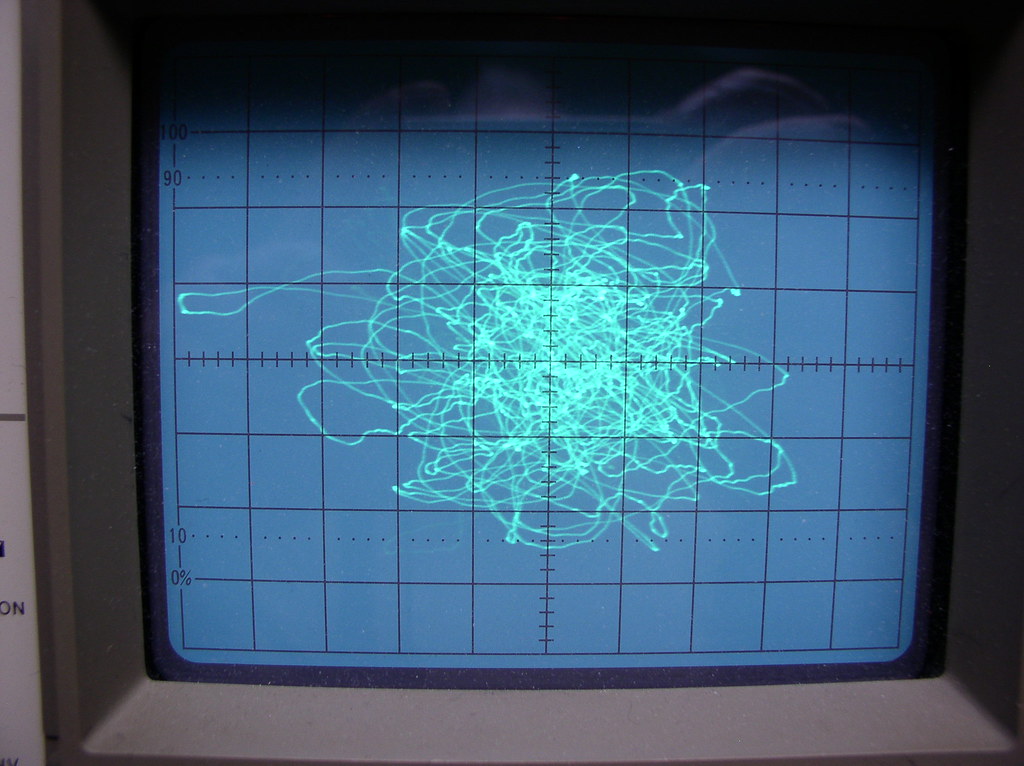
Stereo performance of the Fisher multiplex is shown below with the scope in x-y mode. Any deviation from a 45 degree line is separation between channels. This one is Beethovens brain on drugs. Some years ago, I did the same for the revised AR-15 with similar results.

1441
13727611295_d1f2a4bca1_b.jpg
 
Last edited:
Back
Top Bottom