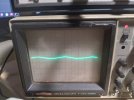
thats just going to trim the tail resistor smaller than 10k.
The tail resistor is still 10k, I just reduced the value of the feedback divider resistor which increased the gain to where a 1Vrms input produces full output.
All that ringing says it wants some compensation, usually across the next stage's grid to ground resistor. It shouldn't bounce like that. Quite possibly thats what you are hearing if its at the edge of oscillation.
I cannot trust the square wave testing until I get the generator adjusted to where the square wave has a 50% duty cycle provided it has an adjustment for that.
It could indeed be at the edge of oscillation, however I can usually see that when doing testing with a sinewave as I'll normally see something on some portion of the waveform, but a sinewave at any frequency fed through the amp looks 100% clean.
So it looks like I have a self biased long tailed pair inverter.
how much feedback is this getting? You may just need more open loop gain to make this sort of inverter work correctly.
Not sure on the feedback, but an input of 1 volt produces full output.
The 200K/300K plate load resistors for the inverter is an unusually large differential. If the top (inverting) tube uses a 200K, then the bottom tube would more likely use a 240K resistor — not 300K, particularly with a High Mu tube like a 12AX7.
Unless I have an issue with the scope and probes at work and my scope and probes at home, that's the value that got both 12AX7 outputs exactly equal at 400Hz.
I measured the signals at the 6V6 control grids.
I moved the compensation cap to where it was originally and the only hiss now is what's coming from the tube buffer.

The main problem I have is that the Schiit Saga S preamp does not go to full 0 volume by design.
So consequently in order for the audio to be barely audible I need the tube buffer set to a lower output such that I cannot get the full 22 watts out of the amp.
For a 9.8mVrms input to the amp a 400Hz tone is moderately loud and music is at a decent listening level.
The gain of the amp at 400Hz is 11.17.
To hear such a small input signal be at a good listening level the open back speaker I have must be very efficient. That could be why I had to take a few extra steps to ensure the amp is as quiet as possible.
Decided to do a test and a MM phono cartridge connected to the amp will drive it to a decent output level.
I connected one channel of the preamp straight to the amp and I do not need the tube buffer. Now if I feed a stereo signal to the amp I'll need to use summing resistors unless it's possible to short the outputs of the preamp together in passive mode and have no ill effects. Now if I do have to use the summing resistors I will need some gain given the resistors will reduce the level some, however if I keep the preamp amp in active mode I could use 100 ohm summing resistors and only lose 1mV of signal.
What I don't know is if in active mode the preamp uses coupling caps on the output.
In passive mode I don't think it does.
So I need a gain of 1 buffer. I can go ahead and use the DRV134 buffer for that. Will need to either only use the + outputs and leave the - outputs floating as that provides a gain of 1 or I can short the - outputs to ground which provides a gain of 2 and use a voltage divider after the board to get the gain back to 1.
That said I could keep the gain of 2 and use a dual gang 50k volume control on the input so that I can have some way to tweak the signal level.
I fixed the symmetry of the squarewave out of my audio generator. All I had to do was set the output to 400Hz or 4kHz and adjust the time/div on my scope to where the top portion of the waveform fills 1/2 horizontal and the bottom half fills the other half horizontal and adjust the pot to where the end of the top portion of the waveform and the beginning of the bottom portion is right dead center horizontally of the screen.
Here's the result of the squarewave testing at 10kHz. It looks much better. I'm sure the squarewave being non-symmetrical caused some issue as the width would have been different for the top and bottom parts of the waveform. I'd be willing to bet the mismatched 6V6 tubes are causing the issue especially if the 6V6GT and 6V6 GTA have slightly different specs. At some point I may get a matched quad of 6V6 tubes. Who would y'all recommend I use to purchase the quad from?

The maximum undistorted output power at 400Hz is 25 watts.
I also noticed that at full output the milliammeters read the following.
6V6GT 95.9mA
6V6GTA 100.4mA
At idle
6V6GT 69.9mA
6V6GTA 69.2mA
So that tells me that the tubes are just different enough to where there's imbalance in the cathode current at full output. A matched quad of 6V6 will likely make the amp even better as the cathode currents will be near equal at full output.
With a matched quad of 6V6 I wonder if I'll gain any power output.
I also noticed that since I got the compensation cap right it seems like that I have slightly more upper treble.
So for now until I get the matched quad of 6V6 I'll not do anything else to the amp.
Also the DRV134 board will go in the case the tube driver is in now and will replace it. The toroidal power transformer will be used as it has two 12.6V AC windings which will connect to the DRV134 board to create the +/- supplies needed. I'll use a DPST switch to connect both output jacks together for a mono output. That way if I ever find another set of drivers and another amp I can go stereo just by flipping a switch. Also the board is X2 gain from input to balanced output and if the + or - out is shorted to ground the chip is then X2 gain on whichever output is not shorted to ground so I can plug in a balanced or unbalanced amp and have the same X2 gain.
The only thing is I don't like the way the meters are mounted in the round holes left from the analog meters I used. Once I get another Dremel I may try to cut the hole square then cut a piece of metal and cut out the meter holes and use bolts and nuts to hold the panel to the chassis.