• Please note that there are a few updates and clarifications made in the Audiokarma Rules, mostly relating to advertising and the addition of the new "Paying it Forward" & "Giving back" forums in the AudioKarma Audio Marketplace section.

My first ever repair - Pioneer SX-450 - need some help!

Luca Signore

New Member
Hey everyone.

So I've been in the processing of doing my first ever repair on a piece of audio equipment on a Pioneer SX-450 I bought for $40 for the purpose. When I first got the receiver, I was getting output only out of one channel (tried switching inputs, speakers, wire, etc) and a lot of crackling/pops from the other. I did a partial recap, cleaned all pots and switches with Deoxit and F5 and I still had the issue. Today, I replaced two transistors on the phono/aux board with KSA992s (one of the little copper circles on the board did lift/pop off - I was able to get the new one soldered on but is there a fix for this?_ and I started getting sound out of the left channel, but still a lot of crackling and the volume is lower. I was fiddling around with it before screwing it back together to work on it later, when I saw a bright spark and the output stopped. I noticed a small piece of my solder wick under the receiver that I must have accidentally overlooked when flipping it back over, and I'm guessing I shorted something. The wick was visible under the holes where the four transistors that are screwed in are on the main board.

The receiver still turns on (the lights turn on, the tuning meter works) but I'm getting no output. There is also no protection relay click, but I'm fairly certain I wasn't getting one when I first got it either.

What should I be looking for and how can I test to see what the issue is? There is nothing obviously burnt or otherwise destroyed to my eye, but, again, I'm definitely a beginner at this.

I really appreciate any help you all can give me - thanks!
 
Register to hide this ad
The 450 doesn’t have a relay, so you’re not going to hear a click.

Did you check all the fuses with a meter?
 
I was thinking a blown fuse also. I'd like to know what needed fixing if you find the problem. I'm really interested in fixing this vintage stuff also but I don't have much experience either, for some reason I'm fired up about it, partly because I don't understand it well and that bothers me haha.
 
The 450 doesn’t have a relay, so you’re not going to hear a click.

Did you check all the fuses with a meter?

Ok so I just checked and both of the 4a 125v fuses are blown - would this be the cause of the receiver outputting nothing at all? Or could it also be causing the crackling/popping when it was working?
 
I was thinking a blown fuse also. I'd like to know what needed fixing if you find the problem. I'm really interested in fixing this vintage stuff also but I don't have much experience either, for some reason I'm fired up about it, partly because I don't understand it well and that bothers me haha.

Looks like both 4a fuses are blown - I didn't check them before, so I don't know if they were already blown, but I imagine it wouldn't have been playing music at all had they been?
 
First, do you know what you are doing? Are you wanting to do the work yourself? You probably shorted a transistor or two but you are going to need to know how to look for them using a meter or scope or both.

Check the output transistors. You probably shorted one or more and the blown fuse(s) usually just proves it.
 
(one of the little copper circles on the board did lift/pop off - I was able to get the new one soldered on but is there a fix for this?_
You're spending too much time on the solder joints. Add a little flux. take your dmm and check continuity.
Before working inside you need to pull the plug and discharge the mains caps. (which should be replaced if you haven't done so.)
crackling can be transistors in the preamp.
Take pics (close up as possible) if in doubt of anything.
schematics, service manual if you don't have it.
https://www.hifiengine.com/manual_library/pioneer/sx-450.shtml
 
A good first step would be to carefully visually inspect the entire unit, both sides, looking for more shorting-bits-of debris and for any broken or cracked or exploded components. If you find any that look suspicious, pull them out and test for proper function with a "cheap $20 component tester" or a multi-meter.

Next replace those fuses. I don't recall the fuses in my 450 to be 4A. That's a little high. Be sure to use fast-blow and it slow-blow fuses.

If they blow again when you power up, then you have a sort or a component that has failed shorted. If that's the case, report you findings back here and AK'ers will help you diagnose.

If the fuses don't blow immediately, then let us know the resulting state of performance.

Good luck!
 
Solder wick is useful but also get one of these solder suckers. Also you must dip clean your solder tip after every joint for best results.
upload_2019-5-3_8-18-36.png
upload_2019-5-3_8-22-38.png
build a dim bulb tester. clear bulb optional.
upload_2019-5-3_8-20-54.png
 
First, do you know what you are doing? Are you wanting to do the work yourself? You probably shorted a transistor or two but you are going to need to know how to look for them using a meter or scope or both.

Check the output transistors. You probably shorted one or more and the blown fuse(s) usually just proves it.

I'm in the process of learning - I understand the basics, but I'm for sure not very knowledgeable. However, I do want to the work myself.

Am I checking these below then?

index.php


What should I specifically be checking them for with my multimeter?
 
A good first step would be to carefully visually inspect the entire unit, both sides, looking for more shorting-bits-of debris and for any broken or cracked or exploded components. If you find any that look suspicious, pull them out and test for proper function with a "cheap $20 component tester" or a multi-meter.

Next replace those fuses. I don't recall the fuses in my 450 to be 4A. That's a little high. Be sure to use fast-blow and it slow-blow fuses.

If they blow again when you power up, then you have a sort or a component that has failed shorted. If that's the case, report you findings back here and AK'ers will help you diagnose.

If the fuses don't blow immediately, then let us know the resulting state of performance.

Good luck!

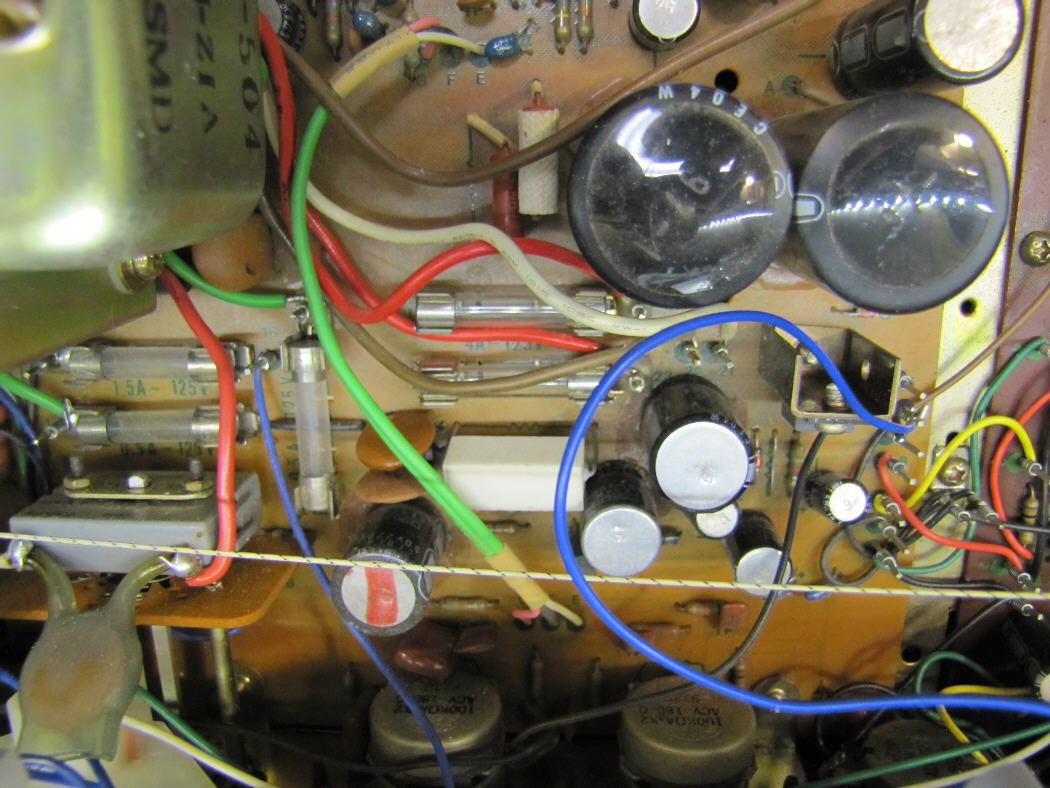
Ok so these are the fuses that blew (the two on the right) - are the output transistors the main thing that would cause these to short? Or could it be something else on this board? Visually everything looks good. The main caps were replaced.

450psb.jpg
 
You're spending too much time on the solder joints. Add a little flux. take your dmm and check continuity.
Before working inside you need to pull the plug and discharge the mains caps. (which should be replaced if you haven't done so.)
crackling can be transistors in the preamp.
Take pics (close up as possible) if in doubt of anything.
schematics, service manual if you don't have it.
https://www.hifiengine.com/manual_library/pioneer/sx-450.shtml

The main caps and all other electrolytics were already replaced. I bought ksa992s to replace the transistors on the preamp board - q201-204, but when I went in there, I found that only two of them are pnp while the other two were npn? So either I'm reading the schematic wrong or I bought the wrong replacement transistors.
 
I'm very new to this - what does the dim bulb tester do?
the bulb limits voltage and current. it will indicate a short somewhere (usually the power supply) if bulb stays bright. If it dims then okay.

I have not read the service man. but if states pnp and npn then prob. ordered 4 of same# by mistake?
 
Others will chime in..
See that search pane on top right of all pages? type in pio. sx-450 see what comes up from other posters to learn by.
be patient, take breaks, make notes and take pics for reference.
bink
 
Ok so these are the fuses that blew (the two on the right) - are the output transistors the main thing that would cause these to short? Or could it be something else on this board? Visually everything looks good. The main caps were replaced.

Looking at the schematic I can see those two fuses are indeed 4A fast-blow fuses. They interrupt both sides of the power transformer's secondary that eventually provides the +25V and -25V used by the output transistors and nearby circuitry.

Yes, if any of the output transistors failed and shorted, that would result in blown fuses. Similarly, some of the resistors near the output transistors could fail shorted and also cause those 4A fuses to blow.

You can easily pull the output transistors and test them for shorts with a multimeter. The 0.5 2W resistors near the output transistors would be the second thing I'd pull and check for shorts.

I do want to say there is a mistake on the schematic which is corrected in this image:

IMG_3195.PNG
 
Back
Top Bottom