• The move to the new server is done. There are some software and database maintenance updates in process. This has us passing the hat around to help out. We appreciate any donations. Seriously, even a dollar helps. The payment page may be found here - https://www.audiokarma.org/support.html

Need Help With Yamaha M-80 Monaural Ohm Load

3-way

New Member
I have a Yamaha C-85 with a pair of Yamaha M-80 stereo amps ran monaurally via the C-85's NORMAL & INVERTED pre-outs as outlined in the C-85 manual and driving 4 - Klipsch La Scala's. 1 - La Scala connected at A and a 2nd La Scala connected at C on each of the M-80 amps.

I just picked up a pair of 1974 Klipschorn's and want to connect them to the remaining SPEAKER outputs on each of the M-80's.

Can the monaural M-80 in the system mentioned above simultaneously drive an 8 ohm Klipschorn and two 8 ohm La Scala's via the A+B+C (8 ohm min. for A, 4 ohm min. for B and C) speaker terminals?

How would I read the MAIN METER display accurately or is now just for show?:)
 
Register to hide this ad
It will be 5.3 ohms nominal load with the k-horns added. That will actually be an easier load than it had been with just the LaScalas.

With three pairs of speakers, B+C will be in series, which will be in parallel with A. So, the nominal impedance will be

1/((1/8)+(1/(8+8)))=5.3

The meters will be closest on the 4 ohms setting.
 
Last edited:
Can the monaural M-80 in the system mentioned above simultaneously drive an 8 ohm Klipschorn and two 8 ohm La Scala's via the A+B+C (8 ohm min. for A, 4 ohm min. for B and C) speaker terminals?:)

I wouldn't drive more than one set of 8 Ω or > in that bridged configuration.

Unless you wire the three sets in series.

Have a fire extinguisher handy.. Just in case..


I'm thinking your amps will see 4Ω with one set of 8 Ω speakers connected .
 
That's a good point. In bridged mode the load felt by the amp is effectively doubled (half the impedance).

Since the minimum recommended impedance is normally 4 ohms, in bridged mode the mimimum becomes 8 ohms.

Since the two La Scalas represent a 2 ohm equivalent load in bridged mode, either the M-80s are tougher than sometimes given credit, or given the sensitivity of the speakers the amp isn't needing to work very hard to get the SPL you're running. Adding the K-horns actually helps lighten the load little bit but the effective impedance is still pretty low @ 2.65 ohms (5.3 divided by 2 because of bridged operation).
 
Last edited:
The M-80 is rated to 2 ohms and protection circuit will kick in if needed. I had an M-65 that must of thought I was a sadist or something. It was a beast. Just recently sold it off with a lot of other gear.
 
It is not officially rated at two ohms operation. Whether this is because it's actually not recommended or if it's just to skirt official testing at 2 ohms I don't know. I've owned two and there is not a continuous rating power spec at 2 ohms, and the back panel lists 4 ohms for any single pair of speakers.

Regardless, they're being used in bridged mode which doubles the minimum rated impedance. If, for sake of discussion it was rated for min. two ohms stereo, it would be min. 4 ohms in bridged mode.
 

Attachments

  • Screenshot_2015-01-03-23-55-17.jpg
    Screenshot_2015-01-03-23-55-17.jpg
    117.6 KB · Views: 14
Last edited:
The Klipschorns @ A and the La Scala's @ B + C, Correct?

I read somewhere that the M-80 power output is 660W with this connection method, seems a bit high....any thoughts?

Could I run the 2-M-80's in stereo with the C-85 via the NORMAL pre-outs by connecting a "Y" to the C-85 (1-male RCA x 2 female RCA). The LEFT & RIGHT [NORMAL] PRE-OUT stereo signal is split and connected to both Left & Right MAIN-IN on each of the M-80's?

It should be easier on the M-80's and the 250W rated power output in stereo should be enough to drive all 3 pairs of the very efficient Klipsch. Would it also increase the damping factor?

Again, the K-Horns @ A & the La Scala's @ B+C, Correct?

I want to thank everyone for their input, you guys are great!

I don't know much about audio tech, but I can answer any question you have about installing ceramic tile, mosaics and natural stone. Retired now, but I was a licensed tile contractor for over 30 years.
 
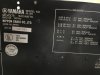
This thread is really old, but I want to add some remarks to clarify how to use the A, B, C terminals on the M-80, and similarly, on the M-65 that I have...

For the M-65, and I assume for the M-80 also since the M-80 owner's manual reads similar to the M-65 owner's manual about connecting speakers, the back of the amp says this:
Yamaha-M65-model-series-number-101861.jpg
Basically, it says that the minimum speaker load on the amp must be 4 ohms or more at all times.

One pair of speakers, on A or B or C, requires 4 ohms minumum / speaker.

The owner's manual says that A is in parallel with B and/or C, and that B is in series with C.

Two pairs of speakers, on A+B or on A+C (parallel speaker connections), must have 8ohms / speaker, or a total parallel ohms equal to 1/(1/8+1/8) = 4 ohms minumum.

Two pairs of speakers, on B+C (series speaker connections), must have 2ohms / speaker, or a total series ohms equal to 2+2 = 4 ohms minimum.

Three pairs of speakers, on A+B+C, must have 8ohms/speaker on A, and 2ohms/speaker on B and C, or a total ohms of 1/(1/8 + 1/(4+4)) = 4ohms minimum.

If you were connecting 2ohms/speaker on B+C, but then switched off one of the pairs, then you'd be at 2ohms, which is not supported (maybe burns up the amp). Similarly, if you were running speakers on A+B+C with the minimum ohms (8 on A, 4 on B and on C), but then you switched off B or C, then you'd be at 1/(1/8+1/4) = 2.66 ohms, which is not supported (maybe burns up the amp). So, depending on what is connected, it could be dangerous to switch off a pair of speakers when running two or three pairs.

Many Yamaha speakers are 6ohms (e.g., NSX-10000, NS-2000, NS-1000x, NS-500M, NS-200ma). So, you can run one pair on terminals A just fine. If you run two such pairs on A+B, then total parallel ohms would be 1/(1/6+1/6) = 3 ohms (< 4ohms), which is not supported. But, you can run them on terminals B+C, where the total ohms in series is then 6+6 = 12 ohms. I think it would be an easy mistake to connect 6ohm speakers to A+B instead of the correct B+C.

Seems tricky! Hopefully I got this right and it is helpful clarification!
 
Last edited:
Hi everyone, trust this message finds you well.
I do understand that this thread is old but would like to ask if the following connection is ok.
I run a set of 8ohm speakers and a set of 6ohm speakers on my Yamaha M-80. (In parallel)
One 8ohm speaker is connected on channel A, right, and the other channel B right.
The one 6ohm speaker is connected on channel A left , and the other channel B left.
 
Hi everyone, trust this message finds you well.
I do understand that this thread is old but would like to ask if the following connection is ok.
I run a set of 8ohm speakers and a set of 6ohm speakers on my Yamaha M-80. (In parallel)
One 8ohm speaker is connected on channel A, right, and the other channel B right.
The one 6ohm speaker is connected on channel A left , and the other channel B left.


Normally one connects corresponding speaker pairs to left and right, say pair #1 to A left and A right and pair #2 to B left and B right.

Connecting Pair #1 to A left and B left and pair #2 to B right and B left is rather unconventional.

Is there a special reason you have connected as you describe, or trying just to know what is the more correct way?
 
Normally one connects corresponding speaker pairs to left and right, say pair #1 to A left and A right and pair #2 to B left and B right.

Connecting Pair #1 to A left and B left and pair #2 to B right and B left is rather unconventional.

Is there a special reason you have connected as you describe, or trying just to know what is the more correct way?

The reason I connected them in this way was that I have read that speakers with different ohms can not be connected in parallel. (I have a set of 8 ohm speakers and a set of 6 ohm speakers)
Hence me connecting them in this way.
 
I've got a Yammy M40 (120 watts). I've been able to run a pair of 4ohm speakers on the A channel and two pairs of 8 ohm speakers on B and C without issues.
 
The Yamaha uses a series/parallel arrangement when using A+B+C

A+B or A+C are parallel.
B+C is series
Which, I believe, then A+B+C means A is in parallel with B and C in series.

4 in parallel with 16 is 3.2 ohms net.

The OPs 6 and 8 in parallel with conventional wiring using A+B would be ~3.4 ohms. If he still has the 8 ohm speaks on one channel and the 6 ohm speaks on the other, one channel is running 4 ohms and the other is 3 ohms. A nonstandard way for sure.
 
The reason I connected them in this way was that I have read that speakers with different ohms can not be connected in parallel. (I have a set of 8 ohm speakers and a set of 6 ohm speakers)
Hence me connecting them in this way.

Sure they can be. I suggest rewire to the conventional way.

Both speakers of the 8 ohm pair to A; one speaker to left A, the other speaker to right A.

Repeat for the 6 ohm pair except connect them to left and right B.
 
Back
Top Bottom