Need input from experts...3 amps one set of speakers...my solution

rotobadger

Suffering AZ Cardinals Fan
Subscriber
I know this has been discussed a few times but I wanted to see if my workaround is a viable solution.

I have 3 amps that I would like to be able to switch between (not hot switching) going to one set of speakers. One of which is a tube amp. I am aware of the issues that can be caused by running a tube amp with no load so I am prepared for that.

Here's my semi-DIY solution:

This switcher (TC-7220) is a "break before make" type as is necessary for my scenario. However, it only allows for two amps, not three. My potential solution is to place a knife switch (also break before make) in between two amps and the input from that into the switch box. This would allow me to (hopefully) safely switch between two amps on the one input with another amp on the other input. I've attached a diagram of how I imagine it would work. I would need two knife switches, obviously, for left and right channels.

Is this a viable solution? I can't see how this would not work but I am not as experienced or knowledgeable as some folks here.

Any comments regarding this solution would be appreciated.
image2.png image1.jpeg
 
Register to hide this ad
Hello.

Did you think about building just a small box with 2 of this, or even heavier duty? I think there are even industrial quality rotary selectors to adapt.

You should think some solution to connect a dummy load to the tube amp when not connected to the speakers. Perhaps you need the tube amp connected to a selector that does "speakers/dummy load"

http://www.hybrid4x4.com/image/cache/products/049602-600x600.PNG
 
Last edited:
Hello.

Did you think about building just a small box with 2 of this, or even heavier duty? I think there are even industrial quality rotary selectors to adapt.

You should think some solution to connect a dummy load to the tube amp when not connected to the speakers. Perhaps you need the tube amp connected to a selector that does "speakers/dummy load"

http://www.hybrid4x4.com/image/cache/products/049602-600x600.PNG
I have, indeed, thought about building my own. I've decided against it for a few reasons that I won't bore everyone here with.

Also, as I said in my original post, I am aware of the potential problems of running a tube amp with no load attached. I may, in fact, add a dummy load to make sure it's safe but it's very unlikely that I will run into an issue based on my circumstances.

Regardless, still wondering if my above "solution" is reasonable (or some variation of).
 
Much more reasonable is one of these https://www.mouser.com/ProductDetail/Grayhill/56A30-01-4-03N?qs=sGAEpiMZZMvNbjZ2WlReYhndqMY8foDImwjdK1hizNk= and a pair of 20 ohm, 5 or 10 watt resistors permanently wired across the 16 ohm terminals on the tube amp. Wire the speaker terminals to common terminals of the switch and the amps to the 3 selectable positions. I am using reasonable as in reasonable cost.

Good Luck

Shelly_D
This is more along the lines of what I was looking for. I couldn’t find a 3 way switch but this is it.
 
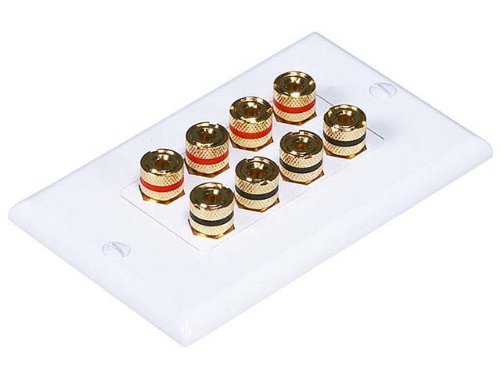
I use two of these mounted on my wall in plastic boxes. Wire the plates directly to my amps/receivers (4 of them to be exact). End of Speaker runs have banana plugs so I simply move to the appropriate spot for each component. Also makes supporting multiple speaker sets easy.

41Gp8DPWkLL.jpg


Simple and cheap. Still need to be careful though you do leave a tube amp powered up with no load, or so I hear....
 
I use two of these mounted on my wall in plastic boxes. Wire the plates directly to my amps/receivers (4 of them to be exact). End of Speaker runs have banana plugs so I simply move to the appropriate spot for each component. Also makes supporting multiple speaker sets easy.

41Gp8DPWkLL.jpg


Simple and cheap. Still need to be careful though you do leave a tube amp powered up with no load, or so I hear....
I had also considered an option like this. No switches at all just “plug in when ready”.

I think my solution, in a way, is similar though. The knife switch is simply a mechanical version of manually moving the amp leads around.
 
Much more reasonable is one of these https://www.mouser.com/ProductDetail/Grayhill/56A30-01-4-03N?qs=sGAEpiMZZMvNbjZ2WlReYhndqMY8foDImwjdK1hizNk= and a pair of 20 ohm, 5 or 10 watt resistors permanently wired across the 16 ohm terminals on the tube amp. Wire the speaker terminals to common terminals of the switch and the amps to the 3 selectable positions. I am using reasonable as in reasonable cost.

Good Luck

Shelly_D
Shelly:

Can I ask for further clarification? If I were to wire a resistor, as you suggest, across the 16ohm lead on the tub amp, how would I go about connecting it correctly? One end of the resistor on the 16ohm connection and the other end where? Also, this would not affect normal 8 ohm usage with the amp?

Thanks for your help as I'm very unfamiliar with these types of modifications and want to make sure I dont botch anything.
 
Shelly:

Can I ask for further clarification? If I were to wire a resistor, as you suggest, across the 16ohm lead on the tub amp, how would I go about connecting it correctly? One end of the resistor on the 16ohm connection and the other end where? Also, this would not affect normal 8 ohm usage with the amp?

Thanks for your help as I'm very unfamiliar with these types of modifications and want to make sure I dont botch anything.

You would set it up like a 16 ohm speaker, one end on common and the other on the 16 ohm terminal. Then hook up the 8 ohm speakers (in this case the leads to the switch) to the normal 8 ohm spots. Should work fine. If you perceive distortion in listening at high volume, increase the value of the resistor.
 
You would set it up like a 16 ohm speaker, one end on common and the other on the 16 ohm terminal. Then hook up the 8 ohm speakers (in this case the leads to the switch) to the normal 8 ohm spots. Should work fine. If you perceive distortion in listening at high volume, increase the value of the resistor.
Perfect...thanks for the clarification!
 
I had also considered an option like this. No switches at all just “plug in when ready”.

I think my solution, in a way, is similar though. The knife switch is simply a mechanical version of manually moving the amp leads around.

By the way, the google search term that found the switch is "4 pole, 3 position" switch. Poles refer to the number of switching circuits combined on one device, positions refer to the number of items you can switch between on each switching circuit.

Hope this helps.
 
By the way, the google search term that found the switch is "4 pole, 3 position" switch. Poles refer to the number of switching circuits combined on one device, positions refer to the number of items you can switch between on each switching circuit.

Hope this helps.
That does help, thank you.

While I have you, one final question regarding the resistor:

My amp (which is still in route, a Pilot 240) has the following four speaker connectors, one set for left and right:

Main, EXT, 8, 16

I'm assuming "main" is the same as "Common" and is where the negative lead would go and the positive would go to 8 (8 ohm speakers)? So, would the resistor share the "main" connector with the speaker connector for the 8 ohm connection? Meaning the resistor would be connector to Main and 16 and the speaker would be connected to Main and 8 on each side?

Thanks again for your patience with my newbie questions. This is my first tube amp. Pretty excited to get it.
 
That does help, thank you.

While I have you, one final question regarding the resistor:

My amp (which is still in route, a Pilot 240) has the following four speaker connectors, one set for left and right:

Main, EXT, 8, 16

I'm assuming "main" is the same as "Common" and is where the negative lead would go and the positive would go to 8 (8 ohm speakers)? So, would the resistor share the "main" connector with the speaker connector for the 8 ohm connection? Meaning the resistor would be connector to Main and 16 and the speaker would be connected to Main and 8 on each side?

Thanks again for your patience with my newbie questions. This is my first tube amp. Pretty excited to get it.

I don't know enough about the amp to tell you. Some amps (like a Fisher 400 receiver) have a wire lead that is placed on an impedance value terminal and then the speakers are hooked to the plus and minus (or ground or common) lead. Others, like Dynaco amps, have a common terminal and one terminal for each impedance and you hook the speaker to the correct terminal you need. I don't know what the Main and EXT are are in this case and so cannot guide you here.

Sorry.

Shelly_D
 
I picked up one of these for speaker switching. Without looking inside I cant see any reason you cant just input three amps & output one set of speakers.

https://www.ebay.com/p/RadioShack-H...ter-Switch/1200704713?iid=192880870302&chn=ps
Using this box the way you suggest could easily lead to disaster as it allows more than one set of speakers (amps in your scenario) to be active at the same time. This would be, essentially, like wiring two amplifiers to one set of speakers at the same time. I am specifically looking for a “break before make” solution which this is not.

Thanks tho.
 
Using this box the way you suggest could easily lead to disaster as it allows more than one set of speakers (amps in your scenario) to be active at the same time. This would be, essentially, like wiring two amplifiers to one set of speakers at the same time. I am specifically looking for a “break before make” solution which this is not.

Thanks tho.
Yes that could happen. Each switch engaged stays down and can be visually verified. One would be wise to pay attention. I have other switches that may have a solution. Let me look em over a sec and get back with you.
 
Yes that could happen. Each switch engaged stays down and can be visually verified. One would be wise to pay attention. I have other switches that may have a solution. Let me look em over a sec and get back with you.
IMG_6694.JPG Just looked these over. They can be wired many ways (make break) but the contact power may be limited. i used to use them for light dc but pretty high current. i will maybe do one amp each if we had three.
 
IMG_6695.JPG Dug up this box of switches which can easily handle the load. but would require energized relays. How elaborate do you want to be here??

I have contractors which will do the job. I imagine there would be a loss of fidelity along the line but switching will do it.
 
Back
Top Bottom