Please explain. Someone?

Status
Not open for further replies.

freQ(*)Oddio

Super Member
The strongest material known to man can cut stone/ steel/ but wears out from 2 grams of viny pressure at 33.3 rpm? Somethings fishy. Yes its tiny , but no less dense .

 
Register to hide this ad
diamond , the strongest material on earth can be polished.
speed plus dust is abrasive, now think the surface contact point are microns, So keep both always very clean.
AG.
 
Those pressures are enormous, so keep in mind that a slight increase in contact area decreases those pressures by quite a magnitude. Think about that when buying a stylus profile, conical are the worst and Line Contacts and other exotic cuts have much larger contact areas. They might be more expensive on the front end but the reduced wear on your vinyl can save in the long run by quite a bit.
 
Thomas Edison did declare his diamond stylus to be "permanent" -- "There are no needles to change. That bother is done away with", as his ads proclaimed.

But then again, he was nearly deaf.

miller_ad.jpg
 
Also keep in mind the stylus is exposed to incredible g forces as it slams side to side in the groove. Any slight mistracking enhances that effect. Cantilever failure is another concern as the hours pile up.
 
When I was a kid I got a paper cone and put a pin through the end of it and an old record on the turntable to see if I could get sound out, I got sound alright but the amazing thing was the speed at which that pin wore out, it literally wore down before my eyes, try it and see for yourself.
 
When I was a kid I got a paper cone and put a pin through the end of it and an old record on the turntable to see if I could get sound out, I got sound alright but the amazing thing was the speed at which that pin wore out, it literally wore down before my eyes, try it and see for yourself.

As a bored 'home alone' 10yr old I spent a happy day experimenting with a variety of home made stylus for our old radiogram's ceramic cart, few lasted a whole record, the safety pin one wore quite quickly.

I remain strangely pleased I got music, of a sort, using a wooden one (toothpick). My father seemed less pleased.
 
Pressure on the contact area (as already discussed) is certainly a big issue, as is the abrasive nature of all the "crud" that the stylus has to plow through in the grooves of a dirty record. Another factor is "mileage". Just for S&G's I decided to look that up. Apparently, the total groove distance/length of the average album side is ~1/4 mile. http://www.wou.edu/wp/killips/2009/12/28/length-of-the-groove-in-an-lp-record/ So, for every couple hours of listening pleasure, you are putting some serious mileage on that tiny "rock" at the end of the tip.
 
As a bored 'home alone' 10yr old I spent a happy day experimenting with a variety of home made stylus for our old radiogram's ceramic cart, few lasted a whole record, the safety pin one wore quite quickly.

I remain strangely pleased I got music, of a sort, using a wooden one (toothpick). My father seemed less pleased.
Clearly your dad is a tree hugger. :D
 
Those pressures are enormous, so keep in mind that a slight increase in contact area decreases those pressures by quite a magnitude. Think about that when buying a stylus profile, conical are the worst and Line Contacts and other exotic cuts have much larger contact areas. They might be more expensive on the front end but the reduced wear on your vinyl can save in the long run by quite a bit.

Conicals are actually the best in this regard, having the largest contact area. Line contact styli, with their "knife edge" contact area, may have longer contact area but it's also narrower so the contact area is smaller. So they're actually the worst which is why so many of them are designed to track at around a gram. So, in terms of wear (to both stylus and record), the best choice is a light tracking 0.7 mil conical. The advantage to line contact styli is in the retrieval of detail. The narrower contact area tracks the groove in much the same manner and coveing the same area as the cutter did during mastering.
 
Last edited:
Maybe someone mentioned this and I missed it. But the friction also causes immense heat along with the pressure.
 
When I was a kid I got a paper cone and put a pin through the end of it and an old record on the turntable to see if I could get sound out, I got sound alright but the amazing thing was the speed at which that pin wore out, it literally wore down before my eyes, try it and see for yourself.


You were not alone in this "pin" venture. Sewing needles lasted longer than most others. My mom was always hunting for her lost ones.

Was only caught the once with the pennies piled on the end of the arm. Never did it again! :confused:

Q
 
It also says something about the carbon black additive in vinyl. Can be owned and played for 50 years and still sound pretty darn good.
 
Thomas Edison did declare his diamond stylus to be "permanent" -- "There are no needles to change. That bother is done away with", as his ads proclaimed.

But then again, he was nearly deaf.
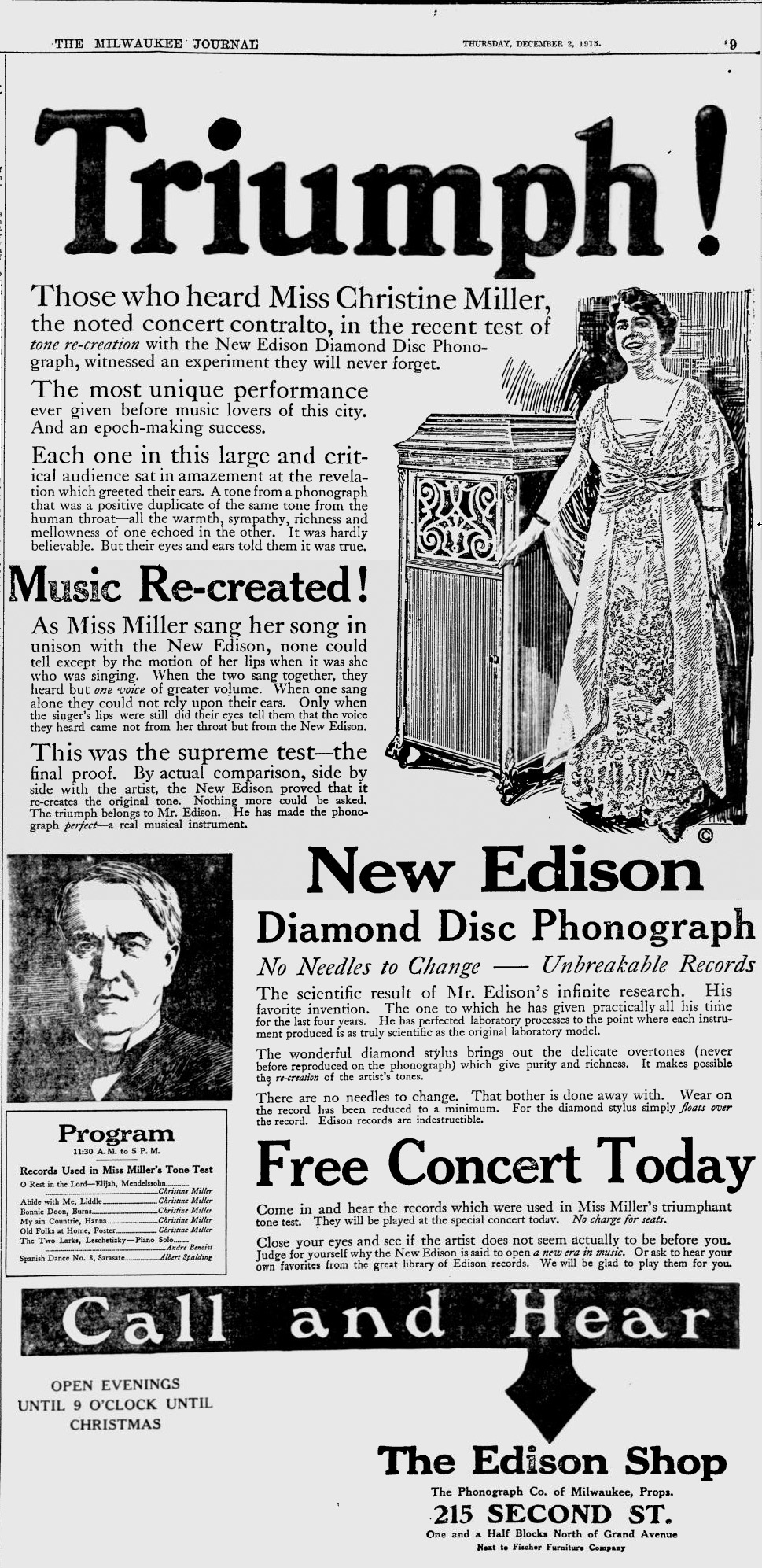
miller_ad.jpg
Oh I think he was probably correct as the material his recording were made from were quite a bit softer than present day.
 
Pressure and friction cause heat, which temporarily melts the vinyl (which is why it can recover from the trauma of a stylus being dragged through it), but the combination of heat, liquification, and pressure create a situation in which all sorts of chemical reactions can take place that do not happen under normal circumstances.
I used to be in optics, and I remember being surprised that no one actually knows what is going on in the polishing process - whether it is physical abrasion, or chemical etching, or a combination. Pitch polishing, which is what is what was classically used for polishing, involves enough pressure and friction to melt the pitch and some polishing compound which floats in the molten pitch, and enough water to keep the pitch from grabbing onto the material being polished. Cerium oxide was a typical polishing compound, and while it is abrasive, in water and at high heat, it can also potentially be acidic, and it wasn't known which factor was more significant. Glass is usually not that affected by acids, but, again, at high temperature and pressures, all sort of reactions can happen.
I suspect something similar is true of the hydrocarbons in vinyl, diamond, and whatever random dust and environmental contaminants there are on the record.
 
Status
Not open for further replies.
Back
Top Bottom